
Items tagged with 'Albany Pine Bush'
Here are a few events coming up at the Albany Pine Bush Preserve
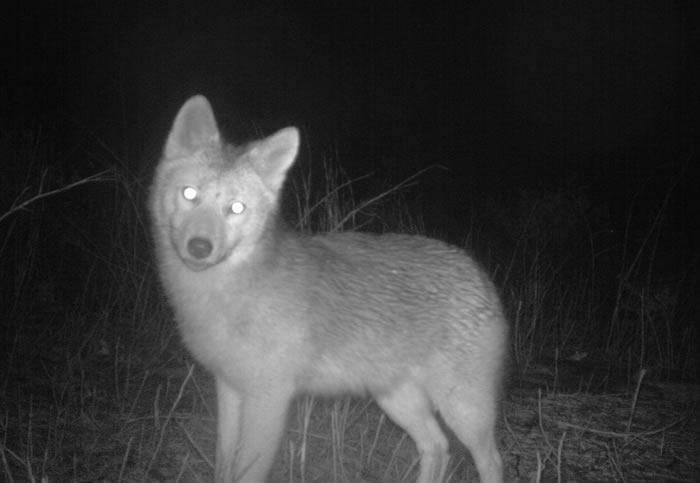
One of the events is about coyotes. The animals sometimes show up on camera traps in the preserve, as above. / photo: Albany Pine Bush Preserve
The Albany Pine Bush Preserve has a bunch of events coming up over the next few months -- about nature, history, or just being outdoors -- for both adults and kids.
Here are a few that caught our eye...
The return of the blue snowflakes
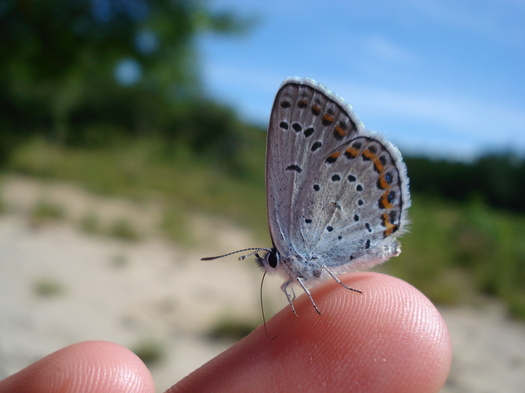
The Albany Pine Bush is an unusual example of an inland pine barrens, and it's one of the few homes to an unusual inhabitant: The tiny, beautiful -- and endangered -- Karner Blue butterfly. And it's making a comeback.
The Albany Pine Bush Preserve Commission announced Thursday that conservation efforts in recent decades have apparently had a big effect on Karner Blue populations in the Pine Bush. In 2007, the preserve was estimated to have fewer than 1,000 of the butterflies. And in 2016: more than 15,000.
Pine Bush Big Birding Day
 It's not any regular birding day. It's a big birding day.
The Albany Pine Bush Preserve Commission is hosting the first Pine Bush Big Birding Day starting June 30, an event in which teams will try to observe as many bird species as possible over a 24-hour period. Blurbage:
"A big birding day allows the Albany Pine Bush Preserve Commission to learn what species of birds are in the preserve. Detecting birds this time of year also suggests that those birds may be breeding here," says Amanda Dillon, Field Ecologist and Entomologist. "Commission staff regularly conduct surveys during the summer months where we record every bird we hear and see at points located around the preserve. This event will help us get more eyes and ears on the ground and expand our coverage area. Birds are very sensitive to changes in their habitat and some can only be found in particular types of habitats like the inland pitch pine-scrub oak barrens found the in the Albany Pine Bush. Knowing which species are present in the preserve tells us a lot about how effective our efforts are in restoring this globally rare landscape."
The bird species spotting starts at 6 pm Saturday with a kick-off and refreshments at the Albany Pine Bush Discovery Center. And then things wrap up Saturday at 7 pm with dinner and closing ceremony. It's free to participate, but registration is required.
Earlier: Birding in Washington Park
photo: Julie Madsen
Animal walk-and-talks at the Pine Bush
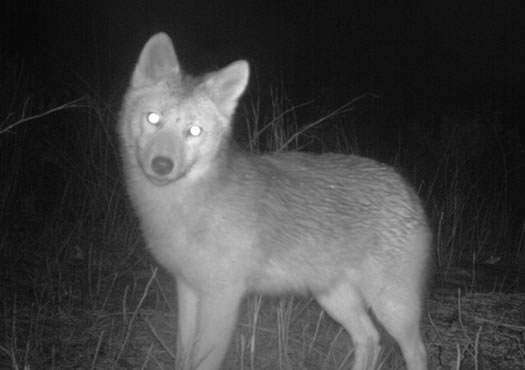
This photo was captured by a camera trap in the Pine Bush a few years ago.
There are all sorts of animals that either live in, or make their ways through, the Albany Pine Bush: coyotes, porcupines, foxes, fishers, deer, and so on.
The Albany Pine Bush Discovery Center has a bunch of family-friendly talk-and-walk programs about these animals coming up over the next month...
Can you spot the coyote?
Coyotes are famously stealthy, able to move through urban and suburban areas while rarely being noticed by people. And in forested areas? Good luck.
The Albany Pine Bush Preserve posted this spot-the-coyote clip on Youtube this week that demonstrates how well the animals blend in. It's a quick clip. Have a look.
As it happens, coyotes are easier to spot when they stand and pose for the trail camera.
And if you're thinking, "Coyotes? Here?" Yep.
The animals have been moving into this part of the country over the last century. And there's research done by scientists who were/are at the State Museum that some of the coyotes in this part country are actually coyote/wolf hybrids (coywolves). A bunch of years ago one of the scientists, who studies urban wildlife, told us research indicated the Albany area is a "population sink" for coyotes -- they move in from more rural areas, but don't end lasting long because they get hit by cars.
Earlier this month in the Altamont Enterprise, Melissa Hale-Spencer wrote a really interesting article about coyotes in the Hill Towns.
Well, hello, there...
Here's a larger, uncropped photo.
The Albany Pine Bush Preserve captured this photo of a coyote with one of its camera traps recently. The way the coyote has its head cocked, it almost has this expression of "Huh, what it's that... (camera snap)."
The Pine Bush uses a handful of motion-activated camera traps to observe animals in the preserve, including foxes, deer, and turkeys.


Coyotes
You might be wondering: There are coyotes in this area, even in a place like the city of Albany? You bet. Coyote populations have been on the upswing since the 1990s. And though they're shy, they do show their face now and then. (The office dog and his friend ran after one at Capital Hills a few months back.)
Earlier on AOA:
+ Coy-something
+ Foxes and fishers and bears, oh my!
photo: Albany Pine Bush Preserve
Gillibrand requests federal designation for the Pine Bush
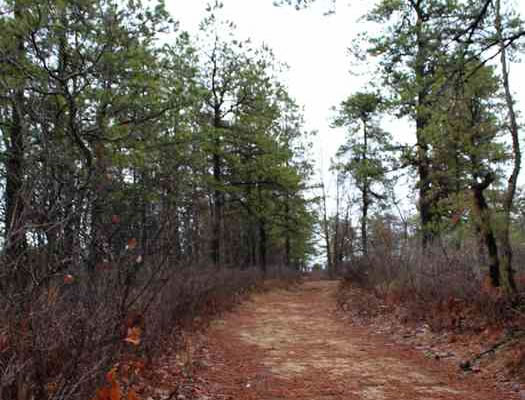
Kirsten Gillibrand's office announced today that the Senator is asking the US Secretary of the Interior to designate the Albany Pine Bush Preserve as a National Natural Landmark. From the letter KG's office released:
The Albany Pine Bush Preserve is a unique ecosystem located on a 3,200-acre site in Albany County, New York. The preserve is one of the best-remaining examples of an inland pine barren habitat. The open areas and well-drained sandy soils of the preserve support a globally-rare pitch pine-scrub oak community and is home to more than 1,300 species of plants, 156 species of birds, 20 species of amphibians and reptiles, and 30 species of mammals, as well as rare species of butterflies and moths. Among its diverse flora and fauna, the Albany Pine Bush supports the federally-listed endangered Karner blue butterfly, as well as the rare inland barrens buckmoth. The Albany Pine Bush is the site of one of thirteen Federal Recovery Units working to rebuild adult populations and restore suitable habitat for the Karner blue butterfly across the range of the endangered species.
The term "National Natural Landmark" sounds kind of impressive -- and the National Park Service website says "NNLs are the best remaining examples of a type of feature in the country and sometimes in the world." But we get the impression it's a largely symbolic. The designation doesn't change ownership of the landmark, nor does it impose any land use restrictions, according to an FAQ about the program posted by the National Park Service. It's largely a voluntary commitment by the landowner to preserve the landmark. (The Albany Pine Bush Preserve is a state preserve.)
If anything, the National Natural Landmark designation is another sign that people's perception of the place continues to evolve, to the ecosystem's benefit. The last couple of hundred years haven't been kind to the Pine Bush. It suffered from a rather poor reputation in the 19th century. The Thruway and Washington Ave Extension were plowed through it. A mall was built. A landfill sited in it. It's only in the last four decades or so that momentum has shifted in the direction of preservation.
The Pine Bush once covered an area of about 40 square miles -- it's now about 1/8 that size.
There are 596 National Natural Landmarks in the US and its territories -- and 27 sites designated as National Natural Landmarks located at least partially within New York State, according to the National Park Service. The list includes two in the immediate Capital Region: Bear Swamp in Albany County, and Petrified Gardens in Saratoga County.
Earlier on AOA:
+ The Karner Blue and Nabokov
+ Why the Albany Pine Bush is sandy
+ The Rapp Road Community Historic District
Frog songs
Not a bird.
Today's moment of nature: a grey tree frog signing at night in the Albany Pine Bush.
Speaking of sounds at the Pine Bush... There's a "World Listening Day" hike planned for this Thursday (July 18) to "explore the sounds of the Pine Bush, [and] discover how sound plays an important role in conservation." The hike is at 5 pm. It's $3 per person / $5 per family. Pre-registration required.
Wild about turkeys
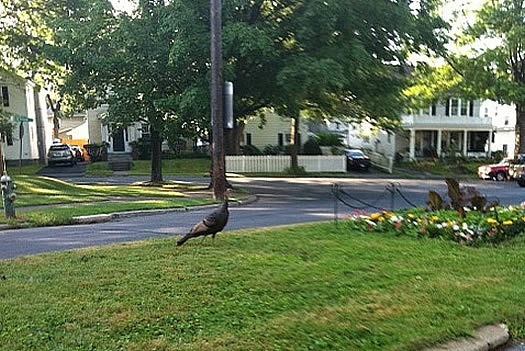
A wild turkey spotted in the Melrose neighborhood in uptown Albany last year. (photo via David M)
The turkey is, of course, a centerpiece of many Thanksgiving meals. But the birds have a long and varied history in this country. Among their admirers was Ben Franklin, who once wrote that he preferred the turkey over the bald eagle as a symbol:
For in Truth the Turkey is in Comparison a much more respectable Bird, and withal a true original Native of America... He is besides, though a little vain & silly, a Bird of Courage, and would not hesitate to attack a Grenadier of the British Guards who should presume to invade his Farm Yard with a red Coat on.
So turkeys go with this country like cranberries go with, uh... turkey.
Even so, we're always a bit surprised -- and it makes us smile -- to see wild turkeys hanging out in residential areas of the Capital Region. As they peck their way through a neighbor's yard, the turkeys are just like, "What are you looking at?"
The Albany Pine Bush Discovery Center has a program coming up about wild turkeys. So we bounced a few questions about the birds to Jacqueline Citriniti, an environmental educator at the center.
It turns out wild turkeys a more interesting than a Butterball.
The Karner Blue as another sign from the Year of Odd Weather
They find the weather strange, too.
Another effect of the non-winter/early spring: Karner Blue butterflies have managed to squeeze out an extra generation this summer. From an Albany Pine Bush Preserve press release:
Karner blue butterflies typically have two broods per year, one in May/early June and the second in July. The discovery of a third brood is both remarkable and a bit alarming to Preserve scientists because the eggs produced by the July brood of adult Karners typically overwinter to produce adult Karners the following May. An early and very warm spring is the suspected cause of earlier broods this year and the additional late-season butterflies currently flying in the Preserve. The impacts of a third flight of adults to the long-term recovery of the species are unknown. ...
Only time and continued monitoring will determine if the late 2012 hatch will have an impact on the 2013 butterfly population and the longer-term recovery of the species. "We had no idea a third flight in a single season was possible before 2010" said [Albany Pine Bush Preserve Conservation director Neil] Gifford. According to Gifford, it was in 2010 that Karner blue butterfly managers from Wisconsin to New Hampshire suspected that the late season adults they were seeing may be a previously unknown third flight. "We don't yet have a good understanding of what the implications of a third brood will mean for the recovery of the species" said Gifford, adding "it will likely depend on whether the changing climate brings such conditions more frequently."
The preserve says this spring's emergence of Karner Blues was the earliest on record -- 10 days earlier than the previous record, and 21 days earlier than the 20-year average.
To say that the weather over the past year is odd would be an understatement. A handful of the signs and side effects:
Now emerging: Karner Blues
Beautiful and rare.
The Albany Pine Bush Preserve Commission announced today that it has 600 Karner Blue butterflies emerging from their cocoons right now. From the press release:
Adult female Karners are captured from New York sites and immediately transported to the rearing facility in Concord, NH. Eggs produced by these butterflies are raised to chrysalises and returned to the Albany Pine Bush Preserve. The adults that emerge are released into restored habitat to begin new colonies. ...
"This is a very exciting, and very limited chance to see this Federally endangered butterfly," says Discovery Center Director Jeffrey Folmer. "One question visitors often ask is 'Where can I see the Karner blues?' These beautiful, but tiny butterflies are rare, hard to spot, live only three to five days and are difficult to distinguish from other similar non-endangered butterflies. We now have 600 of them emerging from their chrysalises one by one and they're on view until they all emerge."
The commission says butterflies will available for viewing at the Albany Pine Bush Discovery Center until mid-July. Admission is free.
The Albany Pine Bush -- a sandy inland pine barren -- is one of the Karner Blue's native habitats (there aren't many remaining). In fact, the butterflies are called "Karner Blues" because of the no-longer hamlet of Karner, New York. Vladimir Nabokov -- yep, the author -- stopped to study the butterflies there in 1950 and ended up naming them. Nabokov once described the insects as being "like blue snowflakes."
Earlier on AOA:
+ The Karner Blue
+ Why the Albany Pine Bush is sandy
+ On state animals, vegetables and whatnot
photo: courtesy of the Albany Pine Bush Preserve Commission
... said KGB about Drawing: What's something that brought you joy this year?