
Items tagged with 'tech'
Future jobs, done by humans and not
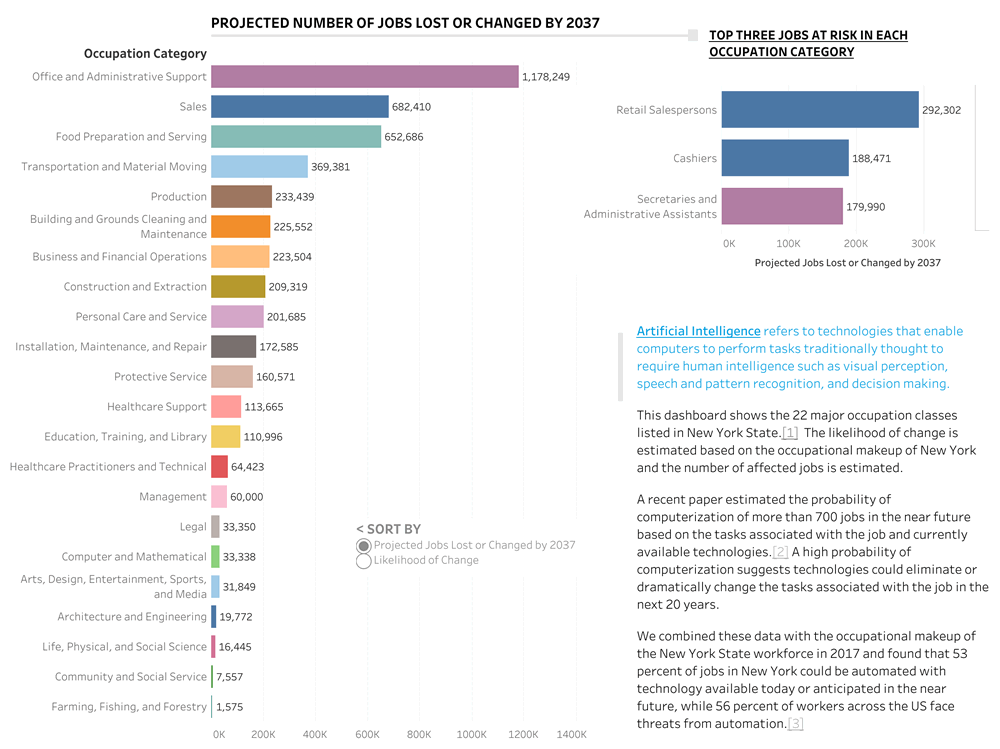
Roughly half of the jobs in New York State could be automated or otherwise significantly changed by artificial intelligence over the next 20 years. That's from an ongoing look at the issue by the Rockefeller Institute of Government here in Albany. From a post by Rockefeller's Laura Shultz:
The calculation is based on individual occupations. A recent paper by Frey and Osbourne estimated the probability of computerization of more than 700 jobs in the near future based on the tasks associated with the job and currently available technologies.[1] A high probability of computerization suggests technologies could eliminate or dramatically change the tasks associated with the job in the next twenty years. We combined these data with the occupational makeup of the New York State workforce in 2017 and found that 53 percent of jobs in New York could be automated with technology available today or anticipated in the near future, while 56 percent of workers across the US face threats from automation.[2]
Rockefeller has put together an interactive graphic that highlights the number of jobs -- by industry and type -- that could be affected around the state. (That image above is a static version of the graphic.) At the top of the list are office support, retail salespeople and cashiers, and food service -- potentially 2.5 million jobs lost or changed.
This struck us as a key clip from Shultz's post (emphasis added):
Growing a chair
Green Island-based Ecovative is one of the Capital Region's most interesting companies. For the past decade it's been developing ways of using mycelium -- mushroom roots -- to "grow" all sorts of materials that can replace things like styrofoam or leather.
In the clip embedded above, the company shows an experiment in making a chair using the mushroom root tech. It's interesting to watch how the process works -- and, also, that something not-quite working is part of the path.
Ecovative's mushroom root tech is now being used to make (not) leather

This is wild: Ecovative has partnered with a company in California to use its mushroom root tech to make a material that looks remarkably like leather.
That company -- Bolt Threads -- now has a Kickstarter for the first consumer product (tote bags) made with the not-leather, which it's calling Mylo. (That's one of the bags above in the photo.) The Kickstarter went live this week and is almost halfway to its $40,000 goal.
From a Bolt Threads FAQ:
We use corn stalks and supplemental nutrients to feed and grow our mycelium. We precisely control growth conditions like temperature and humidity to encourage the mycelium to grow upward and self-assemble into an organized mat of interconnected cells. Their connections give the material strength. We then use a natural tanning process and compress the mat to be as thin or thick as we'd like the final material to be. At this point the mycelium is no longer growing. The final step is to imprint any desired pattern, which gives us the final material. ...
Our friends at Ecovative pioneered this mycelium fabrication technology, which literally grew out of the great work they've been doing in creating soft flexible foams. We were blown away, and thrilled when they agreed to allow us to help develop it into a commercially viable new material. We've established a long-term partnership with Ecovative to optimize this technology and put processes in place to produce commercial-ready Mylo™ material and bring products to market that consumers will love.
As you know, Ecovative was started by two RPI grads about a decade ago and it's now based in Green Island. It uses what are essentially mushroom roots to bind leftover agricultural materials into various environmentally-friendly packing materials and fiber boards. The tech has gotten the company international attention, and it's been used in all sorts of projects.
photo via Bolt Threads Kickstarter
Artificial tulips
More AI tulips!!! With the larger dataset I've made and spectral normalisation I'm able to get much more variety in the type of tulips it produces. pic.twitter.com/19vhpyLwDj
— anna ridler (@annaridler) June 1, 2018
This is random and weird and kind of wonderful, and because tulips...
An artist in the Netherlands named Anna Ridler is working on a project in which she's training an alogrithm to create tulips. It's called "Mosaic Virus" and it's a commission for the Impakt Festival in Utrecht later this year (festival theme "Post-Truth"). Blurbage from her website:
Drawing historical parallels from "tulip-mania" that swept across Netherlands/Europe in the 1630s to the speculation currently ongoing around crypto-currencies, this video work is generated by an artificial intelligence (AI). It will show a tulip blooming, an updated version of a Dutch still life for the 21st century. The appearance of the tulip would be controlled by bitcoin price. "Mosaic" is the name of the virus that causes the stripes in a petal which increased their desirability and helped cause the speculative prices during the time. In this piece, the stripes will depend on the value of bitcoin, changing over time to show how the market fluctuates.
Here's a video that might provide a better look.
The streaked tulips that result from this virus -- such as the famed Semper Augustus -- are called "broken tulips."

How Albany does not have a bar called The Broken Tulip, we do not know.
[Via the whims of the Twitter recommendation algorithm, maybe because of Abe? Who knows.]
Earlier:
+ Portraits of tulips
+ Because it's park furniture shaped like a tulip
E-bikes stretch the idea of what a bike can be in interesting ways, but they're stuck in a gray area here in New York
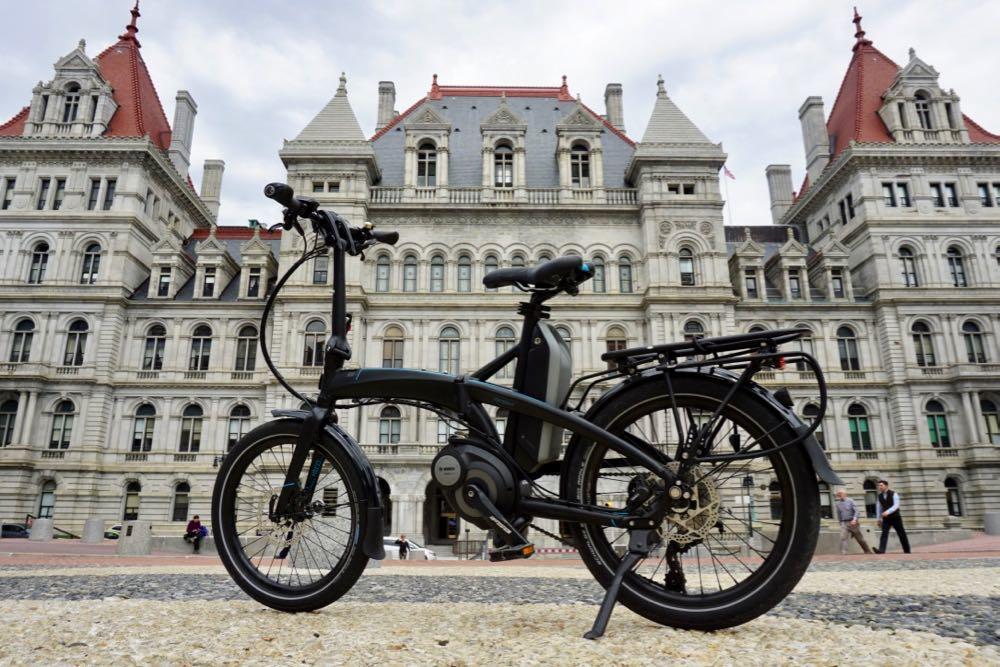
Bikes can be a good way to get around. They don't take up a lot of space on roads. They're environmentally friendly. They're fun.
There are also some drawbacks that prevent people from embracing bikes as an everyday transportation option: the relatively slow speed of travel, the sweat, just the general physical exertion of riding.
E-bikes -- which give riders a little help thanks to an electric drive -- can address a lot of these issues. Riding one feels a little bit like magic. And their popularity is on a big upswing.
But there's a snag: New York State doesn't have clear rules for e-bikes.
And that casts some doubt on their future here.
At the new Zebra Bras in Troy, the measuring tape is a 3D scan

If you are a bra-wearer, you already know the struggle to find the right size bra.
Standard sizing does a poor job of accommodating non-standardized bodies, and misinformation is rampant. Many women don't know what a properly-fitting bra is even supposed to feel like, and uninformed employees at mall stores often measure incorrectly.
But maybe all of that will soon be a thing of the past.
Sure, custom bras have been around for a while, if you're willing to spend enough cash. But recent innovations in 3D scanning and printing have the potential to eliminate issues with fit.
Zebra Bras is a new business in downtown Troy that uses 3D printing and scanning to create bras that are customized to your body. I talked with owner Hannah Johnson about how it works...
Virginia Eubanks and Automating Inequality at Market Block Books

One of the hottest books of the moment right now about the intersection between tech and government and society is Automating Inequality by Virginia Eubanks, an associate professor of political science at UAlbany and a Troy resident. And Eubanks will be at Market Block Books in downtown Troy March 31 to talk about the book.
Automating Inequality: How High-Tech Tools Profile, Police, and Punish the Poor was released in January, and it's gotten a string of high-profile coverage and strong reviews in outlets ranging from NPR to Wired to Vox to Boing Boing. Book blurbage:
Since the dawn of the digital age, decision-making in finance, employment, politics, health and human services has undergone revolutionary change. Today, automated systems--rather than humans--control which neighborhoods get policed, which families attain needed resources, and who is investigated for fraud. While we all live under this new regime of data, the most invasive and punitive systems are aimed at the poor.
Automating Inequality systematically investigates the impacts of data mining, policy algorithms, and predictive risk models on poor and working-class people in America. The book is full of heart-wrenching and eye-opening stories, from a woman in Indiana whose benefits are literally cut off as she lays dying to a family in Pennsylvania in daily fear of losing their daughter because they fit a certain statistical profile.
The event at Market Block is Saturday, March 31 at 11 am. It's free.
By the way: You might remember Eubanks from her article in The Nation a year or so back about Troy, the effects of Irene, and the future of flood insurance.
author photo: Sadaf Rassoul Cameron
Family Electronic Textiles Workshop / MomUp! Raising Kids Who Code at TVCOG
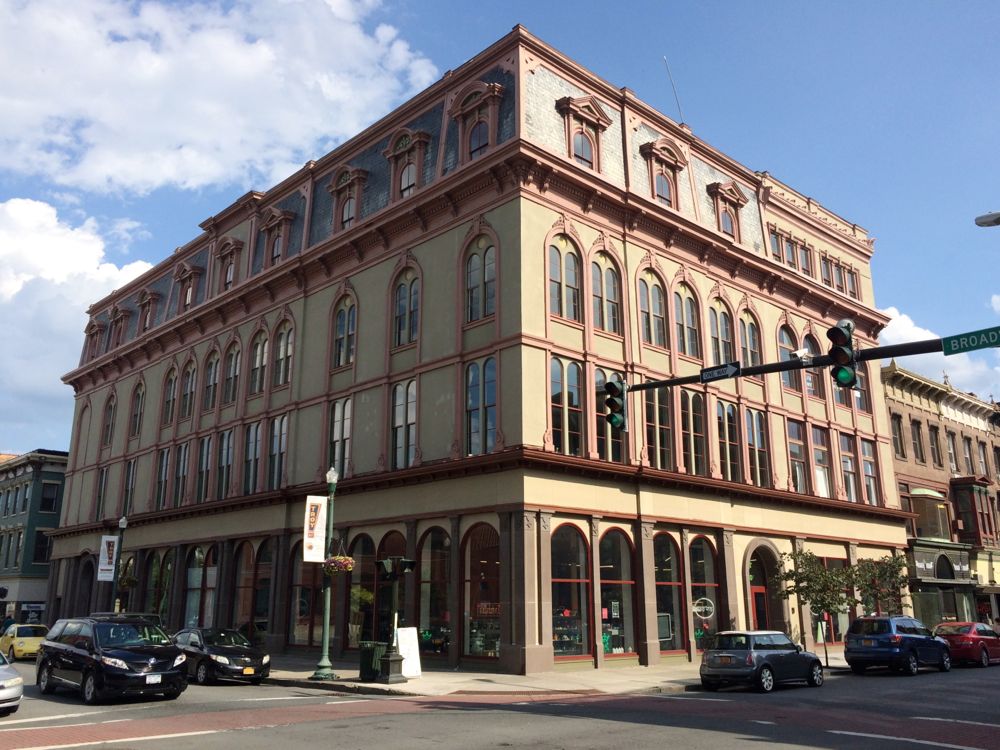
TVCOG is in the Quackenbush Building in downtown Troy.
This looks like it could be fun: The Tech Valley Center of Gravity and its THINQubator program for kids is hosting a Family Electronic Textiles Workshop this Sunday, February 4. Blurbage:
In this project based workshop Youth-Adult pairs will learn together about electronic textiles (e-textiles) working with conductive thread, sewable batteries, LEDs, and microcontrollers to make a plush monster with a glowing heart to take home. Adult participants will also gain info on where to buy parts for future projects, and get links to lessons for other e-textiles projects. No previous sewing experience is necessary. The workshop is geared to kids 8 and above, but younger ages are welcome if the accompanying adult feels the child will be able to handle this level of activity.
The workshop is from 1-4 pm. The registration fee is $55.
MomUp! Raising Kids Who Code
Also that Sunday: TVCOG has a program called "MomUp! Raising Kids Who Code" from 9-11 am. Blurbage (link added):
It's like you can almost smell the pizza
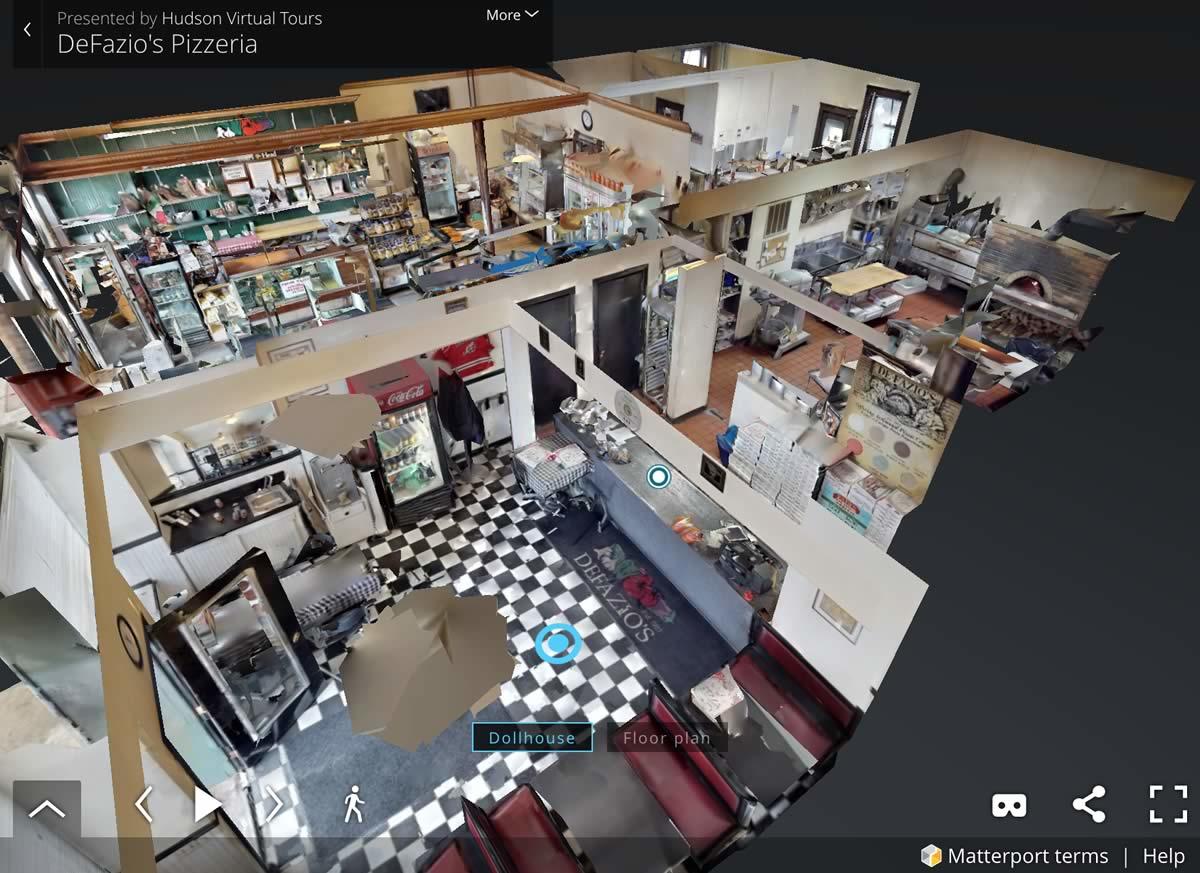
A screengrab from the DeFazio's tour.
This is fun: A Troy-based company -- Hudson Virtual Tours -- is creating 3D/virtual reality walkthroughs of spaces.
It's posted a handful of examples from around Troy, including The Clark House establishments, the Burden Iron Works Museum, and St. Paul's Church.
The image above is a screengrab from the "dollhouse" view of the virtual tour of DeFazio's. It's interesting to be able to "walk" around the shop and the kitchen spaces, gawking at all the little details. (Don't miss the Tournament of Pizza trophy.)
One of the backers of Hudson Virtual Tours is Owen Bush, who was involved with the Troy-based virtual reality company SpaceoutVR. They're using the Matterport 3D camera to capture the spaces.
There's at least one other local company doing something similar, the Colonie-based Filmworks 109. It's also posted a few examples, including a walkthrough of Franklin Plaza decked out for the holidays.
Hack Tech Valley
 The Hack Tech Valley hackathon will be at Schenectady County Community College February 10-11. Registration is now open for the event, which is being sponsored and hosted by the Schenectady-based company Transfinder.
Hackathon, you say? Event blurbage:
This 24 hour hackathon will be open to students (18+), professionals, and anyone that wants to put their development skills to the test. You and your team will work through the night to create an app that will wow, impress and inspire your fellow developers and the judging panel. The weekend will begin with the challenge reveal during Opening Ceremonies, coding will start immediately following opening remarks and continue until hour 24! All submitted apps will be presented, judged and awards will be presented during closing ceremonies.
Throughout the competition participants will be provided meals, snacks and yes, lots of coffee and energy drinks. Along with the main competition, Hack Tech Valley will have several categories open for prizes. Need a break from all of the coding? Check out one of the games or other side challenges.
Organizers the prizes for the competition are valued at $5,000. Transfinder says it's expecting as many as 300 participants.
Here are the details about registering. And, as with anything like this, if you're interested it's worth taking the time to read the rules.
The Albany Police Department is starting up its officer body camera program
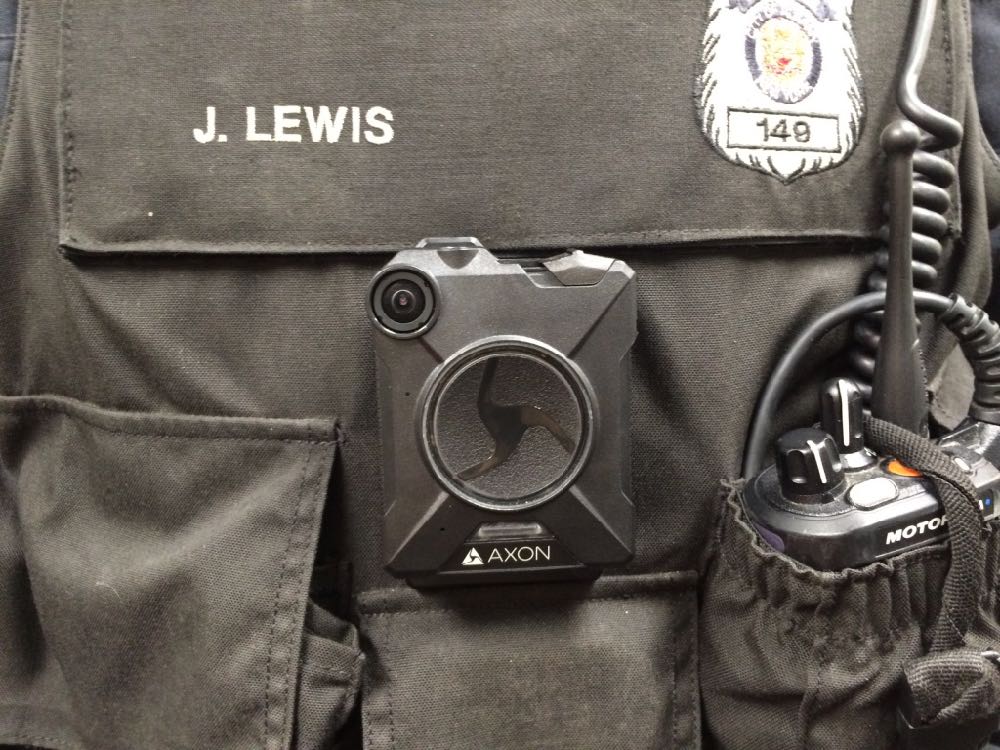
One of the officer-worn body cameras that Albany police will be using.
Updated
A handful of Albany police will be routinely wearing body cameras starting this Monday, the police department formally announced Friday. APD will eventually be rolling out cameras to more than 250 officers in the months ahead.
The debut of the cameras as part of officers' regular gear is the culmination of process the department's been working on since 2015.
The cameras hold the promise of potentially adding increased clarity and accountability to interactions between police and members of public -- but they're not without limitations.
Juice for electric vehicle sales
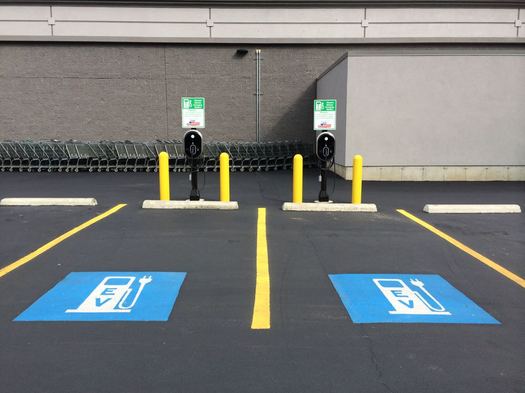
The number of electric vehicles sold in New York took a big percentage jump during the first half of this year, according to the Cuomo admin. Sales were up 61 percent from January to June 2017 compared to the same period in 2016.
The administration attributes to the jump to the new electric vehicle rebate the state started offering this spring. New York State is now offering up to $2,000 for qualifying vehicles, bringing the total potential federal and state rebate to $7,500. The Cuomo admin points to a sharp uptick in sales this year after the rebate started (sales January to March were up 44 percent compared to 2016, and up 74 percent April to June.)
The total number of electric vehicles sold in New York State during the first half of this year: 4,209. And through the end of August, there have been 2,332 "Drive Clean Rebate" applications submitted.
Albany Can Code fall 2017 classes
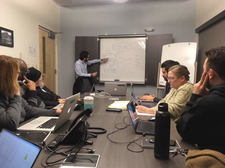 Albany Can Code -- the local non-profit focused on helping people transition into careers in software development -- has opened applications for its fall courses, which start in October.
What is Albany Can Code? Blurbage:
We are a not-for-profit organization founded in June 2016, dedicated to the vision of a talent-fueled pipeline for our region's software sector. To build this pipeline, we work with employers, educators, and community organizations to identify, train, and advocate employment of people with the skills to work in software and IT jobs.
The goal is to remove the economic and cultural barriers to working in technology. We want our region to have an inclusive, vibrant, and expert pipeline of technologists. Part of that mission involves changing mindset in our region about who can be a technologist, and how to evaluate candidates for technology jobs.
The classes being offered this fall are front-end and back-end web development. That is, one class about the code displaying stuff online (HTML, CSS, Javascript, and so on) and one class about the virtual machines that turn out stuff online (servers, databases, and so on). The front-end development course is at the SCCC facility in downtown Albany, the back-end classes are at SCCC in Schenectady. The classes are in the evenings.
Tuition for the classes is $1,500. Help in getting financial assistance is available through SCCC.
Here's an FAQ for potential students.
photo via AlbanyCanCode Facebook
Listening Here
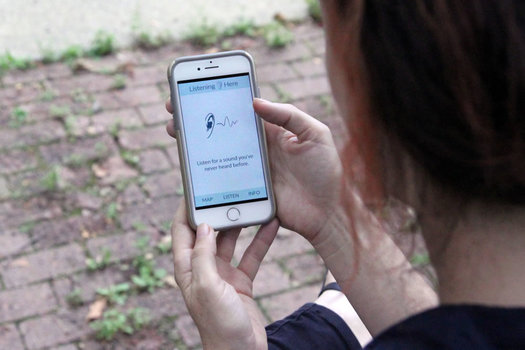
A new project focused on what Albany sounds like is launching September 1. Listening Here -- a web app -- is the creation of composer/sound artist Stephanie Loveless and composer/technologist Cristyn Magnus. Blurbage:
Created utilizing input from over 100 community members, "Listening Here" promotes attention to environmental sounds; utilizing written prompts tailored to the user's geo-location, people can experience the variety of unique and engaging sounds in the Capital City. As an example, Loveless and Magnus point to the difference in how crowds sound on a street corner compared to the space under The Egg at the Empire State Plaza. ...
The app has been in the works since 2016, but the seed was planted long before that as Loveless and Magnus met 10 years ago, in a class on Deep Listening, the philosophy and practice of Sonic Awareness developed by renowned American composer and Rensselaer Polytechnic Institute Professor Pauline Oliveros.
About the genesis of the project, Loveless says "We started our project with questions like what sounds matter to people in Albany? What does our city sound like? What happens when we take the time to listen?" The project incorporates input from over one hundred locals and hours of walking around Albany with a portable recorder. "Sound is around us all the time, and it affects us physiologically and psychologically, but we rarely take the time to listen. Our app encourages people to take off their headphones, step out of their cars, and really listen to their environment."
If you'd like to contribute to the project, there's an Albany sound memory survey online. It asks about sounds people hear in the city.
The launch party for the project is Friday, September 1 at the Albany Center Gallery at 6 pm. You'll be able to try out the app, take listening tours with artists, and participate in interviews about sounds in Albany.
photo: Rose Mitchell-Tenerowicz
Search Albany
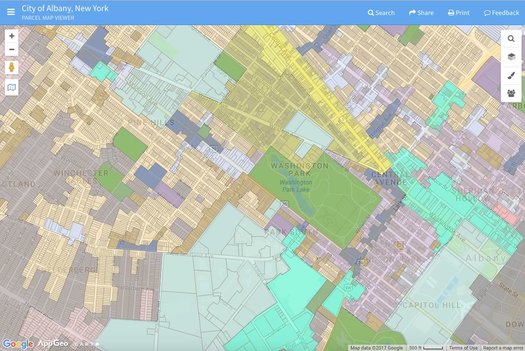
The city's new zoning map as displayed through Search Albany.
The city of Albany unveiled a new online tool -- called Search Albany -- for accessing all sorts of info related to properties around the city Tuesday.
It's basically a map through which you can access details about individual properties -- such as the name of the owner -- as well as neighborhood-level info such as zoning districts and Common Council wards.
The best way to get a feel for it is to just play around with it, so go for it.
But here are also a few quick things about it...
Self-driving car to test in Albany

A photo of an Audi self-driving car distributed by the Cuomo admin.
Audi will begin testing of autonomous vehicle technology -- a self-driving car -- in Albany near the Capitol June 13, the Cuomo admin announced Wednesday. Press release blurbage:
Included in the FY 2018 Budget, new legislation allows for testing autonomous technology through a year-long pilot program. Audi of America Inc. was the first company to apply for the rights to demonstrate this technology in New York and the first to be approved under the program. The technology they plan to demonstrate in the Capital Region is considered to be a Level 3 in autonomous vehicle operations by the Society of Automobile Engineers, meaning it is capable of safely allowing hands-free driving at posted highway speeds, but requiring a person to take over if required. Two trained engineers will be in the vehicle to monitor the system and ensure safety, one in the front seat and one in the back seat. The vehicle has already logged thousands of miles on highways across the U.S. safely.
That "level 3" is halfway along the SAE's scale from no automation all the way up to fully-automated, self-aware vehicle that swears at you when you cut it off.
The conventional wisdom right now is that self-driving cars are The Future. And pretty much every car company -- along with companies such as the Google affiliate Waymo -- are working on the tech. (Ford recently sacked its CEO, apparently in large because a deal fell through with Google on self-driving tech.) [Automotive News]
The implications of having cars that can drive without humans opens up a range of possibilities, including greater safety and convenience. But it also raises questions about the future of public transit, how cities are designed, commuting, and jobs. [Quartz]
For example, to link this to another hot topic here: Uber has been vigorously pursuing self-driving tech, presumably to eliminate human drivers, and the cost of paying them, from the service in the future (with all the usual Uber drama). [NYT x2]
Earlier: Four trends shaping the way people will get around the Capital Region in the future
Albany police planning to start using body cameras this summer
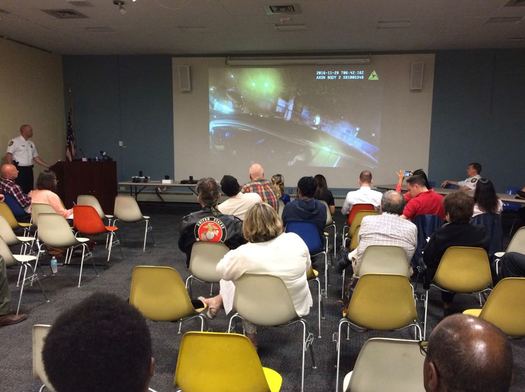
The crowd watching sample video at Tuesday's meeting.
The Albany Police Department has a plan to start deploying body cameras to all its officers this July.
The details of the rollout of the cameras -- and how they'll be used -- were the main topic of a presentation by acting police chief Bob Sears at an Albany Community Policing Advisory Committee forum at the Albany Public Library Washington Branch Tuesday evening. Sears also took a bunch of questions from the crowd in discussing the department's policy for the tech.
Here are a few more bits about the much-anticipated program...
A "self-sustaining, power-generating island unto itself" in Albany

The Empire State Plaza is set to become "a self-sustaining, power-generating island unto itself" as part of a plan formally announced by the Cuomo admin Monday to build a power plant and microgrid for the ESP buildings. In other words, the ESP is basically getting its own power plant and if there's a power outage, it'll still be able to have power.
And that's a good thing. The ESP is the location of many state operations. But the really interesting part of all this might be what this project sets up for other parts of downtown Albany in the future...
Albany police forum to talk about officer body cameras
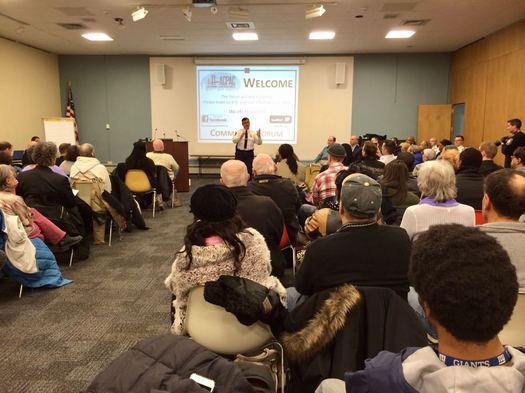
From one of the public events last year.
There's a public forum Tuesday, May 23 to talk about the Albany Police Department's work toward using officer body cameras. The meeting -- organized by the Albany Community Policing Advisory Committee (ACPAC) -- is at the Albany Public Library's Washington Ave Branch at 6 pm.
The APD has been looking at whether/how to use body cameras for more than a year now. And last summer it released a draft policy last summer. And this past fall it began a pilot test of body cameras from four different vendors. The city has a federal grant to help cover the cost of an eventual program, which is expected to be expensive.
Police body cameras are an important topic. Advocates of the tech have touted the cameras as a tool for increasing accountability of police and helping to provide more certainty about what happens during interactions between officers and the public. But use of the cameras also prompts questions about privacy, perspective, and who gets to interpret the resulting images.
ACPAC has two public events about the issue last year -- both were well attended. And not only did people show up, they were ready with insightful, sometimes tough, questions for the department. So this is another opportunity to offer feedback.
State troopers in Albany
Tracking trucks in Albany's South End
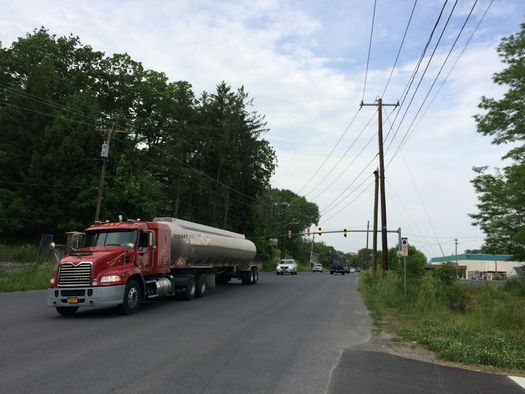
South Pearl Street last summer.
People in Albany's South End have long been calling for attention and resources to focus on air quality and other environmental health issues in the neighborhood. And there's a project coming up that's using an interesting tool to study truck traffic along the South Pearl Street corridor -- one of the factors related to air quality.
The city of Albany and the Capital District Transportation Committee will be using automatic license plate readers to better understand how trucks move through the neighborhood. From a CDTC press release:
Instead of assigning people to record license plate numbers at several locations for 24 hours a day for 1-2 days, this survey will install and use automatic license plate readers (ALPRs) over a longer period of time to obtain the same data, in greater quantity with more reliability.
The goal of the survey is to identify truck travel patterns and generators, and to develop possible alternative routes. The data collected will only be used for these purposes. ...
The study area will be bounded on the north by the intersection of Green Street and 4th Avenue, on the west by South Pearl Street, on the south by the City of Albany boundary, and on the east by Smith Boulevard and Church Street in the Port of Albany. The ALPRs will be installed at 6 intersections in this area. The project is expected to be completed in September 2017 with a final report.
CDTC will be working with a company called FES Installations to study the data generated by the 15 license plate readers.
This is a different sort of use for the technology that the one for which it's been most famous in recent years: Law enforcement agencies have made extensive use of license plate readers over the past decade, scooping up huge amounts of data about where vehicles have been spotted, including here in New York State. That's prompted debates about how the tech should -- or should not -- be used, and some of the civil liberties and ethics issues involved. [Democrat and Chronicle] [TU] [The Atlantic]
New York State is now offering a rebate for electric cars
The EV charging stations outside the Market32 on Madison Ave in Albany.
The Cuomo admin officially launched a rebate for electric cars Tuesday -- New York State will now chip in up to $2,000 for qualifying vehicles. That's on top of federal of a federal tax credit that's worth up to $7,500.
Press release blurbage:
$55 million of the Drive Clean Initiative is dedicated to rebates of up to $2,000 for purchase of a new plug-in hybrid electric car, all-electric car or hydrogen fuel cell car. In addition to the $55 million in rebates, $15 million will support improving consumer awareness of electric cars and their many benefits, installing more charging stations across the state, developing and demonstrating new electric car-enabling technologies, and other efforts to put more electric cars on New York's roadways. The initiative will be managed by the New York State Energy Research and Development Authority and will help the state achieve its goal to reduce greenhouse gas emissions 40 percent by 2030.
The rebate can be applied to more than 30 different models of vehicle, though the amount slides based on the all-electric range of the car. Also: If the vehicle is more than $60k, the rebate is just $500 regardless of range. (Let's face it, if you can afford a Tesla a rebate's probably not going to sway you.)
Checking in on UAlbany's plan to convert the Schuyler Building in Albany into the home of its new engineering college

A UAlbany rendering of what the converted building could look like.
It was just about a year ago that UAlbany officially announced a plan to turn a former Albany school district building next to its downtown campus into the home for the new College of Engineering and Applied Sciences.
The idea behind the $60 million project is that the conversion of the Schuyler Building would not only provide space for growing a public option for engineering education in this area, it would also be an injection of activity right into the city's midsection that could help set the surrounding neighborhood on a new, vibrant path. And UAlbany has been seeking $20 million from the state go get things going.
So, how's that coming along?
A step toward the new 838 area code
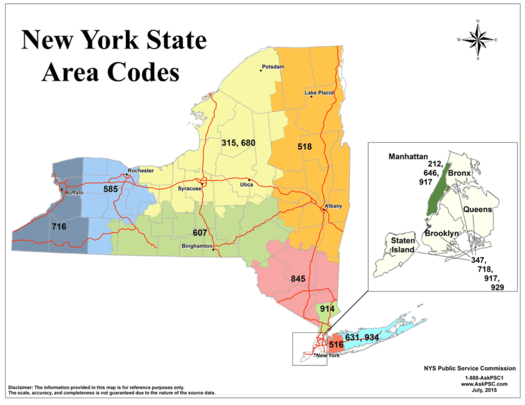
The new area code for this part of New York State is set to start in September. And the first (small) changes for telephone users connected to the new 838 area code begin later this month. From a state Public Service Commission press release blurbage:
As an intermediate step in the implementation of the new area code, a permissive dialing phase begins March 18, 2017, which will allow customers to dial either 7-digits or 10-digits (area code plus 7-digit local telephone number) on calls within the 518 area code; calls to other area codes must still be dialed as 1+ ten digits. The permissive dialing period will end on August 19, 2017, at which time callers will be required to dial 10-digits (area code plus 7-digit local telephone number).
Beginning September 19, 2017, customers in the 518 area code region requesting new service, an additional line, or a move in the location of their service, may be assigned a number in the new 838 area code.
In other words, this is all to get people accustomed to using 10-digit numbers ahead of when they'll actually have to use them.
Oh, and the other way looking at that September date is that it's the deadline for getting a new phone number with a 518 area code -- if, for some reason, that's important to you.
838? What is going on?
Here's the short backstory to all this...
Open Data Day hackathon at TVCOG
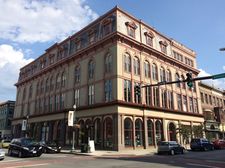 The Tech Valley Center of Gravity in Troy is hosting an Open Data Day hackathon this Saturday, March 4. Blurbage:
Open Data Day is a collection of local gatherings of open government advocates, developers, programmers, statisticians, and citizens who want to build things with and promote the use of open data. ... Join us at Tech Valley Center of Gravity from 9AM to 3PM! In addition to a hackathon, we're planning quick talks and workshops to introduce participants to the concepts and tools essential to working with open data.
We hear from organizer Ursula Kaczmarek that there's still some space left for people who'd like to participate. Also: "The event is free and we'll provide all the coffee and sugary snacks people need to participate."
Here's how to register.
Access to public information is becoming a modern civil right. Finding ways to make this sort of info easier to access and use for all sorts of people is a worthy goal.
TVCOG advertises on AOA.
Applications open for AlbanyCanCode spring classes
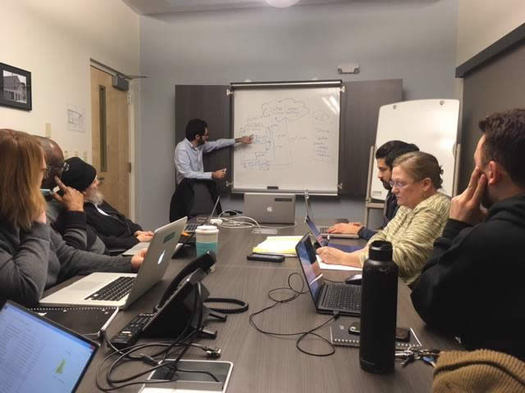
AlbanyCanCode -- the local non-profit focused on helping people transition into careers in software development -- is currently accepting applications for its spring courses. The application is a short online survey that asks a few biographical questions, along with few a skills assessment questions.
What is AlbanyCanCode? Blurbage:
AlbanyCanCode, was established in the summer of 2016 to serve two key stakeholder groups: local employers of software and IT professionals, and local folks who have the aptitude to work in software but lack local options for training. Our initial 12-week course in Front End Web Development attracted more than 80 applicants. A majority of the ten final students were income-qualified for a full grant of the $1,500 tuition. Following course completion in late January 2017, nearly half of our students have now been hired or are in the process of interviewing for internships at area software employers
The classes on the slate for this spring are front-end web development (HTML, CSS, JavaScript, jQuery, Bootstrap) and back-end web development (PHP, MySQL, Python, Ruby). (With those two groups of skills, you can build a bunch of stuff online.) The courses start in April.
And if you're an employer or educator, it sounds like AlbanyCanCode would be happy to hear from you about potential partnerships.
photo via AlbanyCanCode Facebook
Clean tech hackathon at Tech Valley Center of Gravity
The Tech Valley Center of Gravity in Troy is hosting a clean tech hackathon October 15-16. It's free to attend if you'd like to gawk at what's been made. And if you have a team that would like to take part, registration is still open -- there will be $5,000 in cash prizes.
What is this hackathaon? Blurbage:
A hackathon is an event, usually lasting more than a day, where groups of computer programmers and other tech-oriented people collaborate intensely on projects using software. Hackers typically staying in the space the entire time working constantly. To help inspire the competitors, organizers of the TVCOG Clean Tech Hackathon have solicited problem statements from key players in the industry in the areas of Advanced Buildings, Renewables and Clean Transportation. Some problems hackers may tackle include: making solar photovoltaic and wind energy more predictable; innovations in "smart" building technology that can adjust energy usage based on intelligent predictions of the occupants' behaviors; and designing hardware/software solutions that use on-street installations to improve bike and pedestrian safety and comfort.
Participating teams will have mentors from NYSERDA, BessTech, The Wagoner Firm, New York State Mesonet, and Bette & Cring Construction Group. Also: "An abundance of high quality free food is available to all hackers and participants."
As mentioned above, it's free to attend or participate, but registration is required.
TVCOG advertises on AOA.
Say hello to our new area code
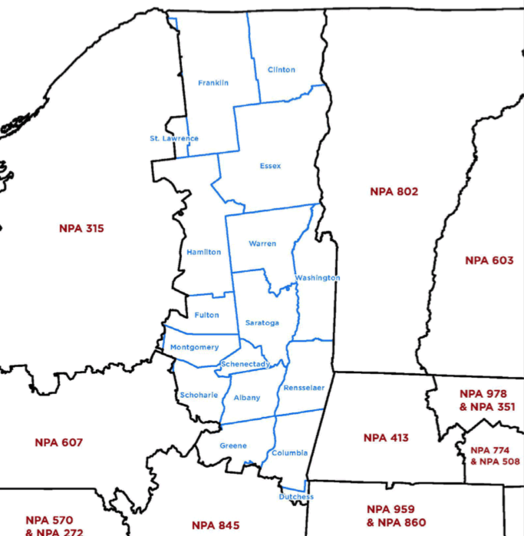
The current 518 geographic area.
The new area code for this area will be: 838.
The state Public Service Commission announced the designation Tuesday, and said the new area code will be in effect by the third quarter of 2017.
The 838 area code will be an "overlay" to the 518 area code. That is, they'll share the same geographic area. At some point in the near future -- probably sometime next year -- new phone numbers distributed in this area will just get 838 instead of 518. Then whenever you (or your phone or phone system) dials a local phone number, you'll have to include the area code with the seven-digit number. (Here's some background on how this situation came about.)
Here's a bit more about how this is all planned to shake out...
We're getting another area code
The 518. / image: NYS Department of Public Service
The state Public Service Commission has approved a plan to add a second area code to the region currently covered by the 518 area code. The prompt for the addition: 518 is projected to run out of phone number sometime next year.
There were two potential plans on table for alleviating the number crunch -- adding the new code in an "overlay" to the existing 518 region, or splitting the 518 area into two parts with one side keeping 518 and the other getting a new area code.
The pick of the overlay option isn't a surprise. When officials presented the options earlier this summer, it very much sounded like things were headed in that direction. From a PSC press release announcing the pick Wednesday:
The Commission examined both "geographic split" and "overlay" options. Based upon its review, the Commission determined that an overlay is the preferred option because it is easier to implement from a technical standpoint and less expensive from a customer standpoint, especially for business customers who could be forced to change signage and branding in the event of a geographic split. An overlay occurs when a new area code is superimposed over an existing calling area, and, by definition, it results in more than one area code serving the same calling area or region. Under an overlay plan, existing telephone numbers remain unchanged, and all new telephone numbers would be assigned the new area code.
So, bottom line, what does this mean for actually using a phone here? Not that much. It's just that starting sometime in the next year or year and a half, every time you dial a local number you'll have to dial 10 digits instead of 7. (A change most people probably won't even notice for many calls because the dialing is done by a mobile phone or some other system.) And anyone getting a new number will get the new (not yet announced) area code.
Even so, a moment to reflect on the end of 518, one of the nation's original area codes, as an only-code... Now, move over, you're getting a sibling.
Power tool drag racing in Troy
This video is from a power tool drag race in San Francisco a decade ago.
This is weird, in a potentially gleeful way: One the events at the Troy Mini Maker Faire at the Tech Valley Center of Gravity this Saturday will be power tool drag racing. Blurbage:
Power Tool Drag Racing puts racing contraptions powered by ordinary power tools in head-to-head competition to see who takes it ... who REIGNS SUPREME!
The history of Power Tool Drag Racing is apocryphal and filled with myths, legends, hyperbole and downright facts. Never let facts get in the way! Needless to say, it's probably been around since the first hand power tools were available and some genius decided to zip-tie the trigger on a belt-sander and watch it tear across the floor to sounds of mad glee, terror and pure, unadulterated delight.
The power tool drag races will be outside on the street.
The Troy Mini Maker Faire is this Saturday, August 27 from 11 am-6 pm at TVCOG (corner of Broadway and 3rd Street). It's free to attend. And, of course, that's also the same day at the Enchanted City festival, also in downtown Troy.
TVCOG advertises on AOA.
A face in 128 points
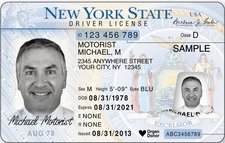 The Cuomo admin is touting an upgraded state DMV facial recognition system that launched earlier this year -- the admin says the system is intended to help catch fraud and identity theft, and it's prompted "more than 100 arrests and 900 open cases since it launched in January."
A clip from the press release that we thought was interesting:
The upgraded system increases the number of measurement points on the face from 64 to 128, doubling the number of measurement points mapped to each digitized driver photograph and vastly improving the system's ability to match a photograph to one already in the database. The system also allows for the ability to overlay images, invert colors, and convert images to black and white to better see scars and identifying features on the face. Different hair styles, glasses, and other features that change over time - including those that evolve as a subject ages - do not prevent the system from matching photographs. DMV will not issue a driver license or non-driver ID until the newly captured photograph is cleared through the facial recognition system.
Since the facial recognition technology was implemented in 2010, more than 3,800 individuals have been arrested for possessing multiple licenses. Additionally, more than 10,800 facial recognition cases have been solved administratively, without the need for an arrest. If the transactions are too old to pursue criminal prosecution, DMV is still able to hold subjects accountable by revoking licenses and moving all tickets, convictions, and crashes to the individual's true record.
The Cuomo admin says almost half of the people tagged so far are accused of using a stolen identity in order to get a new license because their old license has been suspended or revoked.
Albany area mobile service is toward the back of the pack
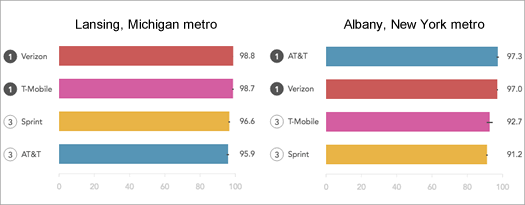
We clipped the RootMetrics overall performance graphs for Lansing (#1) and Albany (#112) and put them side by side.
Maybe it doesn't matter as much if you're toward the back of the pack when the whole group is moving faster.
We were thinking about that while looking through the latest RootMetrics report about mobile service (data and voice) both here in the Albany area and across the nation. Because two things jumped out:
+ The Albany area ranked 112 out of 125 metros for overall mobile network performance. And the Hudson Valley ranked last.
+ But if you compare the individual service provider scores for Albany with that of Lansing, Michigan -- the #1 overall metro -- the difference isn't really that big. (Sprint and T-Mobile service were indicated to be worse here -- and Sprint's data speeds were way slower in Albany.)
Reaching for a new way of picking up recycling
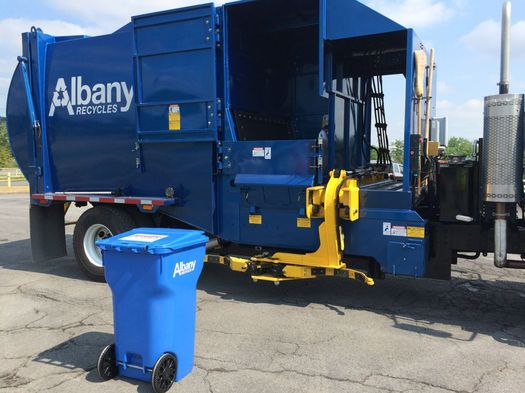
Trash is one of those things that most of us probably take for granted -- but collecting it, and finding a place to dispose of it, is a critical part of any city. It's just something we don't tend to think much about unless something changes (or doesn't work).
So, here's prompt to think about the topic a little more: Starting this week the city of Albany is beginning a test of a new way of picking up trash -- recyclables, to be specific.
What's the future of the 518?
You know, the actual area code.
The 518 area code has had a good run. It was one of the original area codes, and it's made it almost 70 years without being broken up or having to share its expansive geographic area with other digits.
But finally, after all those years, it's running out of numbers. The current projection is that its supply of phone numbers will be exhausted by early 2019.
So what now? Here are the two options...
The Weebermobile
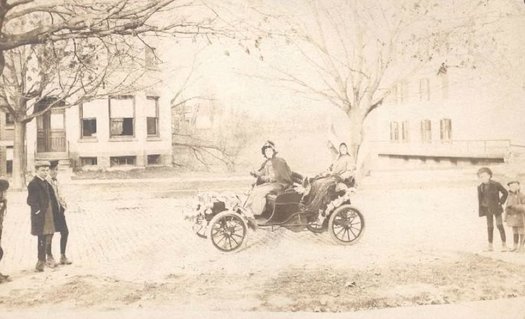
Christian Weeber and his wife Pauline in a Weebermobile decorated for a Halloween parade on Western Ave in Albany around 1905. / photo from New York State Museum collection
Cars are so ubiquitous and ingrained in our culture now that it's hard to imagine a time when they were a new technology -- something cutting edge that inspired new dreams.
That was one of the thoughts we had while reading through an interesting new publication from the State Museum: Weebermobile: Christian F. Weeber, Jr. Inventor, Entrepreneur, and Manufacturer by Geoffrey N. Stein.
Christian Weeber was born in Albany in 1872 and would go on to operate a bike shop in Albany before building his own brand of the car, the Weebermobile, in the late 1890s -- which, according to at least one account, may have been the first automobile on the streets of Albany.
Our augmented local realities
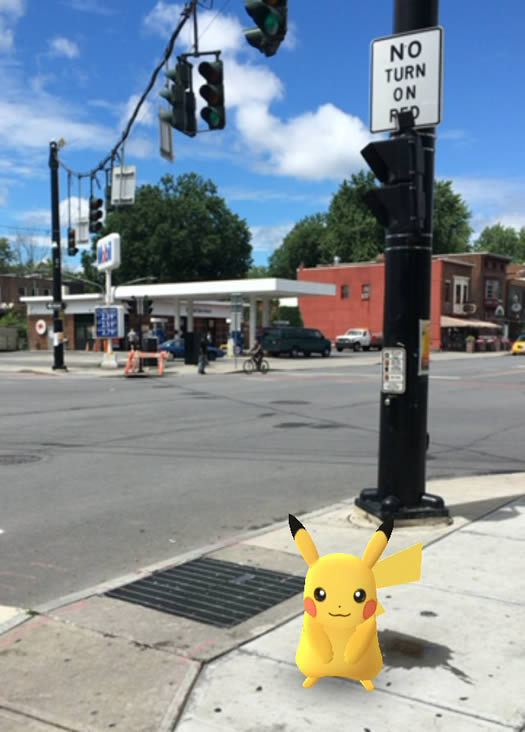
That is Lark and Delaware and Madison. And Pikachu, who apparently couldn't hold it. (Thanks, Paul.)
Said Paul to us this morning: "You should do a post for discussion of #PokemonGo in the Cap Region."
Well, as it turns out, our license to publish things on the internet (THE INTERNET!) will be revoked if we don't post something about the ongoing transformation of the physical world into a playscape for the new Pokemon Go game. (Obligatory Vox explainer.) So here is that post.
Update: There's also someone on Albany Reddit offering (claiming to offer?) "Pokémon Go Taxi" services for $40 per hour. (Insert your own Uber joke here.)
(Thanks, S)
In all seriousness... It is cool how much fun people seem to be having with this game. And given how cities such as Albany are always trying to find ways of highlighting their history and architecture and other aspects -- and prompting people to explore those things -- maybe there are some ideas to borrow here.
Following a virtual Alexander Hamilton. Seeing buildings that are no longer there. Location-activated prizes. There are a lot of possibilities.
Troy Mini Maker Faire at TVCOG
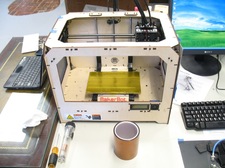 The Troy Mini Maker Faire will be at the Tech Valley Center of Gravity August 27, and there's an open call for makers. Blurbage:
The Troy Mini Maker Faire is looking for artists, engineers, educators, and enthusiasts who are willing to show off their creations, skills, or works-in-progress to the public. The more interactive your exhibit, the better! We hope to have a nice mix of technology, life skills, art, educational activities, and entertainment...
The call includes a big list of the sort of projects they're looking for -- everything from fiber arts to 3D printing to robots to cooking. (The list is after the jump.) Here's the application.
Exhibits will be set up both inside the Center of Gravity space and outside along Broadway. That day is The Enchanted City festival in downtown Troy.
Albany moves toward police body cameras
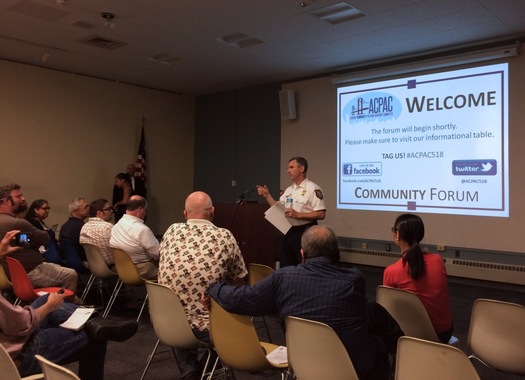
APD chief Brendan Cox at the forum this week.
The Albany Police Department is moving toward testing body-worn cameras for its officers this summer.
That was one of the bits from an Albany Community Policing Advisory Committee forum this week that served as a progress report of sorts for the department's efforts to deploy the devices.
Here's a quick look at where things are at on the topic, along with a few takeaways from the meeting.
Drone class at HVCC
 Noted: HVCC is offering an intro class to flying drones starting in July. Blurbage:
This course provides training essential for learning to fly small unmanned aerial systems (sUAS), also known as drones, either for pleasure, or to understand what is required of a commercial operator.
The course not only covers how to fly sUAS, but multiple types of flight systems from multirotors and fixed-wing, and includes training in autonomous flight. The course covers information required to make educated decisions on what flight systems will meet your needs, combined with the knowledge necessary for safe flight and potentially exploring a career.
Students will learn about emerging job opportunities using sUAS, and entrepreneurs will be exposed to the application and use of this transformative technology in their businesses.
The class meets on Saturdays from 9 am-4 pm July 23-August 6. The fee is $1,499, and includes equipment.
There's an info session about the course June 21 at 11 am.
Earlier on AOA: A future that's up in the air
photo: Flickr user Peter Linehan (CC BY 2.0)
Albany forum on police body cameras
 The Albany Community Policing Advisory Committee is holding another public forum about the Albany Police Department's plans for using officer-worn body cameras. It's next Tuesday, June 14 at the Washington Ave Albany Public Library at 6 pm.
Event blurbage:
Following up on the very successful forum ACPAC held in February on this topic, ACPAC has invited the Albany Police Department to give a presentation on the progress they've made in developing Body-Worn Camera Program policies and procedures since the last forum. Following the presentation, ACPAC will invite attendees to provide further public comment on the developing program.
Here's a copy of the APD's draft policy of body cameras.
As alluded to in that clip, there was a similar forum this past February at which police leadership talked about some of the issues and complications related to body cameras, and members of the public had a chance to express their thoughts. It was an interesting event.
Goodbye, Time Warner Cable
Time Warner Cable is now officially part of Charter Communications after the $55 billion acquisition closed today. And that means the TWC brand will be fading away. The combined company will be called Charter, and the services -- such as cable TV and internet access -- will be marketed under Charter's Spectrum brand. [Bloomberg]
So, if you're a TWC customer, what's all this mean?
Well, Charter's CEO said today in a press release that there won't be many changes right away, but there will eventually be "product improvements and consumer friendly policies."
Here are a few things to keep an eye on:
GameFest 2016 at RPI
 The annual GameFest returns to RPI this weekend with a bunch of demos and talks about video games and their futures, along with an electronic music event. This year's theme is "Visions of the Virtual." The events are free and open to the public.
Here's some blurbage about the student-created games demo and competition at EMPAC that's part of the fest:
On Saturday, April 30, the GameFest expo, competition and symposium at EMPAC features over 50 student teams from colleges and universities across the Northeast, with a game design competition hosted by Vicarious Visions. Dive into virtual reality and fly a stunt kite, or become a narwhal making sandwiches at a deli counter. Play through a tale of love and loss using your own facial expressions, or explore an immersive environment of freshwater ecology. Check out the future of multiplayer gaming, haptic feedback devices, mobile games and more.
(Aren't we all narwhals making sandwiches at the deli counter of life?)
The schedule also includes Algorave 0x0F -- "an evening of cutting-edge electronic music, interactive visuals, and live-coding performances" -- Friday night at the Tech Valley Center of Gravity. And there will be keynotes and mini talks on Saturday. A condensed schedule is after the jump.
Thinking about police body cameras in Albany

Albany police chief Brendan Cox addressing the crowd at the start of the forum.
The Albany Police Department is planning to pilot test officer body cameras this summer, with an eye toward eventually expanding the program to the whole department. And the APD is facing a range of questions as it works out the details: When should the cameras be on? What should they capture? Who should get to see the video?
Those were some of the questions discussed at a public meeting to gather input about the topic this past Tuesday at the Albany Public Library main branch. As Albany police chief Brendan Cox told the media beforehand:
"[Body cameras] can seem very simplistic until you start getting into the nitty gritty and recognize that you're dealing with human beings, you're dealing many times with human beings in crisis, but then you're also dealing with human beings in just regular interactions. So you want to try to get it right. Because you don't want to set up false expectations, you don't want to hurt anybody, you don't want to cause any more trauma. So you really want to try to do your best to set up policies, to set up procedures, and to set up trainings."
The hope is, of course, that officer body cameras will provide more and better information about what happens between the police and the public -- from stuff like complaints about rudeness, all the way up to situations in which a person dies during an interaction with police, such as in the death of Dontay Ivy.
Members of the public at the meeting had a lot of questions about the program. (It sounds like both the police and the public are still sorting through what they think about the idea.) But there were also a lot of suggestions.
Here are four thoughts about the topic...
Public event to discuss the future of police body cameras in Albany
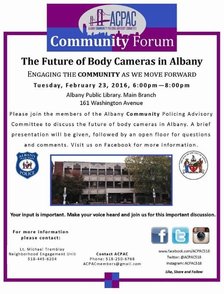 The Albany Police Department and the Albany Community Policing Advisory Committee are holding a public event to discuss the use of body cameras this Tuesday, February 23 at the Albany Public Library main branch at 6 pm.
Blurbage: "Please join the members o the Albany Community Policing Advisory Committee to discuss the future of body cameras in Albany. A brief presentation will be given, followed by an open floor for questions and comments. ... Your voice is important. Make your voice heard and join us for this important discussion."
APD chief Brendan Cox will be there to give a presentation, according to an APD press release. Last fall the feds announced the city of Albany was getting a grant to help cover the cost of adding officer body cams.
Body cameras for police officers are one of those things that feel inevitable. Between the increased push for better evidence about what happens (or doesn't happen) during police-community interactions, and the falling price of the tech, it's not hard to see an eventual future where every police situation is filmed.
But. Technology is a tool, not necessarily a solution. That's one of the points made by an interesting review of body cams by the think tank Data & Society. A clip from a shorter piece about the review in The Atlantic -- "It's Not Too Late to Get Body Cameras Right" -- by two of its authors, danah boyd and Alex Rosenblat:
The temptation of technology as an accountability tool is not new, but accountability is not done by technology. Accountability is achieved by people and systems using tools like technology as part of their bureaucratic processes. There is effectively a global consensus that body cameras are a good thing to have because everyone has a different idea of what they're agreeing to, a different model of appropriate bureaucracy. The bureaucratic and political battles over policies of use, access, and retention are not yet resolved, and they are significant. Who gets to see the footage, and in what circumstances, will matter. The features and capabilities of the technology matter. What happens when the camera reveals more about what was in the officer's scope than what they could physically see at the time, especially at night? Or when cameras get additional features, like heat sensors? Even on basic practical questions, such as whether and when officers or the public should see the footage, there is no consensus.
So, there's a lot to think about to think about on the topic. And like almost all tech issues, it eventually comes back to how people act and the choices they make.
A throne invented in Albany
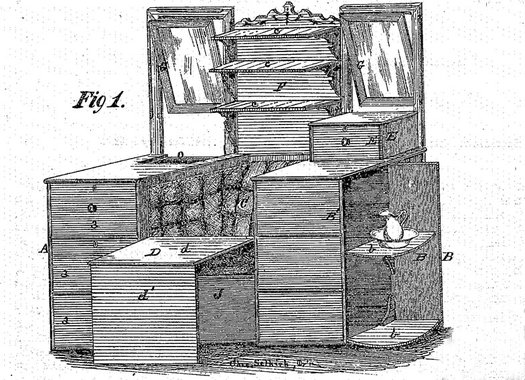
Here's a larger, uncropped version of the illustration submitted with the patent. (Also, check out Elkins's signature -- the guy signed with a flourish.)
Patented 144 years ago this Saturday by Dr. Thomas Elkins of Albany: The Chamber Commode. From this application:
My invention relates 'to a new and useful article of chamber furniture which I denominate chamber-commode; and consists in the combination of a bureau, mirror, book-rack, washstand, table, easy-chair, and earth-closet or chamber-stool, or a combination of a number of the said articles in such a manner as to render the said piece of furniture capable of affording the several accommodations and conveniences to be had only in the several articles as they are now constructed, the object of this invention being the rendering of a single piece of furniture capable of serving in several capacities, whereby the several pieces of furniture now required for accommodation and convenience in a chamber may be dispensed with.
It's a dresser! It's a vanity! It's a book rack! It's a washstand! It's a chamber pot! It's all those things.
Google is looking at the sunny side of your roof
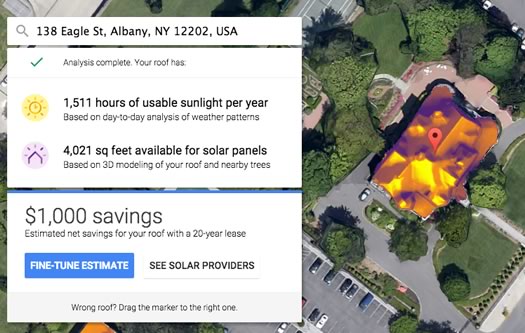
It seems like solar panels are popping everywhere the last few years, on both commercial buildings and neighborhood homes. And if you're curious about the potential of adding solar panels to your home, there's a tool that might help you start to get a sense of that.
Google recently extended its Project Sunroof tool to include the Albany metro area. Basically Google uses its map data of roofs to estimate the solar potential of a building. It then breaks down some estimates for how much a system might cost, and how much the building owner might save if they lease panels, take out a loan to buy them, or just pay cash.
Example: That screengrab above is the a clip from the page generated for the Governor's Mansion in Albany.
Of course, the info that Project Sunroof provides is just going to be a rough estimate. And Google even notes that the figures may vary from the estimates generated by a contractor who actually stops by for a visit. But it's a place to start, and it may help you get a sense of what sorts of questions to ask if you decide to investigate further.
Earlier on AOA:
+ Solar continues to grow around New York
+ Ask AOA: Residential rooftop solar options?
+ Our time in the sun
Internet of things hackathon at TVCOG
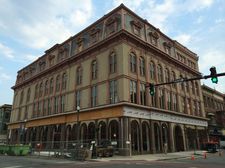 The Tech Valley Center of Gravity is hosting an Internet of Things Hackathon January 30-31. Blurbage:
The hackathon's theme is The Internet of Things (IoT) which is the network of physical objects or "things" embedded with electronics, software, sensors, and network connectivity, which enables these objects to collect and exchange data.
There will be a top prize of at least $1,000, as well as other giveaways including a free TVCOG membership. But [Erica] Iannotti says most hackers will come for the camaraderie, the excitement of competition, the good food (in addition to Cheetos) , the bragging rights and, most of all, the opportunity to mess with hardware they cant afford to own themselves.
"Most hackathons focus on software, this one will combine software, hardware and the Internet," Iannotti said. "Teams of hackers will spend the weekend at TVCOG making software to connect physical objects to the Internet in new and interesting ways."
Judges will include Jeff Branson from SparkFun Electronics and Kishor Bagul, an entrepreneur former chief technology officer of New York State. The event is being sponsored by AT&T.
It's free to participate, but pre-registration is required.
And when an army of internet-connected toasters recruits the Green Island Bridge as part of their uprising, you'll know what happened.
AOA is a media sponsor of TVCOG
The present augmented with clues from the past
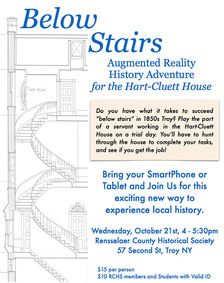 This could be interesting: The Rensselaer County Historical Society has an event at the Hart-Cluett House this week in which you'll be able to explore the historic house using an augmented reality app. Blurbage:
Do you have what it takes to succeed "below stairs" in 1850s Troy? Play the part of a servant working in the Hart-Cluett House on a trial day. You'll have to hunt through the house to complete your tasks, and see if you get the job.
As we understand it, participants will need to download an app onto their mobile or tablet. And then as the explore the house, clues will be revealed in an augmented reality view -- basically images or other information laid over the physical world -- through the app.
The event is the result of a collaboration between RCHS and researchers connected to the Emergent Reality Lab at RPI. (Other efforts at the lab have included building a virtual reality setting for teaching Mandarin.)
"Below Stairs" is Wednesday, October 21 from 4-5:30 pm. It's $15 per person / $10 students.
A future that's up in the air
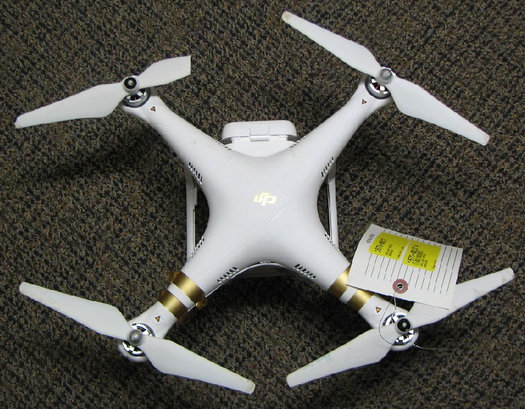
State Police say this drone collided with a chimney on the state Capitol in September and ended up on the building's roof. / photo: New York State Police
The recent incident in which a guy is accused of crashing a drone into a chimney of the state Capitol building got us thinking about how we should look at a future in which all sorts of machines could be buzzing around buildings and treetops -- and what sort of rules there should be for such a future.
Up to this point the feds have set general guidelines for how private citizens can use drones, while setting stricter rules for commercial use. Meanwhile, states have passed all sorts of laws. Arkansas and Georgia have banned drone use around their capitols. Others have laws aimed at keeping drones from being used for voyeurism. And Michigan has a law prohibiting drones from being used to... harass hunters. Here in New York State a bill has been hovering in the New York State legislature the last few sessions that would restrict the use of drones for surveillance by both private individuals and law enforcement.
So we got in touch with Albany Law professor Robert Heverly, who studies these sorts of intersections between the law and tech -- he's written about attempts by governments to set rules for drone use.
Our conversation floated from topics like whether it's trespassing to fly something above a person's property, to privacy, to whether we're headed for a dystopian drone future...
Quirky filing for bankruptcy
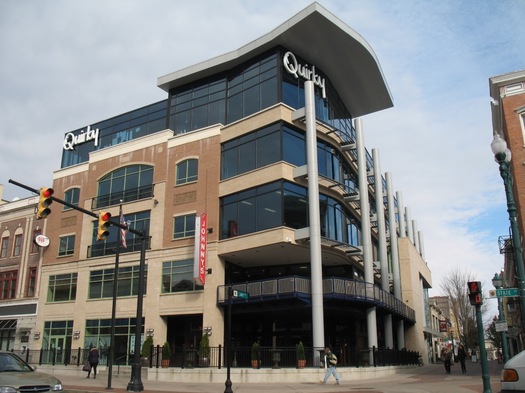
Quirky's office on State Street in Schenectady.
Updated
Quirky -- the consumer products invention company with a large office in downtown Schenectady -- announced Tuesday morning that it's filing for bankruptcy, and says it's working to "facilitate a sale of substantially all of its assets." [Quirky]
The company's office in the City Center building on State Street in downtown Schenectady has served as a customer service operation for Wink, a service for connecting "smart home" appliances (Quirky spun off Wink as it own company). So here's the key local part of the bankruptcy announcement:
With respect to assets related to the business of Wink, Inc., the Company has entered into an agreement with Flextronics International USA Inc. for the sale of certain assets at a purchase price of $15 million. The sale will be subject to higher or otherwise better offers. The Company will look to conduct an auction, if other bids are received, and will be seeking court approval to have the sale close within approximately 60 days. The bankruptcy filing does not impact the Wink experience for users nor how Wink operates day-to-day. Wink's engineers and designers will continue to enhance the Wink platform to provide new, meaningful ways for customers to interact with their smart home. The Wink HUB and Wink Relay will continue to be available at The Home Depot and Amazon. Wink's customer support team will continue to provide the same quality assistance.
Patrick Mahoney, a PR manager for Wink, said today via email that "the Schenectady team is not impacted by this process." And though the company doesn't share office-by-office numbers, he said that Wink overall has 80 employees.
David Buicko of the Galesi Group, which owns the City Center building, told the Daily Gazette today he's confident Wink will stay in Schenectady. [Daily Gazette]
When Quirky's arrival in Schenectady was announced in March 2014, it was touted as A Big Deal that would bring attention and jobs to the city. But there have been rumblings since this past spring that the company was in serious trouble. And this summer founder Ben Kaufman publicly admitted the company was essentially out of money -- he left the company shortly after that. And the word out of the Schenectady office was that things were very shaky (though the company still bought an $8,000 ice cream machine). [Business Insider] [Fortune] [NY Mag] [Daily Gazette]
Earlier on AOA: What is this Quirky in Schenectady?
Capital District Printathalon
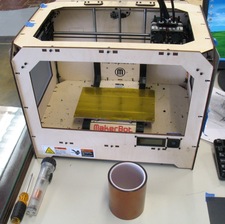 The first Capital District Printathalon is lined up for this weekend at the NanoCollege campus in Albany. Printatha-what?
The Printathalon bills itself as a "premiere 3D printing showcase." So the events are centered around the growing field, in which actual physical objects are essentially "printed" from digital plans. An example: Last year a 3D printer on the International Space Station printed a wrench based on design that had been uploaded from Earth.
The schedule for the Capital District Printathalon includes demonstrations, talks, and a "24 Hour 3D Printing Challenge" in which teams will compete. The event is free for kids 18 and under. And for adults, tickets are $10 for the whole weekend.
A look inside the Tech Valley Center of Gravity new space in the Quackenbush Building
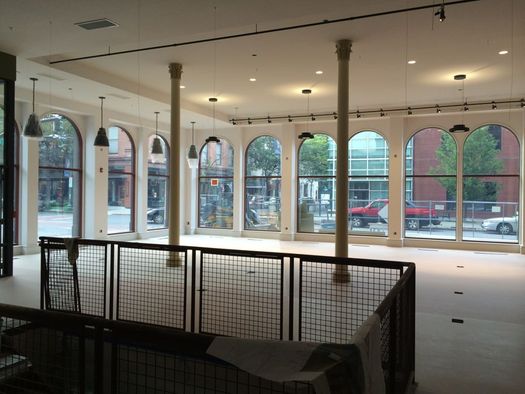
The Tech Valley Center of Gravity is set to cut the ribbon on its new space in the historic Quackenbush Building in downtown Troy today.
The move provides not just some much-needed elbow room for the maker space, but also an opportunity to fill out a larger plan that combines the community workshop with services and space for startups. And, along the way, a beautiful historic building is getting a new life.
Here are a handful of photos from the renovated space and a few other bits...
Chilling the ESP
The Empire State Plaza at 50 exhibit at the State Museum includes a handful of videos about the plaza's creation and inner workings. And it looks like many of those videos are posted online.
Here's one we thought this one was interesting -- it's about the massive chilling system for the plaza, which relies on water pumped from the Hudson River and power from the steam generation plant over in Sheridan Hollow. The system cools 10 million square feet of space at the ESP. The plant could theoretically cool about 9,000 homes, according to the video.
By the way: The water in the reflecting pools at the ESP is also from the Hudson River.
(Thanks, Rafael)
Solarize Albany

There's a boom in solar energy installations right now, including in the residential market. And all sorts of companies have popped up offering home installations -- we see reps from various companies around the Capital Region all the time. But most people have never hired a contractor for a job like this, so there's a lot to learn.
That's one of the reasons an effort called Solarize Albany is interesting (there are similar efforts in other parts of the Capital Region). It's a cooperative effort to pick a solar contractor and buy at a bulk price. Blurbage:
The Solarize Albany campaign is on an approach developed by the Department of Energy (DOE) in 2007, supported by the New York State Energy Research and Development Authority (NYSERDA), and now being adopted by hundreds of communities around the Country. This is not a commercial venture. Rather it is a cooperative venture where purchasing is done on a bulk basis to bring down costs from a commercial installer. In addition, volunteers help people to understand solar energy. Public presentations are being scheduled, where questions about solar energy are answered. At these presentations, the specifics of how to request a solar proposal for your home are shared.
The project has picked Apex Solar as this year's installer. There's a kickoff event for Solarize Albany at the The Linda July 9 at 6:30 pm.
Even if you decide Solarize Albany way isn't the right choice for you, we're guessing the event will include a lot of info about the sorts of decisions someone interesting installing home solar needs to make. (Leasing or buying is a big one.)
As mentioned, there are also the ongoing a Solarize Troy and the new Solarize Saratoga. Solarize Troy has a string of events and info sessions listed on its website. And Solarize Saratoga's official launch is July 8.
Earlier on AOA: Ask AOA: Residential rooftop solar options?
The goal: For everyone in the Capital Region to make a video game
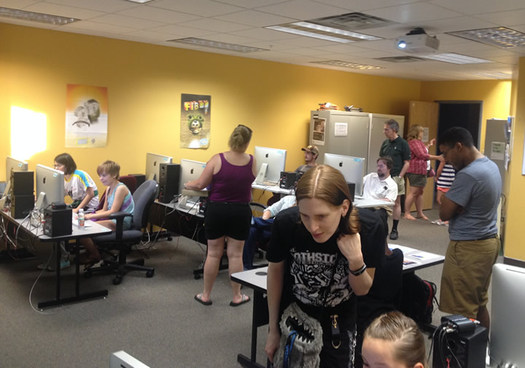
A TVGS interactive showcase earlier this year. / photo courtesy of Jamey Stevenson.
The recently-launched Tech Valley Game Space in Troy has a goal: For everyone in the Capital Region to make at least one game.
Like, every everyone? Yep, everyone.
"It doesn't take long [to learn] if people feel like they're in an atmosphere where there's someone who knows to guide them," TVGS founder Jamey Stevenson told us recently. "There are few things more fun or exciting to me to see people get surprised. It happens during the first hour of doing it."
Toward that goal, TVGS -- which also serves as co-working space for small startup games studios -- is offering a series of classes and events aimed at getting a wide range of people involved: artists, designers, programmers, women, men, kids, introverts, extroverts. One of the events is coming up this weekend at the Arts Center of the Capital Region: River Jam, a free learn-to-make-a-game event for game makers who identify as women.
Stevenson is clearly passionate both about video games, and opening up the process of making them.
Here are a few clips from a conversation with him about learning to make games, the need for diversity in the industry, games as art, and his favorite games...
Tech Valley Game Space: River Jam
 One of the projects in the recent AOA Startup Grant competition that really caught our interest was the Tech Valley Game Space, a Troy-based project aimed at opening the world of video game creation to a wider group of people.
TVGS has a public event coming up this month called River Jam, "a free, 'learn to make a game in 48 hours' event tailored for first time game makers who identify as women." Blurbage:
The first event in the #include series will be River Jam - a free, 48 hour "game jam" that will be held at The Arts Center in Troy starting on the same day as River Fest (Saturday, June 20th) and continuing throughout the weekend. The jam will also be preceded by an optional "intro to game development" workshop that will take place over the prior weekend (June 13th-14th), also at The Arts Center. While the jam is open to all participants, the primary goal for this event is to encourage first time game makers who identify as women to sign up. As such, participants that meet this criteria will be given priority in the event that spaces are limited.
In addition to making an effort to reach out to participants who identify as women, we are also seeking women to help serve as voluntary mentors and provide guidance to the jammers. If you are a local developer that would be willing to contribute some time to help provide expertise and support during River Jam, please send a message to info@techvalleygamespace.com with a brief summary of your background and availability during the weekend of the jam.
River Jam is just one of the upcoming events organized by TVGS -- others include showcases and book-club-like gathering but for video games.
The TVGS co-working studio is at 291 River St. in downtown Troy.
Cameras and unintended consequences
 One of the threads in the recent national conversation about interactions between police and communities has been a push for the adoption of body cameras for officers. The general thinking being that having a video record of encounters between officers and members of the public would help sort out what happened in cases involving allegations of police brutality.
The body camera topic has already popped up here in the Capital Region and we're guessing its prominence will grow during the next few months. The Saratoga Springs Police Department already has body cameras. And police leaders in both Albany and Troy have expressed interest in acquiring the tech. [Daily Gazette] [TWCN] [CBS6]
So, with that in mind, here's some thought-provoking reading: It's a review of what researchers know, and don't know, about the use of body cams by police so far, published by the think tank Data & Society.
There's a lot in there so you might want to get started with a shorter piece two of the review authors, danah boyd and Alex Rosenblat, wrote for The Atlantic titled "It's Not Too Late to Get Body Cameras Right." A clip:
The temptation of technology as an accountability tool is not new, but accountability is not done by technology. Accountability is achieved by people and systems using tools like technology as part of their bureaucratic processes. There is effectively a global consensus that body cameras are a good thing to have because everyone has a different idea of what they're agreeing to, a different model of appropriate bureaucracy. The bureaucratic and political battles over policies of use, access, and retention are not yet resolved, and they are significant. Who gets to see the footage, and in what circumstances, will matter. The features and capabilities of the technology matter. What happens when the camera reveals more about what was in the officer's scope than what they could physically see at the time, especially at night? Or when cameras get additional features, like heat sensors? Even on basic practical questions, such as whether and when officers or the public should see the footage, there is no consensus.
Boiled down (probably too far), the review is a call to think hard about unintended consequences and to be skeptical about placing all the emphasis on technology as a solution.
Tech Valley Civic App Challenge winners
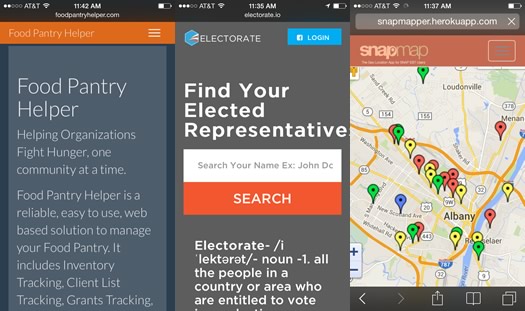
Screenshots from the entries that took that top 3 spots in the contest.
Announced today: The winners of the AT&T Tech Valley Civic App Challenge, which this past March called for entries with "potential to benefit the local community." The contest included $18,000 in prize money.
The grand prize winner: Food Pantry Helper, which was created by Russell Kirkwood of Stillwater, and aims to help food pantries manage their operations more efficiently.
Here's a bit more about that app, along with the other winners...
The future is mobile

Don't squint -- there's a larger version after the jump.
A Siena poll out this week had some interesting bits about mobile phone and other communications tech usage.
Among those bits: 28 percent of upstate respondents to the poll reported having only a mobile phone -- no landline. That was the highest mobile-only percentage for any region in the poll.
Here are a few things that caught our eye, in quick chart form...
Tech Valley Civic App Challenge
 Game on: A coalition of local groups has launched the Tech Valley Civic App Challenge, which will be awarding $18,000 in prize money for community-focused mobile apps built on open data. Blurbage:
The goal of the challenge is to encourage local developers to build and deliver apps and services that serve community needs, connect and engage citizens with their governments and demonstrate how mobile technologies can lead to the next generation of tech jobs and investment. The challenge kicks off March 4th and concludes May 1st. ...
Apps submitted to the challenge will be judged on potential impact on the Tech Valley (40 percent), execution (40 percent) and creativity/novelty (20 percent). To make the challenge truly Tech Valley-centric, teams submitting mobile apps must include at least one member that is either a current resident of the 19 counties (Albany, Clinton, Columbia, Dutchess, Essex, Franklin, Fulton, Greene, Hamilton, Herkimer, Montgomery, Orange, Rensselaer, Saratoga, Schenectady, Schoharie, Ulster, Warren, and Washington) that make up the region or attends one of the region's institutions of higher education. A panel of judges made up of local tech experts, elected officials and community stakeholders will review apps pre-screened by Hack Upstate to determine to what extent each satisfies the submission criteria. Judges will rank finalists and assign prizes. All potential intellectual property belongs to the product teams or individual.
The first place prize is $10k, $5k for second place, $2k for third, and two $500 honorable mentions. The submission deadline is May 1. An awards announcement is tentatively scheduled for May 14 at UAlbany.
The competition is sponsored by AT&T and a wide range of local tech and institutional partners: the University at Albany, Rensselaer Polytechnic Institute, TechConnex (an affiliate for Center for Economic Growth), Tech Valley Center of Gravity, Saratoga TechOUT, Hudson Valley Tech Meetup, New York BizLab, Beahive, Tech Valley Mobile Developers Network, Accelerate518, and Hack Upstate.
These sorts of civic app competitions have popped up in a bunch of places over the last few years. One of the most notable has been the the NYC Big Apps competition -- its winners last year include a system for detecting residential heating violations, a web app for parks info, and a job site.
Authenpic

Nostalgia in app form: A team with local connections has created an app that recreates the experience of using a disposable camera. You can use Authenpic to take a "roll" of 24 photos that you can't see until they're delivered on actual prints after the roll's finished -- no reviewing, no editing, no filters.
The team behind the app includes Albany resident Mari Johannessen, her sister Linda Johannessen, and local designer/entrepreneur Jacques Bastien.
So, why build an app with these built-in limitations?
A push for more, and faster, broadband internet access in New York
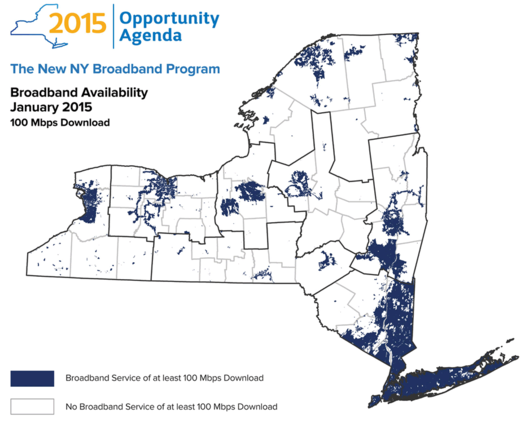
This map depicts parts of the state (in blue) that have access to 100 mbps broadband internet access, according to the Cuomo admin. Here's a larger version, along with county-by-county figures. / map: Cuomo admin
One million people in New York State currently can't get broadband internet access, and 7 million -- including roughly 70 percent of upstate -- can't get access that would be considered very-fast* high speed access.
So reports the Cuomo admin Friday as part of its pitch for a plan to put $500 million of the bank settlement money toward extending broadband internet access to every part of the state by 2019.
The plan aims to use the money as matching grants to private providers to expand access. And one of the conditions of the funding would be that (in most cases) the internet access would have to be at speeds of at least 100 mbps. (For comparison, the "standard" TWC internet connection includes speeds up to 15 mbps.)
The Capital Region lit up by Twitter
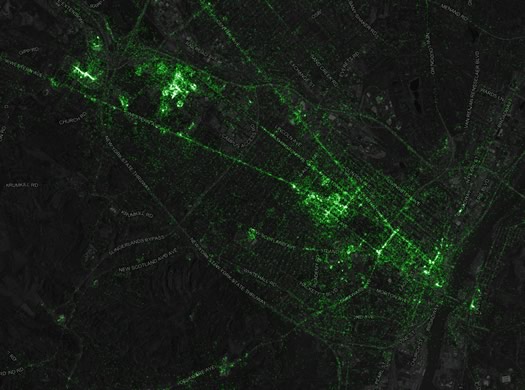
Check out this map of the Capital Region (and the wider world) depicting geotagged tweets for the last 3.5 years. (That's a screengrab above.)
The map is the creation of Eric Fischer, a developer at the mapping company Mapbox. Here's how it was created using some 6.3 billion geotagged tweets.
The patterns here in the Capital Region aren't super surprising -- there are big clusters of tweets pretty much wherever people gather. But a few quick things that caught our eye:
+ Areas with large college students populations registered high concentrations of tweets -- not just campuses, but also neighborhoods like the midtown section of Albany.
+ Transportation nodes and corridors -- such as the Albany-Rensselaer train station, Albany bus station, and interstates -- stand out. (Again, this makes sense -- people are concentrated on transportation corridors. Also, um, maybe there's some tweeting while driving.)
+ Other high density spots: entertainment venues (like the TU Center), hospitals, shopping centers.
(Thanks, Katy!)
Map: Foreclosed properties for sale in Troy
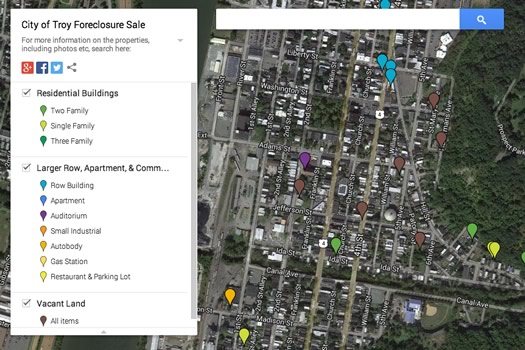
A screengrab of the map.
The city of Troy currently has more than 140 foreclosed properties up for potential sale. The city is accepting sealed bids on the properties -- many of which are vacant land -- between now and December 19.
Here's the list of properties as a pdf. But here's a better way to browse them: a clickable map of the properties along with some of their associated information. (We've also embedded the map after the jump.)
The map is the creation of Anasha Cummings, who was prompted to make it because, as he said to us in an email, "I don't think a PDF on a website is a good way to browse for properties you might want to buy."
Cummings says he's currently in the process of filling in some of the holes in the list (some properties don't have exact addresses) and matching up the properties with more information about them from the city's real property database (important info like square footage, even a photo).
This situation highlights an issue that's frustrated us for a long time: local municipalities often post information/data in ways that make it hard to find or use.
How the Albany metro area accesses the internet
Common.
Roughly 3/4 of households in the Albany metro area have a broadband internet subscription. But almost 20 percent of households don't have any internet access at all.
Those are a few bits from a recent Census Bureau release of data about internet access around the country. Last year was the first time the Census collected this sort of information. So we thought we'd have a look.
A new website for New York State
A screengrab from the site.
The state unveiled its new website today. And it's... a lot better.
State officials say the state's main website hadn't undergone a major design overhaul since 1999 and it showed. The new website is very much in the modern, text-over-shaded-large-images style. It's "responsive" -- which is to say the design adjusts to the type of device upon which it's being viewed. And it includes some helpful new features.
The site bears some resemblance in both form and function to that of New York City. And that makes a lot of sense. The Cuomo admin hired Rachel Haot as the state's chief digital officer at the end of last year -- she had been in the same job with New York City, and had overseen a re-design of the city's site last year. Over at Medium, Haot highlighted some features of the new site.
The new site announcement mentions that the new "redesign elements, functionality and content management system will be extended to all interested State agencies beginning in 2015." That could be a good thing. And we're curious if the state could eventually makes some of this stuff available to local governments, too. (Because local government websites tend to be really, really bad.)
A few quick things we like about the site and things we wish were better...
NANOvember 2014
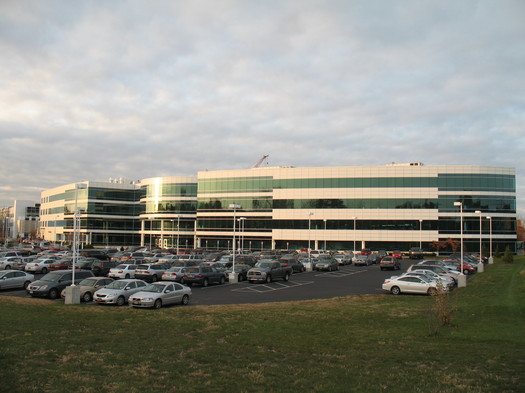
The entity now known as the Colleges of Nanoscale Science and Engineering (CNSE) at SUNY Polytechnic Institute (SUNY Poly) is taking over the month of November again and dubbing it NANOvember.
The series of events starts with the annual Community Day this Saturday, November 1, from 11 am-3 pm. It's free. Blurbage:
In addition to getting an up-close look at CNSE's ever-expanding 1.3 million-square-foot megaplex, both adults and children will have the opportunity to interact with CNSE students, faculty and staff, and to participate in a variety of activities that promote a greater understanding of nanotechnology, including:
+ Tours of the cutting-edge cleanroom facilities
+ Hands-on experiments
+ Cleanroom gowning demonstrations
+ A Kid's Corner featuring several kid-friendly activities relating to nanotechnology
+ Sustainable Energy Activities
+ Nanotechnology overview presentations
+ Displays and hands-on activities showcasing research in CNSE's constellations, including health care, energy, electronics and economics
+ Presentations on CNSE's undergraduate program
Among the other NANOvember events: A public Q&A with Alain Kaloyeros at the Albany NanoTech complex on November 17 "bout the growth of the nanotechnology industry across New York State, its impact on the Capital Region, pertinent educational and economic opportunities, as well as any other topics of relevance."
By the way: As we understand it, there is no truth to the rumor the CNSE/SUNY Poly/Nano Empire will be acquiring other months beyond November and incorporating their date-based distinctiveness into its globally recognized high tech temporal ecosystem.
CDTA now offering realtime bus info
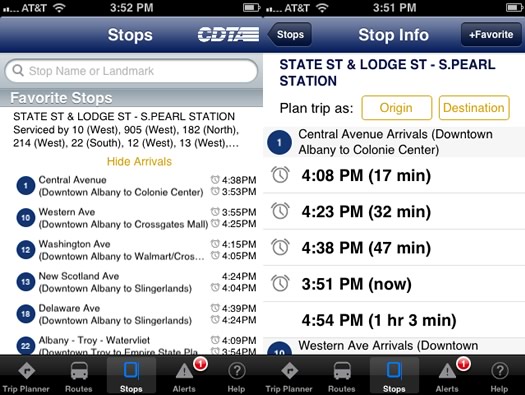
From the iRide app.
CDTA officially announced today that it's now offering realtime info for regular route bus arrivals.* The functionality has previously only been available on BusPlus. Blurbage:
Customers will be able to access real time transit information for CDTA fixed route services through the free CDTA iride mobile application for Apple and Android devices, through Google Maps' mobile apps and maps.google.com, through the trip planner on its website (www.cdta.org) or by speaking with a customer service representative at CDTA's Call Center. Customers will now see a gray clock icon near a route that indicates real time information is available. Real time is currently not available on Northway Xpress service. ...
CDTA tracks its vehicles using GPS devices to report bus location data back to its servers. This information allows CDTA to estimate when the buses will arrive at a stop. If a bus goes off its regular route, the system may not be able to fully predict accurate arrival times.
Here are screenshots of the realtime info display on both Google Maps and the CDTA website.
As long as the realtime info is accurate, the function is a nice addition. In our experience, some CDTA routes and stops tend to have reliable arrival times -- and others less so. (Yep, we're looking at you #10. We know it's not totally your fault what with all the traffic lights and riders. But you've interpreted the concept of a "schedule" very loosely.)
By the way: If you ride the bus, even just occasionally, and you have a smartphone -- definitely get the iRide app if you don't have it already.
* This function has been at least partially active for at least a few days. Thanks to the person who pointed this out to us last week.
CDTA was a sponsor of the Rail, River, Hudson tour.
Albany Common Council passes red light camera ordinance: comments, votes, thoughts
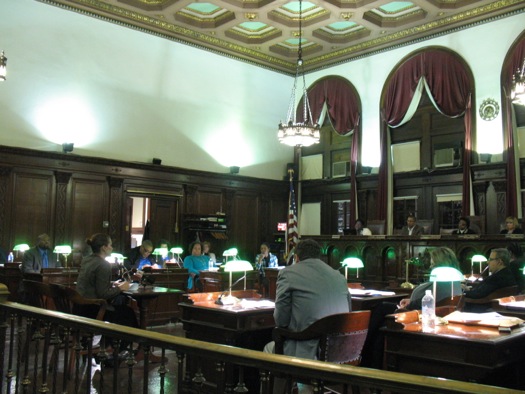
State Assemblywoman Pat Fahy speaks during the public comment period ahead of Monday's night vote on red light cameras.
The Albany Common Council passed the ordinance for a red light camera demonstration project in the city Monday night. The ordinance passed 11-4 after some impassioned comments from council members.
Pending a signature on the bill from mayor Kathy Sheehan, who supports the measure, Albany will be on its way to becoming the first municipality in the Capital Region to get the automatic cameras.
Comments, the votes, the ordinance, and a few thoughts...
Ecovative GIY
 Ecovative -- the Green Island company growing polystyrene-replacement products from mushrooms -- says it will soon be offering the material for people to grow their own structures. Blurbage:
The "Grow It Yourself" (GIY) product enables designers, artists, educators, and innovators to grow their own creations with Mushroom® Materials, just like we do at Ecovative. We hope to inspire the use of healthy, ultra-rapidly renewable, compostable materials in all kinds of products and projects.
The GIY kit includes bags of living Mushroom® Material, which is essentially the same raw material that we use to grow Mushroom® Packaging and other products. GIY growers can use this material to make their own new and exciting creations. In cases where a GIY customer has created a new product that needs to be produced at scale, Ecovative can help. Our production facility in Green Island, NY can replicate designs with a high degree of consistency and quality control.
Ecovative says the first batches of material will be distributed in early September -- there's a sign-up form at that link above. The kits will be $19.99 + shipping.
The Hy-Fi tower
Ecovative's material has been getting (even more) attention lately because of structure that recently opened at MoMA's satellite location in Long Island City. The Hy-Fi tower was designed by David Benjamin, from architecture firm The Living, and makes use of 10,000 bricks grown from Ecovative's product. Benjamin created a prototype of the bricks himself with a few bags mushroom material he got at Ecovative during a visit to the company. Here's a recent interview with Benjamin about the tower and Ecovative on WNYC.
Earlier on AOA: Ecovative in the New Yorker
photo: Ecovative
Annmarie Lanesey, RebateHero
A screengrab from RebateHero.com.
In the grand scheme of things, the internet hasn't been around for a very long time. Yet sometimes it seems like there's already a website or app for pretty much whatever you want. So when you hit on something you can't find, well, it makes you wonder.
That's what happened to Annmarie Lanesey, the co-founder and president of Troy-based internet consulting firm GreaneTree Technology, when she started to investigate rebates. She was surprised that when she went looking in 2010 it looked like there wasn't an online solution for finding and organizing rebates. "It seemed as if we had found one of the last corners of the internet that remained untouched."
Three years later, Lanesey has launched RebateHero.com, which aims to bring the old-school rebate process into the 21st century.
Three things about the latest big announcement about a new tech something
GE CEO Jeffery Immelt, Andrew Cuomo, Alain Kaloyeros, and a large portion of the Capital Region's state and local reps were at the GE Global Research Center in Niskayuna today for the announcement of a new $500 million consortium that's being touted as both a key part of the next era in electronics and a future generator of thousands of jobs (including "at least 500" in the Capital Region).
The New York Power Electronics Manufacturing Consortium will be anchored by GE and the College of Nanoscale Science and Engineering, and will be backed in part by $135 million in funding from New York State. The consortium will focus on what Kaloyeros called the "next generation of semiconductors," with applications across many different industries.
Here are three things about this announcement -- involving the technology, New York State, and the NanoCollege...
Residential rooftop solar options?
Mary messages:
I am thinking of going solar on my home... do you have any information on which company, or companies, offer the best deals and have proven most reliable in the Albany area?
We're very curious to hear people's thoughts and suggestions on this question. The rooftop solar industry has been booming recently thanks in large part to a steep drop in the price solar panels. And just anecdotally, we've noticed panels showing up on a bunch of local houses and businesses.
There seem to be roughly two models for getting panels on a house: buy the panels outright and have the installed -- or pay little or nothing upfront for installation, and then buy the power from the panels at a fixed rate from the installing company.
So, experiences or thoughts for Mary? Please share!
Gawking at the Quackenbush Building, the next home of the Tech Valley Center of Gravity

The Tech Valley Center of Gravity -- the makerspace/startup space -- officially cut the ribbon on its plans to renovate the historic (and enormous) Quackenbush Building in downtown Troy.
So of course we had to stop by for a look.
GameFest 2014
 The annual GameFest at RPI -- a series of events focused on video games -- returns this weekend. And the showcase of student-designed games is open to the public. Blurbage:
The games Rensselaer students will showcase this year are widely varied and include Kajo, a game in which players run and jump their way through a mystical, floating city and use concepts of physics to improve their parkour-style moves. Another game, Space Luddites, features a group of characters fighting back against an oppressive, dystopian future and a powerful company that controls all technology.
The showcase is at EMPAC from noon-3 pm on Saturday. It's free.
openAlbany
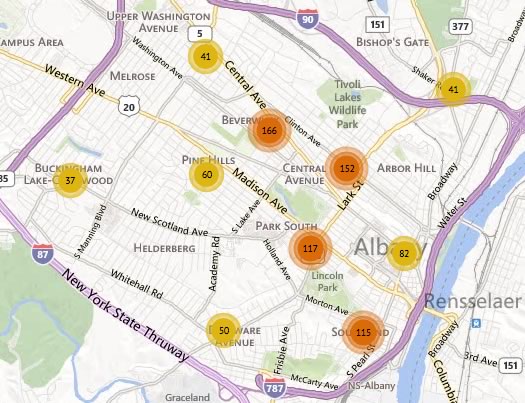
A screengrab from a crime map at openAlbany.
The city of Albany unveiled a new website today -- called openAlbany -- for sharing municipality data with the public -- stuff like crime reports, parking tickets, and city employee salaries.
Said mayor Kathy Sheehan today at a press conference about the reasons for putting together the site: "The first is that we spend a great deal of time responding to information and FOIA requests, so now we can just steer the community to Open Albany and it will be there. Also we know there are a lot of people -- who are a lot more tech savvy than me -- that know how to use this date to make maps and organize it in a way that will be helpful."
We've been banging the drum (softly) for something like this for years. And we gotta say, after poking around openAlbany today, it appears to be an encouraging start.
A few that caught our eye on the first pass...
PechaKucha in Troy: "The Tao of Tech"
 The recently started local PechaKucha series returns this Thursday, April 10 at the Tech Valley Center of Gravity in downtown Troy. This time around the theme is "The Tao of Tech."
PechaKucha is a rapid presentation method in which a speaker gives a talk using 20 slides that are displayed for 20 seconds each. The format forces people to just get right to the point. The idea is to keep things fun -- and moving. First started in 2003, there are now Pecha Kucha nights all over the world. The local series kicked off at the Opalka Gallery this past February.
From an organizer about what's in store from some of the presenters at this next Troy event:
It's a sort of left-brain, right-brain convergence. Erin Lennox has done her eco-engineering field work in the Yucatan. Bob Bownes has a backyard and basement that looks like a mad scientist's dream - everything from ham radio to race cars. Jorel Lalicki is a senior at RPI who recently took over a warehouse in South Troy to build his own manufacturing business -- and I have yet to discover ANY engineering trade he doesn't know -- from advanced lighting to hacking to glass-blowing and piano-tuning. Scott Knox comes at architecture from inside the brain: enough said. Erica Iannotti has a vision and a loaded bag of tricks for revolutionizing STEM education and a turning girls on to science. And Alex Briggs? He will restructure your lifestyle, reorganize your city, and save your planet if you give him half a chance.
There are a bunch of interesting people in the Capital Region doing interesting things. It's just that sometimes you have to know where to look. These sorts of events can be a good place to start.
Doors open for the PechaKucha event at TVCOG at 7 pm Thursday, presentations start at 7:30 pm. Admission is free. There will be drinks from Brown's, and snacks from Muddaddy Flats.
Speaking of the Center of Gravity: Things seem to be coming along on the makerspace's move from the Uncle Sam Parking Garage street level retail space to the nearby Quackenbush Building.
Earlier on AOA:
+ TVCOG awarded regional economic development money for Quackenbush Building
+ A TARDIS in Troy
+ Tech Valley Center of Gravity
Why can't you buy a car directly from a car company?
 The electric car company Tesla has worked out a deal with New York State to allow it continue selling its cars directly to consumers. The deal, which will involve state legislation, will allow the company to continue operating its five sales locations in the state (all downstate). [Cuomo admin]
Auto dealers across the country have been fighting to keep Tesla from direct sales because it upends the longstanding "dealer franchise" system. Tesla recently won a similar deal in Ohio as the one in New York. But it has also been banned from doing so in a handful of states. [The Verge x2]
So, why are car sales set up the way they are? Why can't you just buy a Civic off the internet from Honda? Why are you required to buy via an intermediary?
The guy who invented the web will be at RPI
 Tim Berners-Lee -- who actually has that line in his CV -- will be getting an honorary degree at RPI's commencement in May. Geneticist Mary-Claire King -- who identified the BRCA1 gene -- will also be getting an honorary degree. And IBM CEO Virginia Rometty will be giving the commencement address.
All three will be participating in a discussion led by Shirley Jackson -- "Creating Clarity in Complexity to Enable Transformational Change" -- on May 23.
Berners-Lee created the underlying protocols for the web in 1989 while working at CERN, the particle physics lab, in Switzerland. The idea behind it was to make it easier for scientists and researchers at different institutions to share information (though cat pictures were probably a close second reason). CERN had the first website.
As it happens, the actual room -- you know, the physical space -- where the web was invented is actually in France, just over the border. (There's a plaque there now.)
What is this Quirky in Schenectady?

Quirky founder Ben Kaufman, in a company video: "At Quirky we have one simple goal, to make invention accessible. Now, that doesn't happen overnight. But that's not to say it doesn't happen really f------ fast."
The invention/product company Quirky announced today that it will be opening an office in downtown Schenectady. The news has created a bit of a stir not only because the company is promising 180 jobs, but also because Quirky and its founder -- Ben Kaufman -- have been getting attention and hype in national media over the last few years.
So, what's the deal with the Quirky? Here's a quick backgrounder...
Important question: Will we be able to put magnets on our future magnetic refrigerators?
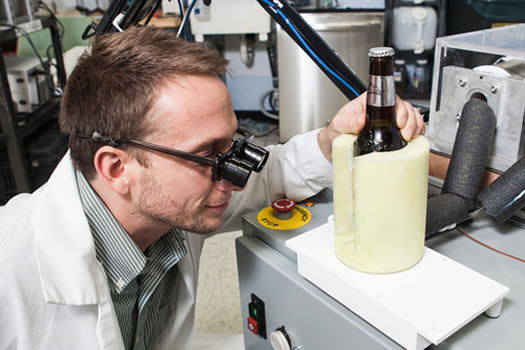
Why develop a new type of refrigerator if not to chill beer?
If ever you wondered what the scientists at the GE Global Research Center in Niskayuna do, here's one answer (of many): develop an entirely new type of refrigerator.
Researchers at the GRC in Niskayuna, along with other research sites around the world, have been working to develop refrigeration technology that uses magnets for cooling. GE recently announced that its researchers believe the tech could be in consumer fridges in about a decade. The company says the technology is about 20 percent more efficient than the sort of technology currently in your fridge at home -- tech that's about a century old. (And it doesn't use some of the substances that make recycling refrigerators difficult.)
A post on GE's Edison's Desk research blog by Frank Johnson, one of the scientists in Niskayuna, explains some of the science behind the technology:
In a conventional refrigerator, a compressor is used to compress and heat refrigerant gas and deliver it to a condenser where it cools off by dumping heat to ambient air. When the refrigerant has given up enough heat it becomes a liquid. It then flows through a tight passage called an expander or capillary tube and drops in pressure and turns into cold liquid at a lower pressure. After exiting the expander it is in an evaporator, really cold, and ready to accept heat from the space it is in, the freezer. When it accepts enough heat it is boiled into gas and is then ready to enter the compressor again. This cycle continues as long as the compressor runs. The magnetocaloric effect is similar except that it occurs entirely in the solid state. The magnetism "evaporates" when heated above a certain temperatures and "condenses" back upon cooling. A magnetic field can be used to drive this reaction and "pump" heat from low to high temperatures, providing the cooling effect.
The magnetocaloric effect has been known for more than a century, but finding a way to apply it in a practical way to a refrigerator has taken years of off-and-on research and the development of new materials. Johnson's blog post covers a lot of that history, and the story illustrates how advances are so often the result decades of work by many people and institutions, often on basic research.
If you're curious, GE scientists talked about the tech this week in a Google hangout.
GE says its researchers are currently working on a magnetic refrigerator that can drop the temperature by 100 degrees. And they see the tech as potential replacement all sorts of cooling devices, including air conditioners.
photo: GE Reports
"Game of Drones" at Albany Law
 Could be interesting: "Game of Drones," an event at Albany Law March 20 focused on discussing the "uses and potential abuses" of drones in this country and abroad. Blurbage:
Presented by the Albany Government Law Review, Game of Drones will bring law professors, practicing attorneys and other experts together to discuss such topics as the use of drones for targeted killing, domestic drone use, and drone journalism.
Nicholas Rostow, Distinguished Research Professor at the National Defense University, will deliver a keynote address on the use of drones within the context of the laws of war, as well as the President's constitutional authorities.
The Albany Law event is from 1-5 pm on March 20 (a Thrusday), and includes two panel discussions and the keynote. (Speaker list at the link.) It's free and open to the public.
Drones have gotten a lot of attention over the last few years because of how the US has used them in places such as Afghanistan. But the use of unmanned aerial vehicles in this country will also probably be a not-small topic of conversation eventually, as local police agencies, media orgs, and regular citizens make use of them.
There was an interesting Verge article last year about how regulation of drones is lagging behind their current and potential uses. And last year there was a bill introduced in the New York State legislature that would have limited how drones could be used.
When you think "drones," you might first think of surveillance and security state type stuff (and not without reason). But there are a lot of potential uses for the devices. We met a pro photographer last year who had mentioned he hoped to use them for commercial aerial photography -- it's just that the rules weren't clear about what was allowed.
ALS advertises on AOA.
photo: Flickr user Don McCullough (cc)
Growing a building, brick by brick

Like spreading mycelia, Ecovative's presence branches out: The Green Island-based company's "grown" building material will be used to make bricks, and those bricks will be used this summer for structures at MoMA's PS 1 facility in Queens. It's a collaboration with the architecture firm The Living.
From a MoMA press release:
The winning project, Hy-Fi, opens at MoMA PS1 in Long Island City in late June. Using biological technologies combined with cutting-edge computation and engineering to create new building materials, The Living will use a new method of bio-design, resulting in a structure that is 100% organic material. The structure temporarily diverts the natural carbon cycle to produce a building that grows out of nothing but earth and returns to nothing but earth--with almost no waste, no energy needs, and no carbon emissions. This approach offers a new vision for society's approach to physical objects and the built environment. ...
Hy-Fi is a circular tower of organic and reflective bricks, which were designed to combine the unique properties of two new materials. The organic bricks are produced through an innovative combination of corn stalks (that otherwise have no value) and specially-developed living root structures, a process that was invented by Ecovative, an innovative company that The Living is collaborating with. The reflective bricks are produced through the custom-forming of a new daylighting mirror film invented by 3M. The reflective bricks are used as growing trays for the organic bricks, and then they are incorporated into the final construction before being shipped back to 3M for use in further research. The organic bricks are arranged at the bottom of the structure and the reflective bricks are arranged at the top to bounce light down on the towers and the ground. The structure inverts the logic of load-bearing brick construction and creates a gravity-defying effect--instead of being thick and dense at the bottom, it is thin and porous at the bottom. The structure is calibrated to create a cool micro-climate in the summer by drawing in cool air at the bottom and pushing out hot air at the top. The structure creates mesmerizing light effects on its interior walls through reflected caustic patterns.
That's a pic on the planned structure above. The whole thing sounds very Ecovative.
[via Gizmodo]
(Thanks, AddiesDad!)
rendering: The Living
Beijing in North Greenbush
This caught our eye the other day -- and it struck us both as potentially very cool, and very RPI.
The school is working to re-establish its Mandarin language minor, which makes a lot of sense. Being able to speak Mandarin is a very useful skill for all sorts of careers. And, you know, there are only about a billion people in the world who speak it.
So, how to go about that? Hire some faculty, start some classes, maybe an exchange program. Sure. But RPI is also building a virtual reality environment to mimic Beijing so that students can practice Mandarin in context.
From a write up of the Mandarin Project by Emily Donohue on RPI's Approach blog:
In late November, the first class of students taking Chinese at Rensselaer since efforts began to re-establish the Chinese language minor, stepped into the Mandarin Project's hangar-like space in the [Emergent Reality Lab] for a test-drive.
They took seats at café tables surrounded on three sides by massive screens projecting the image of a Beijing teahouse. Facing the students at the front of the room was a woman - a virtual woman - who would serve as their teacher.
The students donned 3-D glasses, the same kind you'd find at a movie theater, and one student was designated the guide and controlled the experience by wearing a hat studded with ping pong-like balls and holding a video game controller.
The lights dimmed and the students traveled to Beijing.
As Sheldon and Chang looked on, with what seemed like equal parts anxiety and excitement, the students were led through a series of questions by the virtual instructor. She taught them about traditional Chinese tea ceremonies and they had to use their knowledge of Chinese - still fledgling at this early stage of their studies - to interpret her questions and select the correct answer. By doing so, they moved on to the next part of the lesson.
That Approach link has a bunch of photos and more details. And the video embedded above is from the virtual reality session.
The Albany Institute, Googled
A screengrab from the Albany Institute's collection on Google Art Project.
Check it out: The Albany Institute of History and Art has been added to Google's Art Project, an online gallery of works from museums around the world.
The Google project, started in 2011, now includes 53 works from the institute, ranging from old images of Albany to the Hudson River School paintings to photos of objects. The interface for browsing the images is nice -- and the works are available is very high resolution. An example: check out this panorama of the Albany waterfront from around the beginning of the 20th century. You can zoom in to see details very clearly.
Google Art Project currently has collections from 314 museums posted online. Of that group, 92 museums are also available in "museum view" -- it's like StreetView, but inside the museum. Example: The Art Institute of Chicago.
The Albany Institute will eventually be joining that group -- the Google camera was there today.
It's good to know that when Google's army of robots eventually over the world, the art might be saved.
Earlier on AOA: Virtually browsing the Albany Institute's collections
The Albany Institute advertises on AOA.
screengrab from Google Art Project
A new way of producing maple syrup: "like a sugar-filled straw stuck in the ground"
 Interesting: Researchers at the University of Vermont's Proctor Maple Research Center -- Tim Perkins and Abby van den Berg -- have stumbled across a new, and potentially "revolutionary," way of harvesting sap for maple syrup. From a November 2013 UVM news article by Joshua E. Brown:
Their new technique uses tightly spaced plantations of chest-high sugar-maple saplings. These could be single stems with a portion -- or all -- of the crown removed. Or they could be multiple-stemmed maples, where one stem per tree can be cut each year. Either way, the cut stem is covered with a sealed plastic bag. Under the bag, the sap flows out of the stump under vacuum pressure and into a tube. Voilà , huge quantities of sap.
In short, these plantations can allow maple syrup production in a farm field.
Typically, a traditional sugarbush produces about 40 gallons of maple syrup per acre of forest by tapping, perhaps, 80 mature trees. With this new method, the UVM researchers estimate that producers could get more than 400 gallons of syrup per acre drawing from about 6,000 saplings. ...
"We got to the point where we should have exhausted any water that was in the tree, but the moisture didn't drop," says Perkins. "The only explanation was that we were pulling water out of the ground, right up through and out the stem." In other words, the cut tree works like a sugar-filled straw stuck in the ground. To get the maple sugar stored in the trunk, just apply suction.
Over at Modern Farmer this week, Laura Sorkin -- a maple producer in northern Vermont -- reflects on some of the possible implications of this new method, which could eventually offer cheaper production and protection against the effects of climate change and the Asian Longhorn Beetle. But also:
[T]he news of the plantation system has been a lot to chew on since we learned of it. We are relatively new to the trade but have come to love it, one of the principal reasons being our interaction with the thousand acres of forest behind our home. Like Dave Folino, I fear that the industry will no longer be special to New England but will be usurped by entrepreneurs anywhere with the right climate. And on a more visceral level, I feel that maple syrup is and should remain a product of the wild. Aside from mushrooms and game meat, the woods of Vermont hardly yield anything edible. And yet, this exquisite sugar can be extracted from the trees while still leaving them healthy and the forest a home to everything from rare wildflowers to bob cats. For me, knowing its origins elicits an amount of pleasure equal to tasting its unique flavor when I drizzle it over morning pancakes. Finally, I ponder what will happen to the acres of working forests if landowners are no longer making an income from them through tapping the trees. It would be unrealistic to expect all of those landowners to choose conservation.
Vermont is the country's leading producer of maple syrup -- it produced 1.32 million gallons of syrup in 2013. The #2 state? New York, at 574,000 gallons last year. [USDA]
photo: Sally McCay / UVM
[via Kottke]
Reuters: GlobalFoundries planning to invest as much as $10 billion more at Malta site
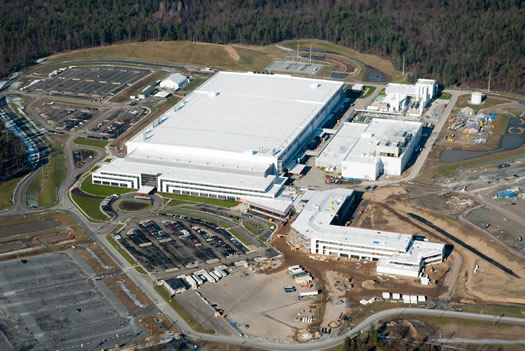
The fab in Luther Forest in Malta.
So, there's planning to spend some money, and there's planning to spend some money. This is the latter: The head of the holding company that owns GlobalFoundries tells Reuters it has received a commitment from its Abu Dhabi state investment fund backers to spend $9-10 billion on expanding capacity at GloFo's facility in Malta.
From the article:
The New York factory, which started operations in 2012, has the capacity to produce 300mm wafers at around 60,000 a month. The wafers are used to create integrated circuits, which are at the heart of all electronic devices.
ATIC wants to expand the factory to produce 20 and 14 nanometer nodes, which will be growth areas in the next three to four years, Ajami said.
Utilizing smaller nodes, crucial parts of computer chips, is a vital part of making electronic devices smaller, such as thinner mobile phones.
Growth rates in the semiconductor industry, which has been hit by falling demand for personal computers as people switch to mobile devices such as tablets, are around the high single- digits, Ajami said.
The Biz Review's Adam Sichko puts the news in some perspective -- the new money would basically double GloFo's investment at the Malta site to date -- and highlights what's still not known -- mainly, whether this means a second fab is on the way. The company has gone through the necessary local approvals for a second fab, but it's yet to publicly commit to building one.
[via @AlbBizHaley]
photo: GlobalFoundries
"Art, Craft, and Technology"
 Could be interesting: Leah Buechley -- creator of "sewable electronic pieces designed to help you build soft interactive textiles" -- will be at Skidmore Thursday for a talk titled "Art, Craft, and Technology." (She's a Skidmore alum.) Event blurbage:
Now a designer, engineer, artist, and educator, Buechley has explored intersections and juxtapositions of "high" and "low" technologies, new and ancient materials, and masculine and feminine-making traditions. She is a past director of the High-Low Teach research group at the MIT Media Lab, where the work focused on engaging diverse groups of people in developing their own technologies. Although still affiliated with the lab she now works independently at the intersection of art and technology.
The "interactive textiles" product that Buechley created is the LilyPad. From its description:
LilyPad is a set of sewable electronic pieces designed to help you build soft interactive textiles. A set of sewable electronic modules-including a small programmable computer called a LilyPad Arduino-can be stitched together with conductive thread to create interactive garments and accessories. LilyPad can sense information about the environment using inputs like light and temperature sensors and can act on the environment with outputs like LED lights, vibrator motors, and speakers.
Here's a TED talk she did in 2011.
Buechley's talk is at 5:30 pm Thursday (November 21) in the Gannett Auditorium at Palamountain Hall. It's free and open to the public.
Earlier on AOA: Tech Valley Center of Gravity
photo via Leah Buechley's website
NANOvember 2013
October is ending and that means it's time to turn the calendar page to, um, NANOvember.
The SUNY College of Nanoscale Science and Engineering has once again lined up a month of events focused on highlighting nanotechnology and what's going at the NanoCollege. The events start this Saturday (November 2) with the annual community day. Blurbage:
CNSE Community Day is a chance for people of all ages from the Capital Region and beyond to receive an up-close look at the exciting world of nanotechnology. Attendees will experience hands-on activities, engaging demonstrations, timely presentations, and guided tours of CNSE's unrivaled Albany NanoTech Complex. Attendees will see firsthand how CNSE and New York State have emerged as the epicenter for the nanotechnology-driven society of the 21st century!
Here's the full list of NANOvember events, many of which are free and open to the public. We've plucked a few that caught our eye -- they're after the jump.
Checking out the Troy crime map
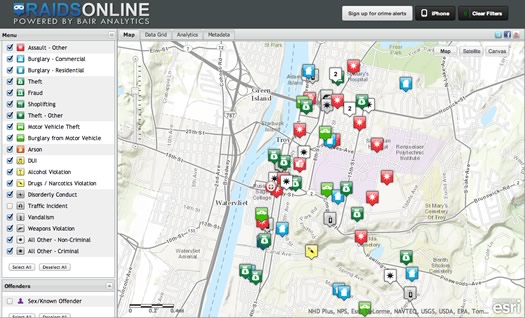
A screengrab from this afternoon.
The Troy Police Department unveiled a new online crime map for the public today. From the press release:
With the exception of crimes related to domestic incidents and sexual assaults, all reported crime in our city will be mapped with a built in 72 hour posting delay. The delay is designed to give Investigators a "first look" at an incident and apply any limitations they see fit specifically relevant to their investigation. Once mapped, the information remains embedded in the mapping, subject to numerous choices the user can make; eg. date range, type of crime, etc. Previously noted exceptions to the mapping will always be subject to inclusion should a public safety need to post the incident be evident.
This is a good step, as we've said a bunch of times before, it'd be great to see other local municipalities head in this direction.
A few more quick thoughts:
Virtually on display at Art Omi
 This could be kind of interesting: Art Omi in Ghent is hosting augmented reality tours of its Fields sculpture park. From the blurbage for Augmented Reality: Peeling Layers of Space Out of Thin Air:
This 40 minute tour allows viewers to enter a virtual world and see pieces created by 8 architects for Architecture Omi. Using an app installed on your smartphone, these works are viewable in real time as spatial projections onto the landscape - marking a further integration of novel technology in our everyday experience. What we experience here is not fully virtual; what we see on our phone is what we see around us, eerily enhanced by the overlay of digital content.
*This exhibition is only viewable through an iPhone, iPad, or Android. An iPad is provided for shared viewing.
The tours start at dusk (they're aiming for 5:30 pm in August). They're free and open to the public. (Though, as it mentions, you'll need one of those mobile devices -- and it looks you'll need the Layar app, as well.)
It appears Omi has done this before, in 2011. A video clip of the exhibit (installation?) is after the jump.
Augmented reality is one of those things that gets hyped now and then -- and seems like it maybe, could be cool and useful eventually -- but often falls flat. It'd be interesting to see how it plays out in this setting.
How 'bout them (new) apples?
 Cornell has introduced two new apple varieties that are now growing around New York State and will eventually be popping up in stores:
SnapDragon: "[G]ets its juicy crispness from its Honeycrisp parent, and it has a spicy-sweet flavor." It's said to have a long shelf life. (The apples on the right are SnapDragons.)
RubyFrost: A later-ripening variety with "a beautiful skin and a nice sugar-acid balance" with a "crisp juiciness." Comparable to an Empire or Granny Smith.
The apples are available this summer, but there aren't that many being grown currently. Cornell says they should be showing up in stores in 2015.
Update: A Cornell spokesman says at least one orchard in this area is slated to have them at their farm stand this fall: Bowman Orchards in Rexford.
This bit about the apples' development, from a press release, caught our eye:
The two varieties have been a decade in the making, and how they've gone to market is a first for the Cornell apple-breeding program and the New York apple industry. Historically, public universities developed new apple breeds and released them to the industry freely. But in 1980, the Bayh-Dole Act gave universities the right to retain the intellectual property rights for their research, with limited plant-based royalties.
In May 2010, Cornell forged a partnership for a "managed release" with [New York Apple Growers], a new industry group, to establish an exclusive licensing agreement in North America for the two apple varieties. Growers pay royalties on trees purchased, acreage planted and fruit produced, and the income is used to market the new varieties and support Cornell's apple-breeding program.
Cornell has released 66 apple varieties since the 1890s, according to the press release, including the Cortland, Macoun, Empire and Jonagold.
Earlier on AOA: Lost and found apples
photo: Kevin Maloney / Cornell
"The man does not remember telling his glasses about enjoying that restaurant, but somehow they know."
 The new issue of the New Yorker includes an article by novelist Gary Shteyngart about using Google Glass -- and Aray Montalvan, a fellow Glass early user and an art director at Proctors, makes an extended cameo. Shteyngart even makes the trip up from NYC to visit Montalvan in Schenectady.
This part struck us as interesting:
Aray was born and raised in Cuba, and came to the United States at eleven. I mention that both of us spent our childhood in totalitarian countries. "It's no different from being in that type of environment," she says of wearing Glass. "I grew up accustomed to knowing that the government knew more than I probably knew about myself and about my family. And I think here it's our choice as to how much we want to share." Does this mean she has any qualms about the technology? "I don't," she says. Aray was an early adopter of Twitter and Foursquare; as a young immigrant, she learned to read English through a computer program. "It's who I am," she says. ...
Before I leave, Aray and I have a Google "hangout." We essentially swap identities. I see what she sees through her Glass, which is me. She sees what I see through my Glass, which is her. We bring our faces closer, as if approaching a mirror, but the feeling is more akin to being trapped in an early Spike Jonze movie or thrust into an unholy Vulcan mind meld.
For the first time, Aray is not seamlessly woven into her technology. "I'm not going to lie," she says. "It's a little freaky." We give each other a hug as we part.
We've been following along with Montalvan's experiences of using Google Glass on her Google+ page. She's been posting pics and videos taken with the glasses (example: taking batting practice at the Joe). Some of the clips very much evoke a cinema verite-style you-are-there kind of feel, like this one in which she follows YNN's Karen Tararache off stage during a show at Proctors.
It's very posssible that Google Glass in its present form won't be the exact way this sort of pervasive life recording/Little Brother tech becomes ubiquitous. But it feels like something similar to it will eventually, for better or for worse.
Let's hope the future comes equipped with image stabilization.
photo: Emiliano Granado / The New Yorker
The not-so-fast lane
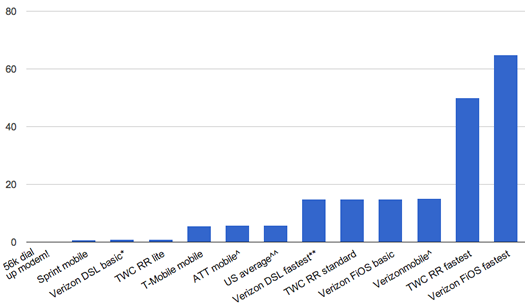
Download speeds in megabits per second. There are a bunch of notes for this graph (below).
An article by Larry Rulison in the TU this past weekend highlighted an irony about "Tech Valley" -- residential internet connection speeds here are, uh, not so fast.
To put things in some perspective on the topic, we put together two graphs. The first is above -- it lists the top download speeds available through residential internet access service in this area.
Probably the most-envied internet hook-up across the country right now is Google Fiber, which the company first started in Kanas City (remember the contest?), and has since spread to Provo, Utah, and soon Austin. It offers connection speeds of up to 1 gigabit, both download and upload. The technical term for that is really &@##$%%^ fast.
So we put together a second graph to compare local speeds to Google Fiber, as well as a few other comparisons.
Why does this matter? Well, of all the problems in the world to have, this ranks relatively low on the list. But people always seem to find a way to fill up available bandwidth. One simple example: Netflix streaming -- that wouldn't be possible in dial-up world.
DIY tiny mushroom house
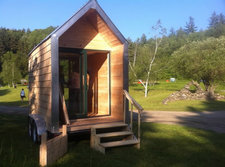 A few months back we mentioned that Green Island based Ecovative Design was "growing" a tiny house using its mushroom tech. Well, the house is now finished.
Ecovative is using the house as a test of ideas as it works toward getting into producing building materials. That idea has been bubbling for a while, but the company temporarily held off on it while it pursued the creation of packaging material (and hooked up with companies such as Dell and Steelcase). The overall aim for both types of products is to provide a eco-friendly alternative to styrofoam.
Now Ecovative is selling DIY kits to create mushroom-based insulation, or an entire tiny mushroom house. The insulation material is $8 per cubic foot. And the basic kit for the house is $8000 (the deluxe kit is $12,000).
Earlier and elsewhere:
+ Fast Company: This Tiny House Was Grown From Mushrooms
+ Ecovative in the New Yorker
photo: Ecovative
Which arrives first? The electric cars, or the places to charge them?
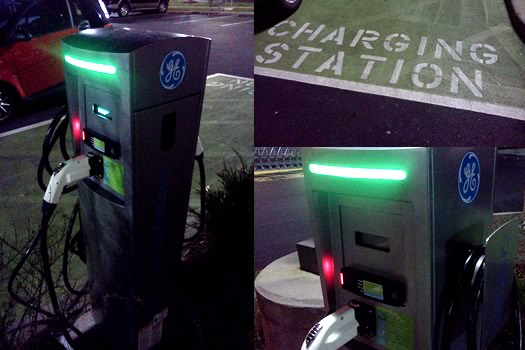
An EV charging station at the ShopRite in Niskayuna. (photo: Kristofer)
Gina recently contacted us looking to get some help with a situation, which breaks down like this: She and her husband are thinking about getting an electric car. He'd be using the car to commute -- he works at the Capitol. And though he's seen that the ESP has charging stations for electric vehicles, they're apparently not for general use.
As Gina commented in her email to us (link added):
"For all the hype and press releases from the Governor's office about a new network of chargers statewide, the actual process for using them *on state worker territory* is frustratingly opaque."
So we looked into the situation a bit. And we managed to get an answer. But more than anything, their situation highlights one of the challenges facing electric vehicles generally.
Spotter
 Here's another mobile app with local roots: Spotter. The app allows people to take a video, upload it and share it -- and here's the twist -- associate it with a place. The videos can then be searched by location -- or a person can follow a place to track videos associated with that location (the same way you'd follow a person on Twitter or Instagram).
So, for example, you could follow the location of a concert venue to see videos shot there during a show (or many shows over time). Check out the screen shot on the right.
Spotter is the creation of three guys: Mike Groves, Kevin Pytel, and Dan Graham. Here's a recent interview with Pytel about what they have cooking.
The app is currently only available for the iOS. It's free.
Ecovative in the New Yorker
 The new issue of the New Yorker include a good article about Ecovative by Ian Frazier. Here's a clip:
Gavin McIntyre, the co-inventor of a process that grows all-natural substitutes for plastic from the tissue of mushrooms, holds a pen or pencil in an unusual way. Gripping it between two fingers of his right hand, he moves his arm across the paper so that his wrist grazes the inscribed line; because of this, he uses pens with ink that doesn't smear. When he draws an explanatory diagram of the chitin molecule--chitin is the principal component of mycelium, the white, rootlike vegetative structure of fungi--he bends over his work, then looks up earnestly to see if his hearer has understood. The gesture makes him appear younger than his age, which is twenty-eight. He wears glasses and has straight black hair, dark eyes, and several piercings, with studs in his lip and ears.
The other co-inventor, Eben Bayer, won't be twenty-eight until June. Bayer is almost six-five, and often assumes the benign expression of a large and friendly older brother. His hair is brown, short, and spiky, his face is long, and his self-effacing manner hides the grand ambitions that people who come from small towns (Bayer grew up in South Royalton, in central Vermont) sometimes have. When he says, of the company that he and McIntyre founded, "We want to be the Dow or DuPont of this century," he is serious. He is their company's C.E.O., McIntyre its Chief Scientist. People with money and influence have bet that they will succeed.
As you know, Ecovative is based in Green Island -- and both McIntyre and Bayer are RPI alumni.
The article highlight both of the founders' backgrounds, along with the key role of RPI professor Burt Swersey in encouraging them, and mycologist Sue Van Hook in helping to grow Ecovative's library of fungus. And it also includes a bunch of interesting bits about the company's beginnings, tech, and plans (fungal resistors for mobile phones?).
More than anything, though, Frazier elegantly lays out Ecovative's ideas alongside the history of Dow Chemical -- the producer of Styrofoam -- and explains why Ecovative could be such an important, industry-altering company.
Earlier on AOA: A whole bunch of items about Ecovative
Grow house
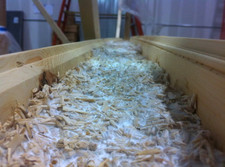 In progress at Ecovative, the Green Island-based startup that creates packaging and insulation from mushrooms: a small house that's growing its own walls. Blurbage:
We spent 5 years focused on protective packaging. Today it's a huge success, being used to package everything from servers to surf boards. Now we're looking ahead to what's next, and it may be time to return to our roots and dive back into building materials.
This project is a bold experiment to build and grow a house with Mushroom Insulation. We could have started by just building a simple wall assembly and subjecting it to lab tests. And we'll surely be doing that soon. But we thought that starting by building a whole tiny house would lead to more learning (possibly through failure) faster than anything else we could do. Also, we all just think tiny houses are really cool.
Basically, they've built a frame and are letting the mycelium (sort of like mushroom roots) fill in the gaps by bonding together agricultural waste. It's pitched as a environmentally friendly alternative to polystyrene insulation.
The company's set up a site with frequent updates tracking the construction and progress.
photo: Ecovative Design
Tech Valley Center of Gravity
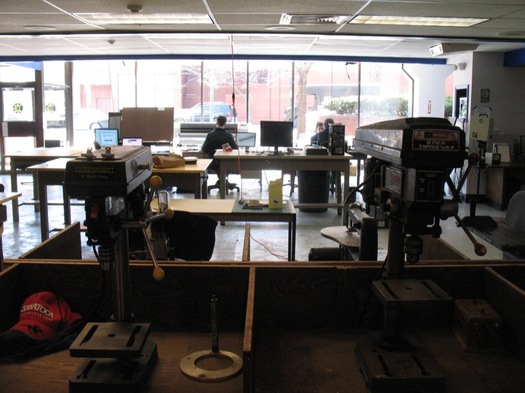
At the corner of 4th and Fulton in downtown Troy, in what was formerly an OTB space on the ground floor of a parking garage, is now a workshop with metal and wood working machinery, racks of tools and parts, 3-D scanners and printers, and biotech equipment.
The new Tech Valley Center of Gravity is a makerspace -- a place for hackers, crafters, artists, geeks to build stuff, take things apart, hack new things to together, and to learn from each other.
But organizers see it as part of something even bigger.
Graffiti Buster
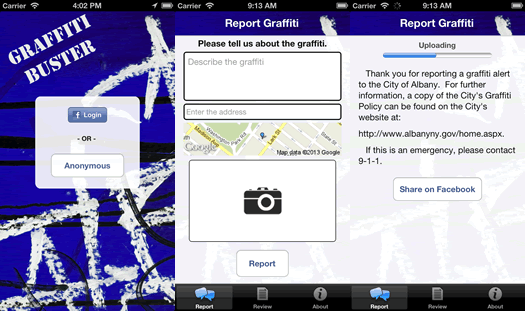
The city of Albany announced a new mobile app today: Graffiti Buster -- a way to report graffiti to the city. It's available for both the iPhone and Android.
The app is the creation of Troy Web Consulting's Tim Varney. You might remember Tim's name -- he also created the Albany: Then and Now history app, as well as the map of the vacant buildings in the city.
Tim explained to us how the app came about, and a little bit about how it works...
Forecast
A screenshot from Forecast.
This is good: Forecast, a new weather site from the Troy-based developers who created the mobile weather app Dark Sky. From the announcement:
About a year ago, we released a little app for the iPhone and iPad called Dark Sky, attempting to do something new and interesting for weather forecasting, a field we think had become pretty stagnant. Approaching 100k sales, it's been fairly successful; however, we've been continually asked for more: international support, longer-term forecasting, an Android app, and so on.
Rather than cram these things into Dark Sky, we decided to do something grander: create our own full-featured weather service from scratch, complete with 7-day forecasts that cover the whole world, beautiful weather visualizations, and a time machine for exploring the weather in the past and far future. You can access it from all of your devices, whether it be your laptop, iPhone, Android phone, or tablet.
A lot of the weather info on the site is available elsewhere, but what makes Forecast so good is the way it presents current conditions and forecasts: simply and without clutter. Even the more advanced features mentioned above -- like the time machine -- have a clean, straightforward presentation. It's just the main weather info you want without all the junk, all easily accessible. (We love the National Weather Service, but yow, can its website be hard to use.)
A few other cool things about Forecast: the predictions are based on an aggregation of multiple sources and -- for the nerdy -- they're sharing their info through an API (a way for other developers to make use of their data).
Forecast and Dark Sky are the creation of the Troy-based team headed up by Jack Turner and Adam Grossman. They released Dark Sky last year after raising more than $35k on Kickstarter, in the process snagging a bunch of media attention.
Troy Night Out app
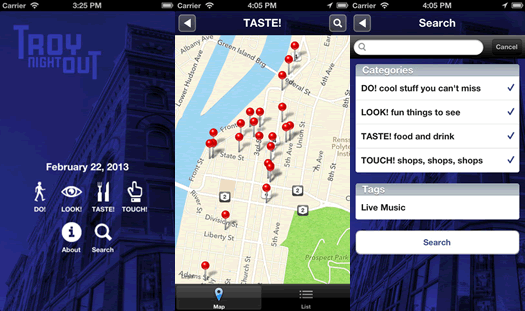
Check it out: there's now a Troy Night Out mobile app. From the description:
Discover the wide variety of businesses in downtown Troy, New York. Troy Night Out happens on the last Friday of each month with things to do, see, touch, and taste. With the Troy Night Out app you can search for participating businesses, get directions, and find out what's happening while your in Troy for the night.
There are screenshots above.
The app is the creation of Troy-based Gavant Software -- it announced Monday that it's donated the app to the Troy BID. The app will have information for this Friday's TNO.
It's available for both the iPhone and Android.
Unsolicited suggestion: It's great to see a local company pitching in to help like this. +1. What might might also be good: a bunch of local arts/events orgs collaborating with a partner to create a multi-place, multi-event local app, one that would include info for events such as TNO and 1st Friday, along with other stuff like Alive at Five and other business improvement districts.
Speaking of Troy Night Out: The new decorated Uncle Sam statues are schedule to be formally unveiled around Troy at next month's TNO (April 26).
Earlier on AOA: Albany: Then and Now App
screenshots: Gavant Software
Life of Pi waves started in Colonie

Here's a large-format version.
Last night Life of Pi won the Oscar for visual effects -- thanks in part to a Cohoes company.
Aquatic Development Group -- which designs and makes equipment for waterparks and pools -- made the wave tank used to simulate the ocean in the film (which involves the main character being trapped with a tiger on a life boat). It was installed at former airport in Taiwan, where the movie was shot.
The photo above -- from a ADG press release -- is from the Life of Pi wave pool. During the acceptance speech, the Life of Pi effects team mentioned the tech "kept us from having to go out to the real ocean."
Here's a TU profile of the company from this past November.
ADG's tech was also used in Master and Commander and the 2006 Kevin Costner film The Guardian. The company has installed 90 percent of the wave systems in the United States, according to its website.
(Thanks, Erik.)
Amelia vs. The Marathon
Check it out: Trouble Impact -- a new indie game studio based in Menands -- released its first game today: Amelia vs. the Marathon.
Here's how Trouble Impact's Cat Musgrove described the game to us in an email:
In the game, you play as up-and-coming marathon runner, Amelia, whose recent wins have attracted the attention of the reigning running champion. The champ doesn't want to be outdone, so she has sent her henchmen to slow you down. It's a family friendly game, with mild cartoon violence (such as throwing hats or getting hit by objects like pizza and cake), and a strong female protagonist (and antagonist!)
The game is available for iOS (iPhones and iPads), Android, Nook (the B&N e-reader), PC, Kindle Fire and the Mac App Store. It's $1.99.
Trouble Impact is a two-person studio -- Cat Musgrove and business partner Issam Khalil both previously worked at Vicarious Visions. Cat tells us Amelia is their take on livening up the well-established format in which you and your enemy each take turns attacking each other (turn-based combat). So they've included things like timing challenges in the game. "With that in mind, we also wanted to take this sort of typical game concept and apply it to subject matter that isn't usually explored in more hardcore games. Issam and I are both runners (we both plan on training for a marathon someday!), so it seemed like a natural fit to make the game about running."
Poking around the studio's blog, it looks like they have some other interesting ideas cooking. One that caught our eye: Crush, which grew out of exploring "the heart-in-your-mouth sensation of actually trying to talk to [a romantic] crush." The prototype game recently got written up on Penny Arcade.
Car crashes, snow, crime, and public data
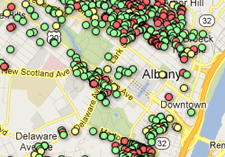
A clip from a map of vacant -- and no-longer-vacant -- properties in Albany, created by Tim Varney last year. See below.
Lots of interesting bits in this Daily Gazette article by Kathleen Moore about how police in Albany and Schenectady are using data*. Here's a clip, about how Schenectady police have been paying closer attention to car crashes:
By tracking car accidents last fall, Schenectady police pinpointed patrols in the Mont Pleasant neighborhood and saw certain crimes plummet by 12 percent in the last quarter of 2012. They are using the same system to respond proactively to crime throughout the city, in hopes of getting similar results everywhere.
Maps of crashes, drunken-driving arrests and other traffic violations are overlaid with maps of crime reports. Police patrols are sent to the hotspots -- locations where traffic problems and crime are high.
"What we know is, the driver that's risky enough to drive drunk ... is often risky enough to take other risks," said federal Highway Safety Specialist Shannon Purdy. "A lot of criminals are caught at seatbelt checks."
A section about the Albany police department mentions how the APD is using weather forecasts to adjust patrols.
Also: Schenectady mayor Gary McCarthy is working with UAlbany's Center for Technology in Government to build a platform that would allow city departments to share code enforcement data (say, about code enforcement), and share it with Albany and Troy.
More, please
That common platform is a good idea. And it's worth pushing even further: Why not created a Capital District consortium for publishing and sharing public data? The org could help develop tools, set common formats, and provide a clearinghouse for sets of public data. It would open the way for more orgs and people to get involved, and even maybe set the stage for new businesses. (NYC is already doing something along these lines.)
Sure, there are obstacles: time, money, attention. And civil liberties issues will probably crop up along the way. But having meaningful access** to data generated by your government is becoming a 21st century civil right.
____
* Yep, it's a Gazette article, but we have a feeling that link will work for you.
** A pdf that you have to file FOIL for is not meaningful access. It's a start, but we do a lot better.
Earlier on AOA:
+ A future timeline of Watson at RPI
+ Map: vacant -- and no-longer vacant -- buildings in Albany -- created by Tim Varney from data published in a city report last year
A future timeline of Watson at RPI

IBM announced this week that RPI will be getting a modified version of Watson, the artificial intelligence system that famously put the beatdown on human players on Jeopardy. Blurbage from RPI press release:
The arrival of the Watson system will enable new leading-edge research at Rensselaer, and afford faculty and students an opportunity to find new uses for Watson and deepen the systems' cognitive capabilities. The firsthand experience of working on the system will also better position Rensselaer students as future leaders in the areas of Big Data, analytics, and cognitive computing.
This is a big deal because systems like Watson -- along with other stuff like Siri, and Wolfram Alpha -- are both the future and The Future (you have to say it while looking off into the distance). They hold the promise of helping people make sense of the torrents of data all around us.
Now, via a flashforward, a future timeline of Watson at RPI.
GlobalFoundries building R&D center in Malta
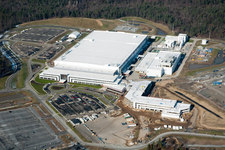 The Cuomo administration and GlobalFoundries officially announced today that GloFo will be building a $2 billion R&D center at Luther Forest. The target date for completion is late 2014. The new center is expected to prompt another 1,000 jobs at the site.
The Cuomo admin noted that "no new incentives were provided from the State" for this new project.
From a statement by GlobalFoundries CEO Ajit Manocha:
... [W]e are making significant investments in strengthening our technology leadership, including growing our workforce and adding new capabilities to make Fab 8 [that's Malta] the hub of our global technology operations. New York State's continued support of the semiconductor industry has created a strong collaborative ecosystem and helped pave the way for this additional investment. ...
The long-held hope has been that the Malta fab and the multiple investments at Albany NanoTech would push this area to become a cluster of tech-related projects, with its gravity pulling other stuff to it. Maybe that's starting to happen now. (And if that mysterious Project Azalea takes root here...)
Another small bit that points toward the tech actually being in Tech Valley: The TU's Larry Rulison noticed that Samsung has recently started trying to recruit "semiconductor talent" from the Albany area -- to go work in Austin.
photo: GlobalFoundries
The Legend of Momotaro

Long, long ago...
Saratoga-based Ghost Hand Games has released an interactive storybook for the iPad called The Legend of Momotaro. From the description (link added):
The famous legend of Momotaro is brought to life with beautiful handcrafted illustrations, animations and narration. Ten panoramic scenes tell the classic Japanese story of an old man and an old woman who's only wish is to have a child. The gods grant their wish in a most surprising way!
As the story of Momotaro unfolds find the hidden interactive elements in each scene to learn about the Japanese culture and language. Watch and listen as subtle animations, authentic narration and sound tell a story of bravery and friendship.
As with Ghost Hand's other games, Momotaro looks great. There are a few more screenshots after the jump.
The storybook app is available for the iPad and iPad mini. It's $3.99
Earlier on AOA:
+ A Shatner app... developed... in Troy
+ Albany: Then and Now app
+ Snow Brawlin'
A Shatner app... developed... in Troy
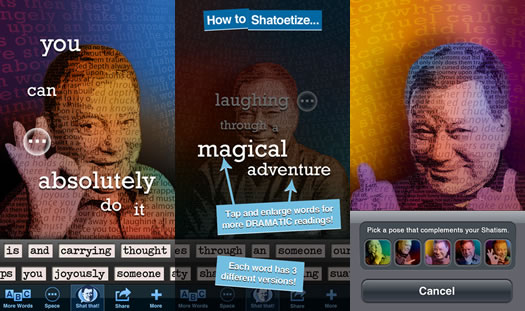
Heh: 1st Playable -- a video game studio in Troy -- helped develop a new iPhone app released today: Shatoetry.
That's Shat as in William Shatner, and oetry as in poetry. Of course.
From the app's blurbage:
Shatoetry is an iPhone app that lets you arrange words - into statements, comments, messages, sentences, phrases, haiku, poetry, or even just random words... with this amazing payoff: whatever you arrange, you'll be able to hear William Shatner perform it for you.
And, of course, because it's William Shatner, there is the opportunity... for dramatic... pauses:
Though the dramatic pause has been a part of human communication for eternity, who else has mastered it like the man himself?
For more dramatic delivery to your Shatism, Shatoetry lets you add pauses between words with Space Bubbles.
Drop a Space Bubble into the Compose Field by simply giving the "Space" button a tap.
Drag it to wherever you want the pause to be... unheard ;)
1st Playable CEO Tobi Saulnier tells the Biz Review the app is part of her company experimenting with the iPhone app market. (1st Playable has done a lot of work developing games for platforms like the Nintendo DS.)
Oh, and his take on the app: it's "as different and as unique as a sunrise." [LAT]
The app is $2.99.
By the way: 1st Playable's office in Troy is gorgeous -- definitely worth a gawk if you ever have the chance.
Earlier on AOA: Kick Buttowski, launched from Troy
Albany: Then and Now app
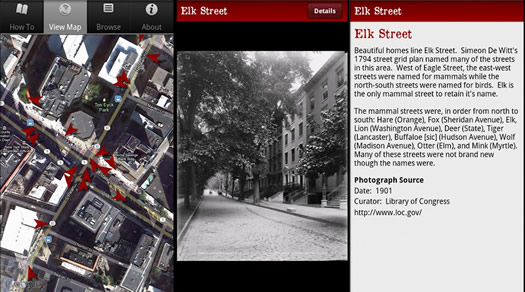
Screenshots from the Android version.
This is good: Tim Varney has created a mobile app -- Albany: Then and Now -- that combines a map of Albany with historical photos and background. As he explained in an email:
The basic idea is that you can walk around downtown and find a spot where a photographer stood 100 (or so) years ago. You can then view the streetscape from his vantagepoint and visually see the changes that have occurred.
Here's a bit more detail from the app's iTunes page:
Make your way to downtown Albany. Open the "Albany: Then & Now" app on your mobile phone and click on the "View Map" button. On the map you'll see red arrows which represent the more than 130 historical photographs in our collection. Each arrow shows where sometime in the past a photographer stood and took a picture of the city's landscape. Most of the photographs are around 100 years old.
Using the map as a guide, walk to one of the marked locations. The center of the arrow indicates where the photographer stood. The direction of the arrow shows which way the photographer was facing. Do your best to stand in the same spot and face the same direction as the photographer did.
On the map, press the red arrow. Voilà ! The image that you're seeing is exactly what the photographer saw years ago while standing in the same location! For more details about the photograph, press the "Details" button.
There's a video of the app in use after the jump.
The app is available for the iPhone and iPad, as well as Android. And it's free.
So, what prompted Tim to make this app?
Steve Wozniak in town September 6
 Apple co-founder and general uber nerd Steve Wozniak will be in town next week for two public events. On September 6 he'll appearing on a panel at GlobalFoundries in Malta -- "What's Next For Tech Valley?" (link added):
An esteemed panel featuring Steve Wozniak, [fiber optics inventor] Peter Schultz and local technology executives will discuss innovation and technology development in Tech Valley. The focus will be on driving economic growth and jobs for the next two decades.
The panel is from 3-4:30 pm. Tickets are $75 / $25 students (with ID). Proceeds will "benefit a local charity as directed by Steve Wozniak." Registration is required.
Speaking of charities, Woz will also be appearing at a fundraiser that evening at Proctors for Peaceful Acres Horses:
Enjoy hors d'oeuvres, a cash bar and conversation with personal computer inventor "The Woz," followed by a concert featuring the wonderful Canadian artist Ariana Gillis.
Tickets for that are $60.
Peaceful Acres is in the Pattersonville. You might remember that Woz was in the area a few months back visiting the horse sanctuary. [CBS6 YouTube] [via TU]

Dark Sky version 2
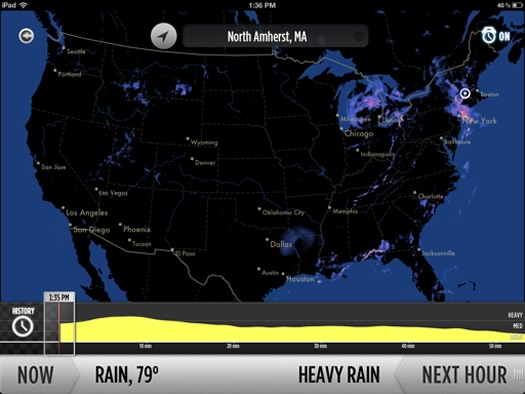
The Dark Sky weather app -- created by Troy-based developers Adam Grossman and Jack Turner -- now has more than 35,000 users, according to the company. The app aims to provide very accurate weather predictions over the very near term -- minutes or hours instead of days. It's now on version 2.0, with new push notifications of when it's going to rain:
Push Notifications are a feature that our users have been requesting since we first launched last Spring. By enabling notifications within the app, we will tell you whenever it's going to rain in the next ten or fifteen minutes, so you'll never get caught in the rain -- even if you forget to check the app. We've actually been working on this feature since the beginning, but it's been very tricky to implement: we're not quite 100% confident that we've gotten it perfect. For that reason, we're currently considering the system to be experimental: if you find that notifications aren't behaving exactly the way you'd expect, we'd love to hear from you. As always, we strive to improve the app with every release.
There's also a now a national radar view (above).
The update is free. The app for the iPhone and iPad is $3.99.
Grossman and Turner funded development of Dark Sky in part by raising more than $39k on Kickstarter last year, and scoring a bunch of media attention in the process.
Earlier on AOA: The Dark Sky app is now available
A comparison of Albany area mobile service
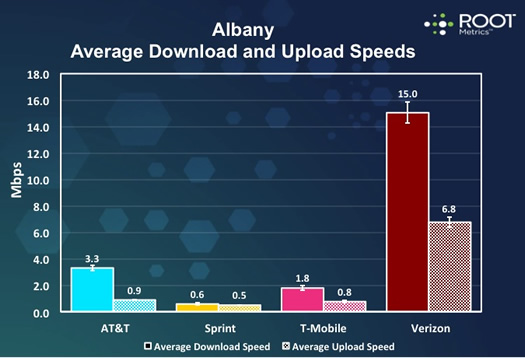
One of these things is not like the other.
Check it out: a company called RootMetrics recently completed an assessment of mobile phone service reliability and speed in the Albany metro area.
Its overarching conclusion: Verizon is the best -- by a lot.
A few bits that jumped out at us:
+ Verizon dominated the data speed comparison because of its LTE network (4g), which is about 10x faster than 3g. See the chart is above. (AT&T hasn't rolled out LTE in this area, yet.) As it happens, Verizon is changing its mobile plans to focus on data service, and the ability to share data service across different devices. [AP/WSJ]
+ All the carriers did reasonably well on voice calling (Sprint was the worst). But Verizon was the only carrier to not have a single dropped call.
+ And the all the carriers were basically same for how long it took to receive text -- with one notable exception: Sprint was waaaaaay slower than the other carriers. Its average time was 68 seconds, compared 3-4 seconds for the other carriers.
How'd they measure all this? From the report's methodology section:
To evaluate the Albany area (the Albany Urbanized Area as defined by the U.S. Census), we performed 7,429 call, data, and text tests, covering all hours of the day and night. Tests were conducted using our RootScout app running from off-the-shelf, Android-based smartphones purchased from carrier stores. The phones were used as a typical consumer would use them and were not modified with any external antennas or other non-standard equipment. The data provided in this report reflect our findings in the Albany market during testing conducted from May 20 - May 24, 2012.
The company also makes an app that measures carrier performance. The results from the app are then aggregated with other users' results.
[via TU]
graph: RootMetrics
"The recession seems to be every place but here"
UAlbany's College of Nanoscale Science and Engineering was featured on the CBS Evening News last night. The angle: how the public/private partnership there is creating jobs -- "even for a blue collar guy." (It should be noted the "here" in the title quote refers to CSNE.)
The package was better than ABC's GlobalFoundries story from earlier this week. (Thankfully, Jim Axelrod did not feel the need the wear a clean room suit.) But, oddly, the CBS package didn't mention the GlobalFoundries chip fab. Maybe the two segments can be stuck together using some sort of cross-network nanotechnology.
Even though these sorts of stories often miss the mark, they're still spreading word of some of the stuff going on here. The same goes for the Obama visit next week. That's worth something -- how much is hard to say -- but something.
(Thanks, Fred! Thanks, John!)
The Dark Sky app is now available
The weather wasn't exactly exciting at this moment. Here's the outlook for a place that was a bit more interesting (meteorologically) at the time.
The Dark Sky weather app -- from Troy-based developers Adam Grossman and Jack Turner (Jackadam) -- is now available in the iTunes Store. The app aims to provide people with very specific weather forecasts for the near future based on location.
The question Dark Sky tries to answer is not "Will it rain tomorrow?" but rather "Will it be raining here during the next hour?" It can help determine if there's enough time for a quick bike ride before a thunderstorm, or how long you have might have wait before you can walk from your office to your car without an umbrella. It can also just satisfy the curiosity of bored meteorology nerds.
Speaking of meteorology nerds, we've been playing around with the app for the last day or so, and it's been kind of fun -- if not always accurate. The radar pictures are super clear and easy to read. And it shows whether the precipitation expected will be heavy, medium or mild. The no-precipitation predictions have been pretty good, and it did signal accurately a few times that rain was approaching. It failed to predict one light sprinkling of rain. (To be fair, we were in a moving car -- and Adam Grossman says that kind of light precipitation can be difficult to detect. And in general, this kind of stuff is harder than it looks.)
If the weather isn't interesting where you are, you can watch storms anywhere in the country.
Dark Sky is available for newer versions of the iPhone (4 and 4s), iPod Touch, and iPad. It's $3.99.
Jackadam funded the development of DarkSky in part by raising more than $39k on Kickstarter back in November. In the process, the app snagged a bunch of media attention (example).
We're looking forward to playing with it more.
Level at the Arts Center

From Everyday The Same Dream by Molleindustria.
Looks fun, interesting, and geeky: Level -- a new exhibition of independent video games -- opens this Friday at the Arts Center of the Capital Region. From the blurbage:
Level presents the games in an immersive environment that simulates a 1990s American video arcade. Each game has its own working cabinet, which allows visitors to play free of charge. The game cabinets are designed and fabricated by We Are Architects with assistance from regional game enthusiasts and friends. Collaborators include Donna Fitzgerald's class at Parson's Child and Family Center, circuit bending sound artist Peter Edwards, and regional furniture maker Leonard Bellanca.
The Friday opening is the Level Festival:
Alongside the exhibition's debut of a wide variety of video games in an immersive, arcade-style environment, Level Festival will feature a booth of vintage games and systems by local game enthusiast boutique Pastime Legends and genre bending electronic music. With support from iEAR Presents!, Level Festival features four intriguing performances by musicians that work in a range of electronic sounds, unconventional instrumentation, and take influence from games and other facets of pop culture. Level Festival performers include Evidence (Stephan Moore and Scott Smallwood), Matthew Carefully (Matthew Loiacono), Bubblyfish (Haeyoung Kim), and Extreme Animals (Jacob Ciocci and David Wightman).
The exhibition is organized by We Are Architects. The opening festival starts at 4 pm Friday and runs until 10 pm (it's free). The exhibit runs through May 25.
Speaking of Troy and video games: The annual GameFest symposium and exhibition at RPI is this weekend.
Yep, the Arts Center advertises on AOA.
RPI students send balloon to the edge of space

The view from about 90,000 feet.
This is great: a group of RPI students sent a weather balloon to the edge of space -- almost 90,000 feet. The balloon was equipped with three HD cameras and the video is remarkable (a few versions are embedded after the jump).
The students are part of a club called "RPI Students for the Exploration and Development of Space" (RPI-SEDS) -- it was founded by Orian Breaux, who recently graduated with an undergrad degree in aeronautical engineering. They launched the balloon from the Class of '86 field on campus -- and it ultimately landed in Maine after reaching 89,777 feet (well into the stratosphere).
So, why? (Other than than the fact it's awesome.) Breaux explains in a blog post:
Let's face it: space isn't sexy anymore. The zeal for the cosmos that once pervaded the American public consciousness has gone flat, and we're not going to rediscover that passion through politicians or NASA administrators. It will reemerge through the efforts of entrepreneurs in the private space industry and through the legions of professionals and students inspired by their actions ...
Our first effort, the high-atmosphere balloon, is an innovative variation on this increasingly common project. The idea that regular students can realize grassroots space projects like this embodies new opportunities to inspire people unlike ever before. That is the central idea behind presenting the high-atmosphere in a 360-degree interactive medium.
Breaux's name might sound familiar -- he's one of the founders of the Swing Syndicate in Troy. As he told AOA last fall about his career plans: "I'm not losing focus on getting into the space industry. I've always had an entrepreneurial spirit. I want to be involved in the movement to privatize space flight. Maybe I'll start a dance studio on the moon -- go back to my roots."
Ecovative in Wired
 There's a profile of Green Island startup Ecovative in the February issue of Wired -- the article is now online via Wired UK (which explains the Britishisms in the linked story above).
You've read some of it before, but there are some interesting new (to us) bits that touch on how good ideas come about, and what it takes to foster them. Also: Eben Bayer and Gavin McIntyre may be the first Wired profile subjects who grew their own headline.
We've posted a bunch about Ecovative, in part because it's an interesting local story with a fun angle (Packaging! Made from mushroom roots! By two good-looking nerdy guys!). But the company also has big potential. The polystyrene packaging business is a $20 billion a year industry (according to the Wired article) -- and Ecovative is looking to disrupt it with a product it says costs the same and doesn't harm the environment. That's an enormous opportunity. And it's growing from the ground up here.
Sure, it's not a multi-billion dollar chip fab or sprawling nanotech campus. But maybe it could be, someday. Upstate New York benefited greatly over the last century thanks to companies that created new industries -- names such as Kodak, Xerox and GE (many of which are now faded). If this part of the country ever finds that sort of prosperity again, it most likely will involve people and companies that have disruptive, industry-creating or shifting ideas.
Is it likely that Ecovative ever becomes as big as Kodak (once was) or GE? The odds are extraordinarily long. But all those companies started somewhere. Why not a warehouse in Green Island?
thumbnail: Chris Crisman / Wired
Kirsten Gillibrand, SOPA/PIPA, 2016, and cake
 There was some interesting blowback today for Kirsten Gillibrand on SOPA/PIPA -- federal legislation touted as a way for copyright holders to crack down on piracy, but in practice would muck up much of the internet. Under pressure from widespread online protest this week, Congressional leaders took the bills off the table today. [TechDirt] [Wired]
Both Chuck Schumer and KG were co-sponsors of PIPA (basically the Senate version of SOPA), and tech industry people in NYC organized a large protest (with actual, in-real-life people) outside the senators' office there on Wednesday. [BetaBeat]
Apparently in response to the protests and the pulling of the bill, KG (or her office) posted on her Facebook page today:
Whether passing the 9/11 Health Bill, repealing DADT, or my call to action for women, I have always urged New Yorkers to make their voices heard. There has been an outpouring of democracy in action over the last several weeks on PIPA & SOPA. While many of my colleagues and I have worked hard to address concerns with the current bill, it is clear this proposal will not create consensus on how to crack down on the real problem of online theft that threatens tens of thousands of New York jobs in a balanced way that ensures our tech companies will continue to flourish. It is time for Congress to take a step back and start over with both sides bringing their solutions to the table to find common ground towards solving this problem. New talks between stakeholders -- media companies, music and film companies, Silicon Valley and Silicon Alley here in New York is a critically needed step forward. Make no mistake, we must act to protect the theft of intellectual property that costs our economy billions in revenue -- but we must get it right without unintended consequences that could stifle the internet.
Which, in turn, prompted Markos Moulitsas (the Kos in Daily Kos) to argue that KG is "trying to have her cake, and eat it too, on PIPA." And the overarching reason, in his view: she's looking ahead to 2016 and a run for a White House.
[via @patrickboegel]
GlobalFoundries: now making chips in Malta
Fab 8. Or, that enormous factory in Luther Forest.
GlobalFoundries announced today that its chip fab in Malta has started making chips. The company is working with IBM on an initial production run of chips at both the Malta fab and IBM's fab in East Fishkill.
GloFo says the chips are based in part on technology that was researched at UAlbany's College of Nanoscale Science and Engineering. And here's where the "nano" part of this comes in: the chips make use of transistors that are just 32 nanometers wide. To say that's tiny doesn't quite cover it -- 4 million 32 nm transistors could fit on a period at the end of sentence. The GloFo fab in Malta -- Fab 8 -- was built to make chips with 32 nm and 28 nm transistors, and smaller.
The company says it expects to be ready for volume production by second half of this year. Once Malta is at full production capability, the fab will be able to produce 60,000 chips a month.
GloFo says it's created 1,000 jobs at the Malta fab -- with another 400 expected this year. It's having a job fair this Thursday at the Saratoga County admin building.
photo: GlobalFoundries
A ShopRite for Slingerlands, and a tech park

Right now there's not a lot there besides dirt.
Thursday was the official groundbreaking for the Vista Technology Campus in Slingerlands. A lot of the attention was focused on one of the tenants already signed up: ShopRite. That makes three stores now officially announced/open for the area (there's a fourth planned for Colonie). ShopRite continues what appears to be a strategy to go to head-to-head with Price Chopper -- the Vista ShopRite is pretty much be right across the road from the Slingerlands Chopper. [Spotlight] [YNN]
Planning for the Vista site has been going on for a few years -- but Thursday's announcements would seem to indicate it's picking up momentum. It's a potentially significant development project. The site includes 150 acres of land planned for development. And the developer -- Columbia Development -- says its plan includes up 1.4 million square feet of office, research and manufacturing facilities, medical office, and retail space.
A few quick thoughts about all this...
UAlbany researchers working on video games to change the way people think
 Interesting: a UAlbany research team has gotten a grant to develop a computer game that aims to train people how to recognize their own cognitive biases. From the UAlbany blurbage:
In partnership with the local game company 1st Playable Productions, the CYCLES project will develop a computer game that will teach players how to recognize six common cognitive decision-making biases: confirmation bias, fundamental attribution bias, bias blind spot, representativeness bias, anchoring bias and projection bias. The goal is to reduce players' dependency on bias in real decision-making situations by as much as 65 percent. "The problem is one that psychologists have been working on for a very long time with limited success," said [psychology researcher Laurie] Feldman.
The interdisciplinary team is headed up by Tomek Strzalkowski from UAlbany's College of Computing (that's him on the right, not impressive-looking whiteboard diagrams) and Information and Jennifer Stromer-Galley from UAlbany's Department of Communication.
The $8.7-million project is funded by US Air Force. And arm of the Office of the Director of National Intelligence is involved -- that arm, called IARPA explained earlier this year, why it's looking to these sorts of games:
Dark Sky app funded, and other local Kickstarter projects
Dark Sky, the weather-just-ahead app from Troy-based web developers Jackadam (Jack Turner and Adam Grossman), reached its $35,000 goal on Kickstarter over the weekend. Its deadline was the end of this month -- and the project is still accepting funding through then.
Here are a few other local Kickstarter projects that caught our eye that are looking for funding -- or recently met their goal...
Park and plug in
The future. Maybe.
Kristofer spotted this electric vehicle charging station at the new ShopRite in Niskayuna. There are four spots in supermarket's parking lot designated for electric vehicles. Apparently Niskayuna town officials requested that ShopRite include the spots as part of its design for the store. [Spotlight]
The ShopRite charger brings the number of EV charging spots in the Capital Region to five, according to Dan Gibson at Our Energy Independence Community. In addition to ShopRite, there are stations at the Holiday Inn Express in downtown Albany, NYSERDA in Guilderland, the Saratoga Technology and Energy Park in Malta, and the HVCC Tec-Smart facility also in Malta.
Here's the thing, though: there are extraordinarily few electric cars on the road. The two currently for sale -- the Chevy Volt and Nissan Leaf -- are new on the market, and the technology -- especially for batteries -- could use some improvement. Most people probably aren't going to be keen to drive a car with a range of at most 100 miles in ideal conditions -- and much less in normal conditions. (To clarify: the Volt also has a gasoline engine, which can kick in after the batteries run out.) [NPR] [USA Today]
It's interesting/fitting that Niskayuna has an EV charging station made by GE, in an everything-new-is-old kind of way. Ace GE scientist Charles Steinmetz had an electric car all the way back in 1914. He used to drive it to his weekend home.
The Edison Exploratorium in Schenectady still has Steinmetz's electric car. There's video of it embedded after the jump.
(Thanks, Kristofer!)
Dark Sky
Check it out: Troy-based web developers Jack Turner and Adam Grossman have launched Kickstarter funding for a new app called Dark Sky. From the blurbage:
Dark Sky is an app for the iPhone, iPad, and iPod touch that predicts the weather.
Using your precise location, it tells you when it will precipitate and for how long. For example: It might tell you that it will start raining in 8 minutes, with the rain lasting for 15 minutes followed by a 25 minute break. ...
Using the same techniques we've developed for predicting rain, we can show you what the storm looks like in between the individual radar snapshots. We replace the jerky slideshow with a beautifully smooth interactive animation. And it's not just pretty... it's easier for your brain to process and understand a smoothly flowing video than a series of images that jump from point to point.
Be sure to watch the video embedded above. It's a good, quick intro to what they're planning.
Jack and Adam are aiming to raise $35,000 (there's a lot of stuff necessary behind the scenes to make this sort of thing work). The pledge levels include a pre-order of the app and various other whatnot.
Capital Region Google Streetview images updating
 It seems like everyone's seen the Google Streetview car driving past sometime during the last few months. We recently emailed Google to find out when the images might started being updated online and got the "anywhere between a few months to a year" answer from a spokesperson.
Well, for parts of the Capital Region, the actual answer appears to be "right about now."
We checked a few theater marquees around the area to get a sense of when they were last recorded. It appears Proctors was captured in August (wrong, it's still the old one), and The Spectrum all the way back in June (also now online). In Troy, the old city hall is now partially demolished on Streetview. And there's a capture of the beginning of construction at the Albany NanoTech expansion. Also: the capture from the original Google crawl of the area that included one of the Editors is no longer online. It's too bad -- we were waving to the car.
A Google spokesperson says the old Streetview images aren't made available online. That's unfortunate -- it'd be fun to compare. You gotta think that will eventually make it online.
We had a handful of other questions for Google about how long it takes to crawl a metro area this size and stuff like that. Unfortunately, its spokespeople very politely said they couldn't answer most of the questions. And they wouldn't hook us up with the local drivers because "they work for us on a short-term basis. They're folks who are familiar with the local roads, but might not be familiar with Google's overarching project or mapping efforts." So it goes.
Here's a recent "Ask Me Anything" on Reddit with someone who says they were a Google Streetview driver.
(And if you were/are the local Streetview driver, we'd love to talk/email with you.)
photo via Google
The Northway Reporter
 Mark Delfs, the creator of the local fill-in musician site GigSavers, emails:
With the knowledge I gained from teaching myself how to construct [GigSavers], I made a followup site called "The Northway Reporter," which will allow the typical Northway driver an opportunity to report all the traffic incidents they see on a daily basis--the radio is too slow with reports and while I was stuck in traffic the other morning, I figured on making a site that we could all use to report (and get reports) about why we are all still getting stuck in traffic on I-87.
The site is formatted for mobile browsers (is it texting-while-driving if traffic's not moving?) and includes links to traffic cams. There's also a Twitter feed. More features are listed after the jump.
This kind of thing usually only becomes useful if a bunch of people use it. But even if it never reaches that point, we give credit to Mark for building it. A lot of people say "Wouldn't it be great if (fill in possibly useful thing) existed..." -- very few actually do something about it.
The Paper Battery Company
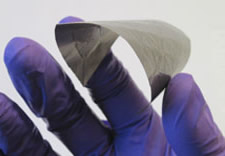 An interesting Troy company announced today it's gotten a $1 million grant from NYSERDA, the state's renewable energy agency. [Paper Battery]
The Paper Battery Company says it's getting the money to build a pilot production line for its "fully printed energy-storage device that is as thin as a piece of paper."
Yep, the company is developing batteries that can be printed onto a paper-like surface.
Tiny Face

Go small.
A handful of local companies have created mobile apps. But this one might be the craziest -- and most fun.
Tiny Face is an app that tests your ability to make your face small. Yep, you read that correctly.
As its website proclaims: "The definitive mobile application for quantitative face-reduction analysis is now available to the general public." Tiny Face uses the camera on the iPhone and iPad to take before and after photos, then it measures the difference. (Just be careful your face doesn't freeze that way.) It's 99 cents in the iTunes apps store.
It's the creation of jackadam, a Troy firm that specializes in building all sorts of creative digital whatnot.
[via Renée]
images: jackadam
Latest mobile app developed locally: Undecided
 The first app from Deadmans Productions, a relatively new mobile app company in Troy, now available for both iPhone and Android. "Undecided" includes a handful of virtual methods for making choices: rolling dice, flipping a coin, drawing straws -- that sort of thing.
The app costs 99 cents. It's a little rough around the edges. Some of the touch objects (if that's the phrase) are a little hard to grab. But it is kind of fun to flip a quarter by giving your phone a little flick (screengrab right). The company is holding a contest to rename the app -- but the current name fits it pretty well.
Zooming out, there's a bit of a mobile app development scene sprouting in the Capital Region. Among the players:
+ Ghost Hand Games in Saratoga has developed a couple of successful (and great-looking) games.
+ Axeva, a Clifton Park company, developed a sudoku-like game called Cohabit and a coloring book app.
+ A group of RPI students created a popular Android utility app.
+ And 1st Playable, a well-established games studio, recently produced its first mobile app game.
Michael Ridley, the founder of Deadmans, told the TU he started the company specifically to develop mobile apps. "Undecided" is the first in a string of five that they're planning to produce.
It's not surprising a lot of companies are dipping their toes in the mobile app pool -- it's projected to become a zillion-something-dollar market over the next few years.
[via Troy Record]
Big new customer for Ecovative Design

Dude, you're getting a Dell.
Dell, the giant computer company, announced today that it is running a pilot program that will use the mushroom-based packaging made by Ecovative Design, the Green Island based startup.
Ecovative has developed a styrofoam replacement material called EcoCradle -- or, as the company points out, it's grown EcoCradle. The packaging material is composed of agricultural byproducts and the thread-like roots of mushrooms called mycelia. And, unlike styrofoam, it's compostable and biodegradable.
Dell says it will be testing EcoCradle in shipments for one of its servers. In 2009, the company started using packaging made from bamboo.
Ecovative already had a deal with office furniture company Steelcase to supply to packaging material. And it's also developed an insulation material based on the same technology.
Ecovative was founded by Eben Bayer and Gavin McIntyre, both RPI grads. The company's gotten a lot of attention -- it was even name-checked on CSI:NY. Last year it was named a "technology pioneer" by the World Economic Forum.
Earlier on AOA:
+ A (very cool) fungus grows in Troy
+ and a whole bunch of other items about Ecovative
photo: Ecovative Design
The code for reservations
 That business card to the right is for Aperitivo Bistro in Schenectady. And the blocky graphic on the card is a QR code (yes, we know you know, but other people might not). If you scan the code with your phone (you might need an app), it takes you to Aperitivo's OpenTable reservation page.
QR codes have been touted as the next big thing (or at least a next thing) for a few years now. This is the first time we've seen a local restaurant use one this way (we bet there are more). On a mobile it is easier than typing in a url (not so much on regular computer).
Lou dropped a great comment explaining more about QR codes a few months back.
Earlier on AOA: "The funky tags"
Kick Buttowski, launched from Troy

Launched high enough, Kick even flies into space.
Check it out: 1st Playable, a video game studio in Troy, has built its first game for the iPhone/iPad. It's called "Kick Buttowski: Loco Launcho" -- it's based on a cartoon that airs on a Disney Channel about a kid who wants to be a daredevil.
The game is a "see how high and far you can fly" challenge. Kick gets launched in the air and you maneuver him to new heights, distances and tricks. Along the way you can earn new add-ons for Kick's sled, allowing him to go higher and farther. It's fun (probably more so if you're in the cartoon's target demo). The game is free.
Up to this point, 1st Playable has focused on building games for the handheld platforms such as the Nintendo DS. Its latest game for that platform is called "Pet Zombies," in which players raise their own zombies -- yep, you even get to feed them brains (what else would they eat?).
By the way: 1st Playable sometimes has kids come in to test games -- which we're guessing would score a few points for parents.
Earlier on AOA:
+ Cohabit, developed by a Axeva in Clifton Park
+ Snow Brawlin', developed by Saratoga-based Ghost Hand Games
iArt: Dan Burkholder's iPhone Artistry
A time-lapse of Dan running through how he creates an image.
Dan Burkholder is an accomplished photographer and artist. His recent canvas of choice? The iPhone.
Dan has managed to coax the iPhone into creating works with rich textures and sweeping panoramas. He's become so good at it that he wrote a book on the subject that will be out in a few months.
We first heard about Dan's work through an exhibit in Troy last year -- his images were being shown at the Martinez Gallery.
We recently took a trip down to the Catskills to visit Dan in his home studio. He lives there with his wife, Jill (another accomplished photographer), and four cats. He was kind enough to show us how he turns an iPhone snapshot into a work of art.
(Video of how Dan creates an image, plus a handful of his works, after the jump. And the youtube versions can be found here and here)
A bowl (made) of mushrooms
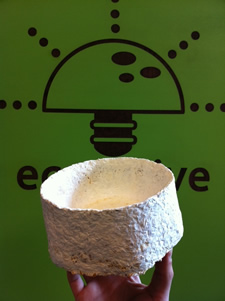 Ecovative, the Green Island-based startup that's developing a styrofoam replacement material made from mycelia (fungus roots), introduced its first consumer product today: the Myco-Bowl.
It sounds like the uses for the Myco-Bowl might be a bit limited:
Keep in mind that these bowls are made of natural materials. Appearance may vary slightly from bowl to bowl. You can fill them with water or plant things in them, but this will cause them to biodegrade. We don't recommend eating out of these.
If that doesn't float your boat, there are also Myco-Ducks.
OK, so consumer products might be the killer app here. Ecovative has developed packaging material for an office furniture company. And it's also developed an insulation material.
Ecovative was founded by Eben Bayer and Gavin McIntyre, both RPI grads. The company's gotten a lot of attention -- it was even name-checked on CSI:NY. Earlier this year it was named a "technology pioneer" by the World Economic Forum.
Earlier on AOA: a whole bunch of stuff about Ecovative
photo via Ecovative
A peek inside Vicarious Visions
This is fun: local filmmaker Mike Feurstein shot a piece about a school field trip to Vicarious Visions, the video game studio in Menands. It likes it could be a fun place to work.
Mike's piece is part of series trying to get kids interested in science, math and engineering. He tells us the piece was also crewed by local high school students.
Also: Sandra over at Albany Kid has put together a short list of local resources for kids interested in learning about video game development. Both Vicarious Visions and 1st Playable in Troy sometimes have kids come in to test games. She's hoping you might know have a few other ideas.
By the way: the next season of Mike's eScape series, shot here in the Capital Region, recently premiered.
Cohabit: two neighbors puzzle over an app
 Check it out: Axeva, a company in Clifton Park, has released an iPhone app puzzle game called Cohabit. From the press release:
Cohabit, the brainchild of neighbors Ken Malsan and Bryan O'Malley, challenges the player to "think twice" and is specifically designed to test a player's ability to solve two puzzles at the same time. Players must fill in a single board with numbers and colors without repeating any of them in the same column or row, similar to Sudoku. The additional challenge lies in the fact that every number/color combination must also be completely unique. Taking it one step further, the game's in depth scoring system rewards strategically minded players for placing a number and color in the same space at the same time - hence the name, Cohabit.
The release says Malsan came up with the idea and then pitched it to O'Malley -- the president of Axeva, and his next-door neighbor in Rexford -- and they often discussed the app while standing in their driveways.
The app works on the iPhone, iPad and iPod Touch. It's $1.99.
We downloaded the app and played it a few times on the iPhone. It is very much like Sudoku. The 3x3 puzzles are relatively easy, but it gets harder as the puzzle size increases. We could see this being a fun way to pass the time while you waiting for something.
Axeva released another iPhone app this past summer -- a color book app called Colortoons. The company's main business is building websites.
There are a few other local developers that have dipped their toes into the app pool. Both Ghost Hand Games in Saratoga and Spiral Design in Cohoes and have built apps alongside their regular businesses.
Earlier on AOA:
+ The CDTA iPhone app
+ Spiral Design's Split the check
+ Ghost Hand Games' Snow Brawlin'
image: Axeva
... said KGB about Drawing: What's something that brought you joy this year?