
Items tagged with 'economy'
Future jobs, done by humans and not
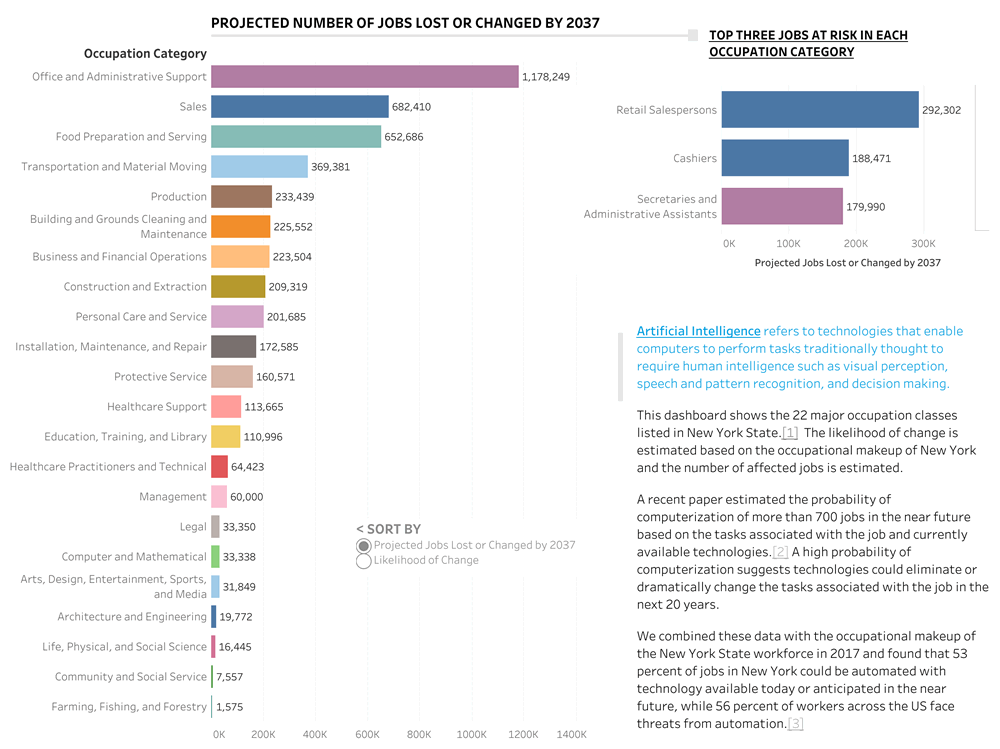
Roughly half of the jobs in New York State could be automated or otherwise significantly changed by artificial intelligence over the next 20 years. That's from an ongoing look at the issue by the Rockefeller Institute of Government here in Albany. From a post by Rockefeller's Laura Shultz:
The calculation is based on individual occupations. A recent paper by Frey and Osbourne estimated the probability of computerization of more than 700 jobs in the near future based on the tasks associated with the job and currently available technologies.[1] A high probability of computerization suggests technologies could eliminate or dramatically change the tasks associated with the job in the next twenty years. We combined these data with the occupational makeup of the New York State workforce in 2017 and found that 53 percent of jobs in New York could be automated with technology available today or anticipated in the near future, while 56 percent of workers across the US face threats from automation.[2]
Rockefeller has put together an interactive graphic that highlights the number of jobs -- by industry and type -- that could be affected around the state. (That image above is a static version of the graphic.) At the top of the list are office support, retail salespeople and cashiers, and food service -- potentially 2.5 million jobs lost or changed.
This struck us as a key clip from Shultz's post (emphasis added):
How the Albany metro area compares favorably to places such as Boston, DC, and Austin
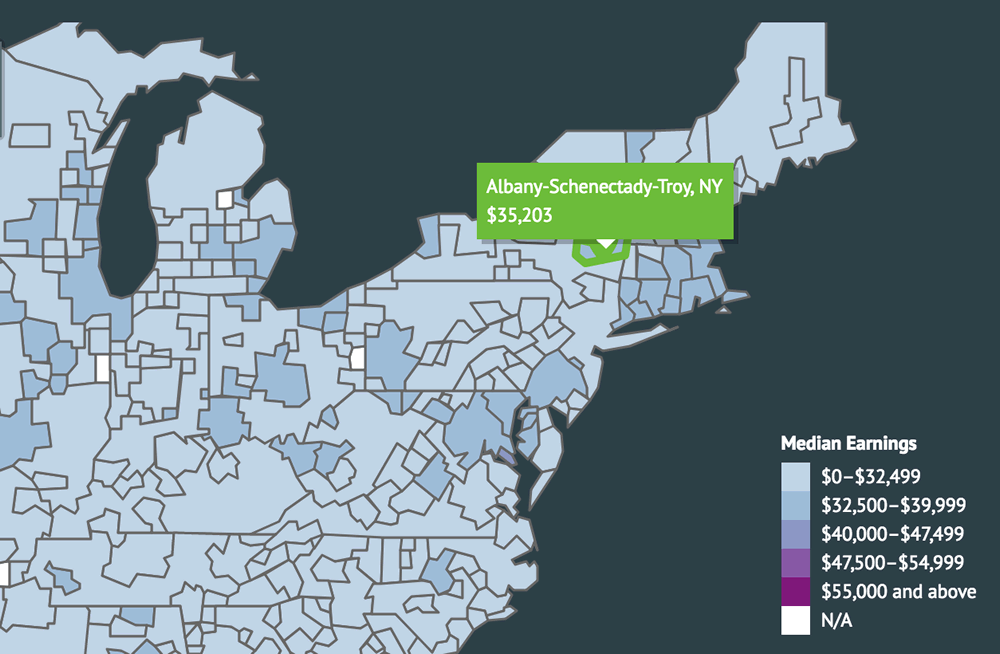
This is a screengrab from the Hamilton Project interactive visualization.
We were having a conversation the other day with someone about some of the things people who don't live here -- especially people from larger metros -- might not understand or appreciate about the quality of life here.
And one thing that immediately sprang to mind: There are (relatively) good job opportunities in the Albany metro area, and the (relatively) low cost of living means you can live here (relatively) comfortably without having to scrape like you would in a lot of big/coastal metros.*
That point is illustrated by this interesting interactive data visualization from The Hamilton Project at Brookings -- it depicts median income by occupation and age across the nation's 300some metro areas. (It's attached to an analysis aptly titled "Where Work Pays: How Does Where You Live Matter for Your Earnings?")
And here's the important thing: it gives you the option to adjust for cost of living and taxes.
So how's that work out for Albany?
Capital Region rent, relatively speaking
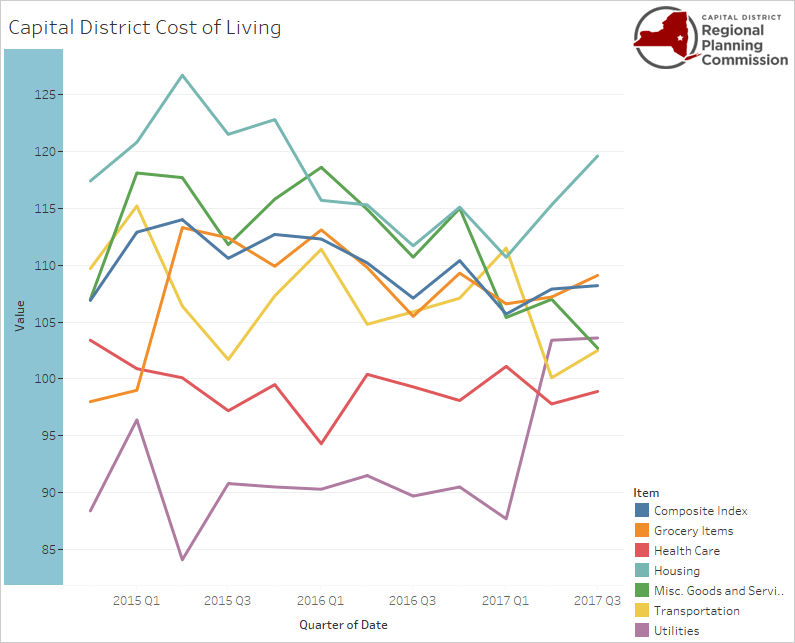
This graph is from the Capital District Regional Planning Commission and the Council for Community and Economic Research. It tracks a Capital Region cost of living measure relative to the national average quarter by quarter. That teal line running along the top is the cost of housing.
Speaking of residential develop and rents and related whatnot...
+ The median gross rent for Albany-Schenectady-Troy metro area was $931 (+/-21) in 2016, according the Census Bureau*. In the city of Albany it was $895 (+/-29). That is, half the rents (plus utilities if not included) were above that mark and half were below.
+ In 2007, the median gross rent for the Albany metro was $779 (+/-18) and for the city of Albany $746 (+/-37). The 2016 rent levels mentioned above are an increase of almost 20 percent in both cases. That increase outpaced general inflation for the United States -- if both had risen at the pace of general inflation, they would have been at $900 and $862.**
The Capital Region leads Upstate in job growth
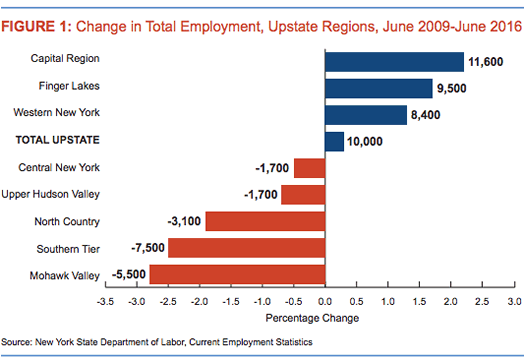
The Capital Region led Upstate New York* in employment grown between 2009 June and 2016 June -- that's from a new report by the state comptroller's office. The Capital Region* was up 2.2 percent over that period, while all of Upstate employment was up just 0.3 percent. It was one of just three (of eight) regions Upstate to see employment growth.
So... good for the Capital Region, right? Yep, but it's not all great.
Here are a few more interesting bits from the report about jobs Upstate...
One thing that sticks out about prices here
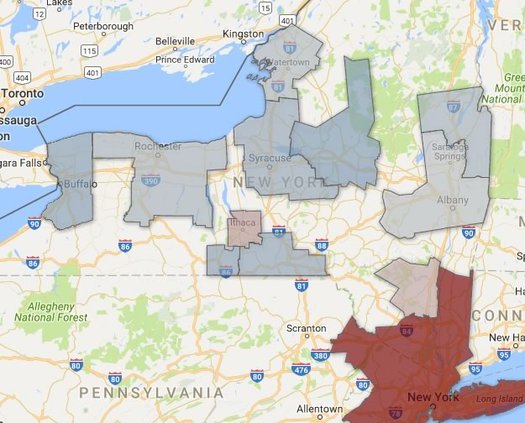
You might have seen that map floating around online recently about "the real value of $100 in each state" -- and New York State had one of the lowest "real" values of any state.
That map was based on figures published by the federal Bureau of Economic Analysis. And one of those figures is something called the regional price parities (RPPs) -- an attempt to measure how much goods and services cost in an area compared to the rest of the country.
You can probably now guess why the state level number for New York is kind of misleading -- if you're lumping in numbers for New York City with numbers for, say, Utica, it's going to be skewed. And to the credit of the think tank that made that state map -- the Tax Foundation -- it followed up this week with a similar map based on metro areas.
Anyway, this is just a long setup for looking at RPPs for metro areas around New York State. There's a static map above for the RPPs for all items across the state's metro areas -- and a clickable map after the jump. And as you can see, most parts of upstate have prices that are about average for the nation -- or lower.
Which is probably what you might expect -- except for one category...
The Capital Region's largest private employers*
* According to the state's RFP for the Harriman campus land sale
Tucked in that request for proposals for the sale of part of the Harriman State Office Campus in Albany was an interesting list: The largest private-sector employers "within commuting distance" of the site.
We've seen similar lists before. The state Department of Labor publishes lists for the state and individual regions (last update March 2014). But that list doesn't include job counts (the labor department cites confidentiality) -- and the one in the RFP does.
So, can you guess the largest private-sector employers in this area? We'll give you a few hints: healthcare and supermarkets...
Getting some sense of New York's upcoming minimum wage increases
As you know, New York State's minimum wage -- or, really, its minimum wages -- are set for large increases over the next handful of years. Areas downstate will eventually hit $15 an hour, and upstate will rise to $12.50, with continued increases planned after that.
Last year during the debate about whether the state should take this path, we tried to get some sense of the proposed increase by comparing the minimum wage to the wages of everyone else in the state. And we did this by region, because making $15 an hour in New York City isn't necessarily the same as making $15 an hour in Utica.
So now that the increases are set, we thought we'd run that comparison again. And we added a new one -- using the cost of housing as a yard stick.
5 bits about jobs in the Capital Region -- and how much they pay
We hear George does this job for free.
Which jobs in the Capital Region pay the most? Which pay the least? Which are the most common? Which are much more common here than other places?
Those are the sorts of questions to which we can an answer from a set of numbers of published by the federal Bureau of Labor Statistics. And, as it happens, the BLS released a new batch of those numbers this week.
And given all the recent discussion about New York State increasing its minimum wage, it seemed like a good time to pick out some bits from the new numbers.
Cuomo moving to raise minimum wage for state employees to $15 per hour
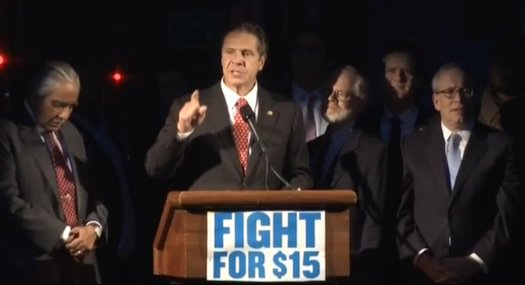
The Cuomo admin announced Tuesday that Andrew Cuomo is moving to unilaterally set a $15 minimum wage for state employees.
The increase would be phased in over the next few years, rising to $15 in New York City by the end of 2018, and by 2021 in the rest of the state. It's projected the increase would affect approximately 10,000 state employees -- 9,000 of them outside New York City.
The governor publicly announced the plan at a Fight for 15 rally in New York City. "This is about basic fairness and basic justice," he said of the push to raise the minimum wage both in New York State and across the country. "We're going to lead the way. The nation's going to watch us."
Degrees of difference between women and men
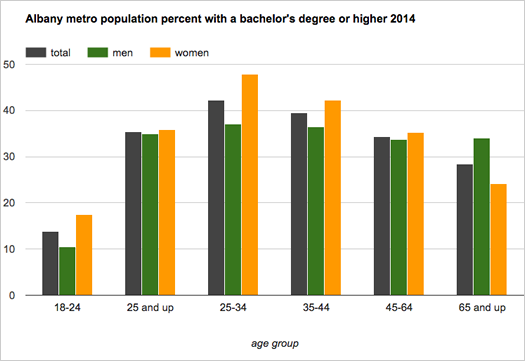
More women than men in the United States had a bachelor's degree or higher in 2014 -- 30.2 percent of women, compared to 29.9 percent of men, according to Census Bureau estimates. And as the bureau pointed out today, it's the first time that's happened nationally since the bureau started tracking the number in 1940.
We were curious about about the numbers for the Capital Region, so we looked 'em up for the Albany-Schenectady-Troy metro area. They're smashed into the chart above.
And here's a bit more...
A snapshot of Capital Region income
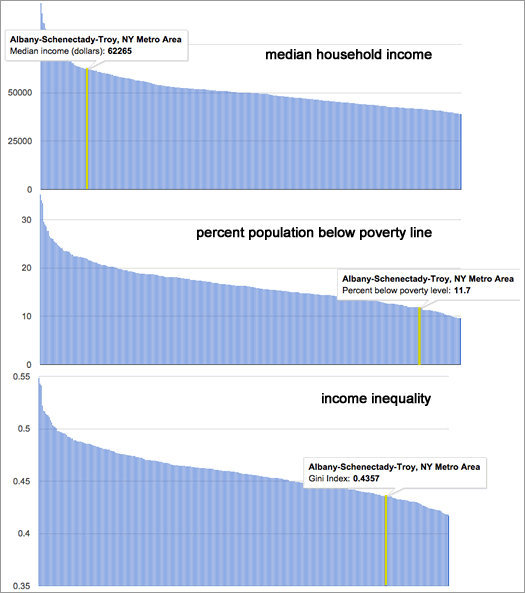
How the Albany-Schenectady-Troy metro compares to the nation's 381 other metro areas.
The Albany metro area continues to have one of the nation's higher median household incomes, and one of the the lower rates of poverty, according to the newest estimates from the Census Bureau.
Household income
The median household income in the Albany metro -- the point at which half the households had more income, and half had less -- was an estimated $62,265 (+/-1,494) in 2014. That's up just a bit from 2013 -- $59,626 (+/-1,981) ($60,593.25 in 2014 dollars). And it ranks 41st among the 381 metropolitan statistical areas the Census tracks.
Poverty rate
The Albany metro area's poverty rate was an estimated 11.7 percent (+/- 0.9). (It was 12.5 percent (+/-1.0) in 2013.) The metro's poverty rate was the 51st lowest among the 381 metros, lower than 87 percent of them. The Capital Region's poverty rate for kids wasn't quite so low -- an estimated 17.1 percent (+/-2), lower than 76 percent of metros.
Income inequality
Another angle on income and poverty is income inequality. And for that the Census Bureau publishes a figure called the Gini index -- a Gini index of 1 means only person has all the income, and 0 means everyone in a group has the same level. The Capital Region's Gini index for 2014 -- an estimated .4357 (+/-0.0119) -- was the 80th lowest (that is, toward the more equal end) among metropolitan areas.
Even if those three measure look relatively good for the Capital Region, there are still some troubling parts to the picture.
Getting some sense of a $15-per-hour minimum wage
When Andrew Cuomo recently proposed raising the state's minimum wage for all industries to $15, it created a big stir -- in large part because that's a big jump from the state's current minimum wage of $8.75 (soon to be $9). And it highlights the question: What is the "right" minimum wage?
Here's one way of thinking about that question for different parts of New York State...
Cuomo: Raise New York State's minimum wage to $15 an hour for all industries

Cuomo announced the push during an event in New York City with Joe Biden.
Updated
Andrew Cuomo announced Thursday that he will be pushing to raise the state's minimum wage to $15 an hour. The announcement accompanied word from the governor that the state Department of Labor has accepted the wage board recommendation that the minimum wage for fast food workers increased to $15 an hour.
Cuomo's push to raise the overall state minimum wage isn't that surprising (even if he had downplayed the push for $15 earlier this year). He had tried to get the legislature to accept an increase to $10.50 ($11.50 in NYC) during the last legislative session. And the fast food wage board plan was pretty clearly an attempt to out maneuver the opposition in the legislature. (State Senate Republicans -- the most likely road block to the minimum wage increase -- criticized Cuomo's handling of the fast food wage increase Thursday.) [NYT] [Politics on the Hudson]
Invoking the memory of both FDR and his father, Andrew called the proposed increase as matter of economic justice. "You cannot support a family on 18,000 a year in New York State, not to mention having a decent living," he said with Joe Biden looking on in New York City. "Every working man and woman in the state of new york deserves $15 an hour as a minimum wage and we're not going to stop until we get it done."
How much does it cost to have "a secure yet modest standard of living"?
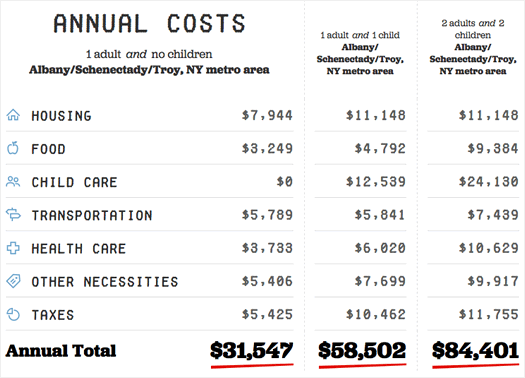
Clipped from the Economic Policy Institute Family Budget Calculator. Numbers are in 2014 dollars.
A family budget calculator posted online Wednesday by a think tank -- Economic Policy Institute -- aims to to answer that question for metro areas around the country. A few of the results for the Albany area posted above. (Here's a Washington Post interactive using the data that gives a quick look at how a metro stacks up against the rest of the nation.)
A bit of blurbage about the calculator:
Poverty thresholds are generally national income levels used to measure the number and share of Americans who are economically deprived. Conceptually, these measures are important metrics, but are fundamentally different from EPI's basic family budgets. Families above poverty thresholds are just thought to be free of outright material deprivation. In contrast, family budgets offer a broader measure of economic adequacy by measuring the dollar amount necessary for families to live securely but modestly in various communities across the nation.
As with anything like this, the methodology is going to make a difference in the outcome, and EPI documents the recipe it used.
One thing that caught our eye right away was the cost of child care. While it wasn't surprising that it was expensive, we wouldn't have guessed it was quite that much. A look through the methodology reveals that the cost of childcare is from data published by state. So it's possible the number is inflated a bit by the downstate cost. (Now we're curious about the cost of day care here in the Albany metro area...)
Earlier on AOA: A few ways of thinking about the minimum wage
Where the commuters are from
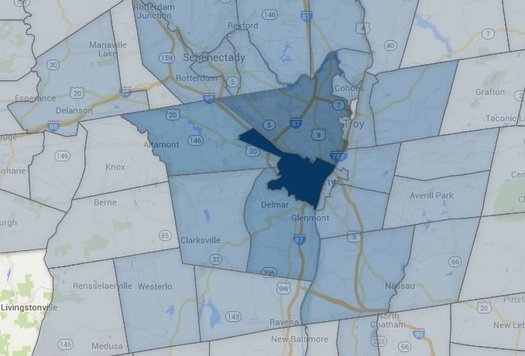
The city of Albany draws commuters from a wide area.
Each weekday in the Capital Region a large tide of people wash into the area's urban centers for their work days, and then stream back home. So large is this tide for the city of Albany that its daytime population during the week rises by 2/3.
So, where do all these people come from? Well, thanks to some recently released Census data, we can some sense of an answer to that question. And to extend the water metaphor a bit further, we can map out the "commuter sheds" that drain into each of the Capital Region's urban centers each weekday.
So let's have a look.
Jobs gained and lost
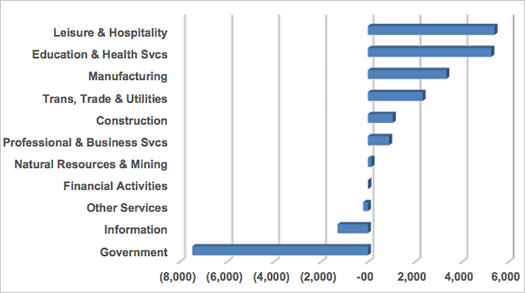
"Government" also includes jobs such as public school teachers. / graph: NYS OSC
That graph above depicts the numbers of jobs gained and lost, by sector, in the Capital Region between 2009 and 2014. It's from NYS Comptroller's Office report out Monday looking at employment trends across the state.
That might sound like a snore-inducing document, but it collects a bunch of bits that help fill out the picture on what's happening (or not happening) in the economy. A few of those interesting bits...
New York State set to raise fast food minimum wage to $15 per hour
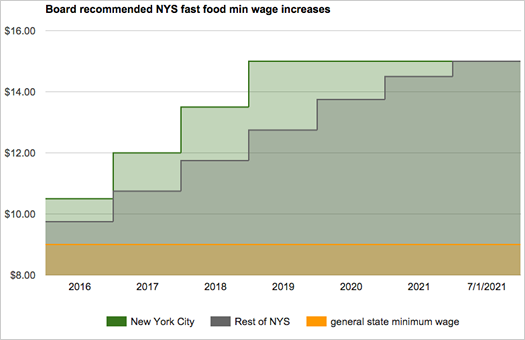
The state Fast Food Wage Board has recommended that the minimum wage for fast food employees across New York State rise to $15 per hour -- eventually.
The board's recommendation, which now heads to the state labor commissioner before it can take effect, lays out two tracks for increasing the industry's minimum wage, for New York City and areas outside the city:
New York closer to $15/hour for fast food workers?
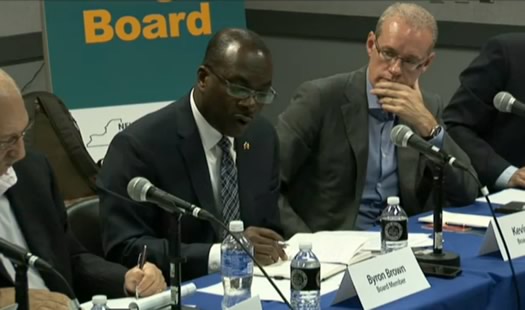
Buffalo mayor Byron Brown, chair of the fast food wage board, at Monday's meeting. / screengrab: NYS DOL livestream
At its last scheduled public meeting Monday the state's Fast Food Wage Board didn't recommend a specific increase in the minimum wage for fast food workers in the state -- but its members' comments pointed toward them eventually recommending a significantly higher rate.
"There's no question in mind that we need a very substantial increase in the minimum wage," board member Kevin Ryan, the chairman and founder of the online shopping site Gilt, said.
"When you look at the industry as a whole in this state, we really should be looking at one wage rate for the state, and that should be $15 and that should be as soon as possible," said board member Mike Fishman, the secretary treasurer of Service Employees International Union.
The fast food wage board was empaneled by the state Department of Labor at Andrew Cuomo's direction in May to consider raising the minimum wage in the industry. The Cuomo admin says the board's recommendation can be enacted without legislation.
On order: Another look at the minimum wage
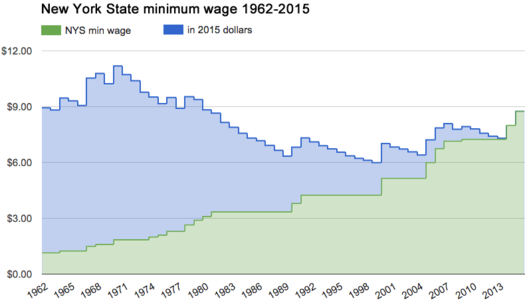
A minimum wage consistent across many industries in New York State dates back to 1962. Here's how it's increased over time, with a comparison in 2015 dollars for some perspective. (Inflation calculations via the federal Bureau of Labor Statistics calculator.)
This chart is recycled from last month, when we put together a bunch of different ways of putting the level of the minimum wage in context. With Andrew Cuomo talking again this week about raising the minimum wage, specifically for fast food workers, we figured it was a good time to highlight that post again.
From Cuomo's op/ed in NYT:
Fast-food workers and their families are twice as likely to receive public assistance compared with other working families. Among fast-food workers nationwide, 52 percent -- a rate higher than in any other industry -- have at least one family member on welfare.
New York State ranks first in public assistance spending per fast-food worker, $6,800 a year. That's a $700 million annual cost to taxpayers.
(Update: See this Capital article about an error in Cuomo's op/ed regarding the number of fast food workers who are raising children.)
The median hourly wage -- that is, the point at which half the people make more and half make less -- for fast food cooks in the Albany metro area was $9.25 per hour in 2014 May, according to numbers published by the federal Bureau of Labor Statistics, with an annual average wage of $20,520. The BLS also breaks out numbers for "combined food preparation and serving workers, including fast food," and the median wage for the Albany metro area was $8.93.
The median hourly wage for restaurant cooks generally in this area was $11.48 per hour, $9.89 for servers, and $9.13 for dishwashers. (Here are the same sets of numbers for New York State generally.)
Elsewhere: Back in March Steve Barnes looked at how an increase in the minimum wage for tipped employees was set to affect restaurants -- and non-tipped restaurant employees such as dishwashers.
If place matters, why specifically?
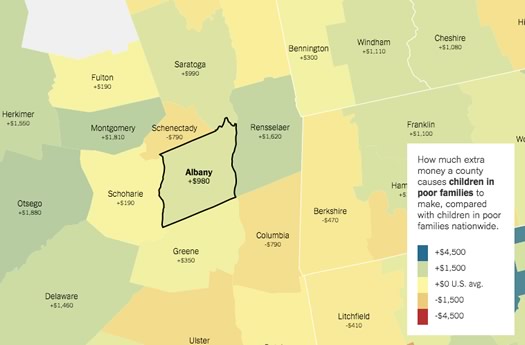
A clip from the interactive map at NYT's The Upshot.
Sometimes information raises more questions than it answers.
We were thinking about that today while looking through this impressive New York Times interactive piece about a new study that examines how place affects the income mobility of children. A clip:
The main innovation of the new paper -- part of the Equality of Opportunity Project, involving multiple researchers -- is its focus on children who moved. Doing so allows the economists to ask whether the places themselves actually affect outcomes. The alternative is that, say, Baltimore happens to be home to a large number of children who would struggle no matter where they grew up.
The data suggests otherwise. The easiest way to understand the pattern may be the different effects on siblings, who have so much in common. Younger siblings who moved from a bad area to a better one earned more as adults than their older siblings who were part of the same move. The particular environment of a city really does seem to affect its residents.
The data does not answer the question of whether the factors that distinguish higher-mobility places, like better schools and less economic segregation, are causing the differences -- or are themselves knock-on effects of other, underlying causes. "We still need clarity on that," Mr. Grusky, the Stanford professor, said.
There are a lot of important details beyond that clip, and it's worth reading that article and the accompanying pieces. Here's economist Justin Wolfers arguing that the study "makes the most compelling case to date that good neighborhoods nurture success."
So, we've been poring over the results for the Capital Region and they raise a lot of questions. For example:
A few ways of thinking about the minimum wage
The "Fight for 15" rallies got a lot of attention around the country this week, including here in the Capital Region, as people pushed for an increase in the minimum wage.
The current minimum wage in New York State is $8.75 per hour. It's scheduled to increase to $9 at the start of next year.
A lot of numbers get thrown around in these discussions, and sometimes it can be hard to keep in them context. So we put together a few easy-scan charts in an effort to get a better sense of things...
Siena poll: Majority support minimum wage increase to $10.50 per hour
 When given the choice of letting the New York State minimum wage rise to the already-scheduled level of $9/hour next year or raise it to $10.50 per hour, almost 3/4 of respondents in a Siena poll out today picked the $10.50 level.
Here's the question text from the Siena poll, because it was a little complicated:
The current minimum wage in New York State is eight dollars seventy-five cents per hour. It is scheduled to go to nine dollars per hour next year. When it comes to the minimum wage, among the following three choices, do you agree more with the State Senate, which wants it kept at nine dollars per hour, OR Governor Cuomo, who wants it increased to ten dollars fifty cents per hour, OR the State Assembly, which wants it increased to ten dollars fifty cents per hour now, with provisions to go higher in future years?
And the answer options:
+ "State Senate, which wants it kept at nine dollars per hour": 26 percent of all respondents
+ "Governor Cuomo, who wants it increased to ten dollars fifty cents per hour": 20 percent of all respondents
+ "State Assembly, which wants it increased to ten dollars fifty cents per hour now, with provisions to go higher in future years": 52 percent of all respondents
The $10.50/hour options drew the combined support of more than 65 percent in each of the three income categories for respondents -- less than $50k, $50-$100k, and $100k+. And it also had at least 50 percent support from both Democrats and Republicans.
The Siena poll also asked about the idea of a having a higher minimum wage downstate -- the yes/no split on that was 47/51 for all respondents. NYC respondents supported 55 percent, it was essentially even for people in the downstate suburbs, and upstate respondents opposed it 63-43.
The Siena Research Institute says the poll was conducted March 15-19 and has a +/- 3.5% margin of error.
Leaning toward renting
Home sweet (rented?) home. / photo: Flickr user Joelk75 (CC BY 2.0)
Last week we wrote about one of the residential conversions in progress in downtown Albany. As is so often the case, a prominent thread in the comments was the rental price. And then chris capped things off with this comment:
Hey, when people start buying houses again this place will be half-empty and they'll have to drop the rent. Have patience...
We were thinking about how chris framed the situation -- essentially, people are leaning away from buying houses right now and toward renting -- and wondering if we could get a better sense of the situation.
Are there numbers on that? Of course. Did we look them up? Of course. Are we now going to share some of the numbers with you, with graphs? Of course.
The Capital Region's unemployment rate continues to drop
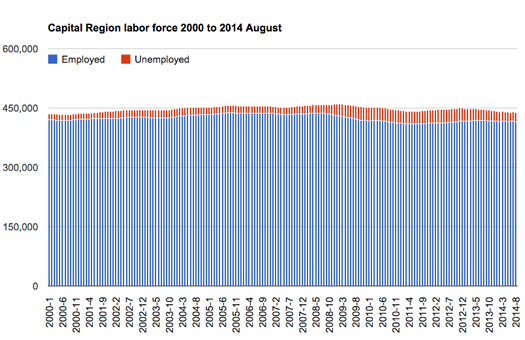
The Capital Region labor force since 2000. Here's a bigger version.
The Capital Region's unemployment rate was 4.8 percent in September -- one of the lowest rates of any metro in the state -- according to figures out this week from the state Department of Labor. And it was down from 6.1 percent in September 2013.*
New York State's unemployment rate was 5.6 percent in September, down from 7.4 percent the year before. And the upstate unemployment rate was 5.5 percent, down from 6.9 percent the year before.
The numbers for September continue a trend for the Capital Region in which each month's unemployment rate has been lower than that same month the year before, dating back to 2012 November.
Nordstrom Rack to open at Colonie Center
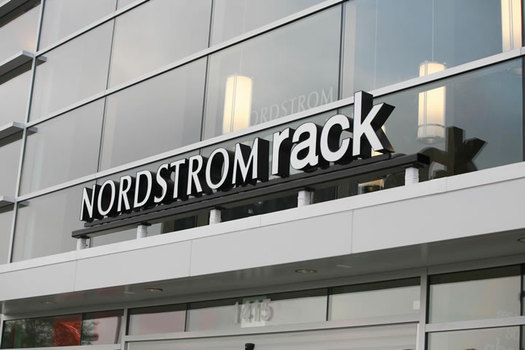
Nordstrom announced Wednesday that it's opening one of its Nordstrom Rack stores at Colonie Center in fall 2015. The company says it will be a two-level store -- roughly 35,000 square feet (roughly the same size as the new Whole Foods there) -- and it sounds like it will be in the same end of the mall as Sears.
Nordstrom Rack is the discount outlet for the upscale department store chain. The company says Rack offers "customers a wide selection of on-trend apparel, accessories and shoes at an everyday savings of 30-70 percent off regular prices."
As it happens, there are more Nordstrom Racks (162) than full Nordstroms (118). And the Colonie Center is one of 22 Nordstrom Rack locations the company has announced it plans to open in 2015.
It's interesting to us that, for whatever reason, the Capital Region appears to be getting attention from higher-end retailers over the last few years. Fresh Market has two locations in the region, Whole Foods opened earlier this year, Lord & Taylor returned at Crossgates just recently, and now (the not-quite-so-high-end-version of) Nordstrom.
We're curious if that points to something shifting in the demographics of this area. (More high-income households because of the nano/chip fab industry, maybe?) Or is it just that these upscale retailers have already expanded everywhere else and they're just getting around to the Capital Region.
Earlier on AOA: What "they" say about here
photo courtesy of Nordstrom, Inc.
... said KGB about Drawing: What's something that brought you joy this year?