
Items tagged with 'science'
Chad Orzel: Breakfast With Einstein

Check it out: Union College physics professor/science writer Chad Orzel has a new book out today called Breakfast with Einstein: The Exotic Physics of Everyday Objects. Blurbage:
In Breakfast with Einstein, Chad Orzel illuminates the strange phenomena lurking just beneath the surface of our ordinary lives by digging into the surprisingly complicated physics involved in his (and anyone's) morning routine. Orzel, author of How to Teach Quantum Physics to Your Dog, explores how quantum connects with everyday reality, and offers engaging, layperson-level explanations of the mind-bending ideas central to modern physics.
From the sun, alarm clocks, and the red glow of a toaster's hot filaments (the glow that launched quantum mechanics) to the chemistry of food aroma, a typical day is rich with examples of quantum weirdness. Breakfast with Einstein reveals the hidden physics all around us, and after reading this book, your ordinary mornings will never seem quite as ordinary again.
Orzel's previous book was Eureka: Discovering Your Inner Scientist . And How to Teach Quantum Physics to Your Dog was a Jeopardy! answer earlier this year.
(We're now looking forward to Waking Up With Newton and an explanation of why it's so hard to get out of bed in the morning.*)
Orzel will be at The Open Door Bookstore in Schenectady this Saturday, December 15 for a signing from 1-2:30 pm.
____
* Yep. That's a terrible inertia joke. Oof.
author photo via Oneworld Publications
Here's a chance to look through the telescope at Siena's new observatory
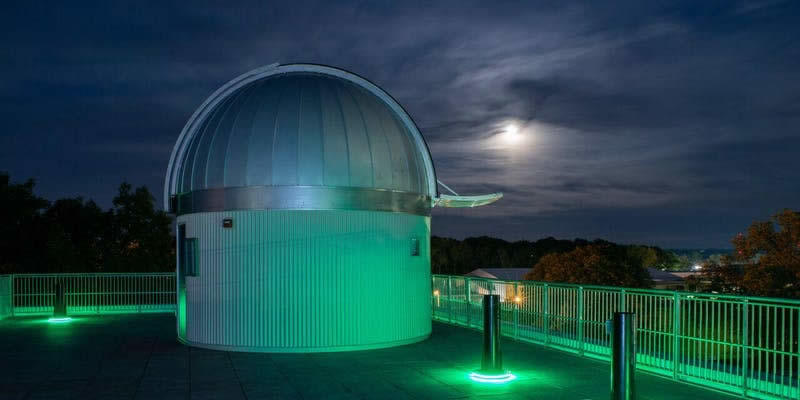
The grand opening for Siena College's new Breyo Observatory is Saturday, November 10. And the observatory will be open free to the public. Blurbage:
Enjoy the opportunity to view the moon, Mars and Saturn through the largest diameter telescope in New York's Capital Region. There will be activity tables for families hosted by Siena's Physics Club and Schenectady's Dudley Observatory, and a giveaway*. [*while supplies last]
That evening there will be a talk led by Fr. George V. Coyne, S.J., former director of the Vatican Observatory and head of the observatory's research group at the University of Arizona. The title: "The Dance of the Fertile Universe: A Meeting of Science and Religious Belief." That's at 6 pm, and viewing will follow.
Then from 8-10 pm, there will be viewing sessions members of the public blocked out in half-hour segments.
Registration is required for both the talk and the viewing sessions. See the link above.
(If it's cloudy that night the public viewing sessions will be moved to November 11.)
photo via Siena College
There's a new type of tick in New York State
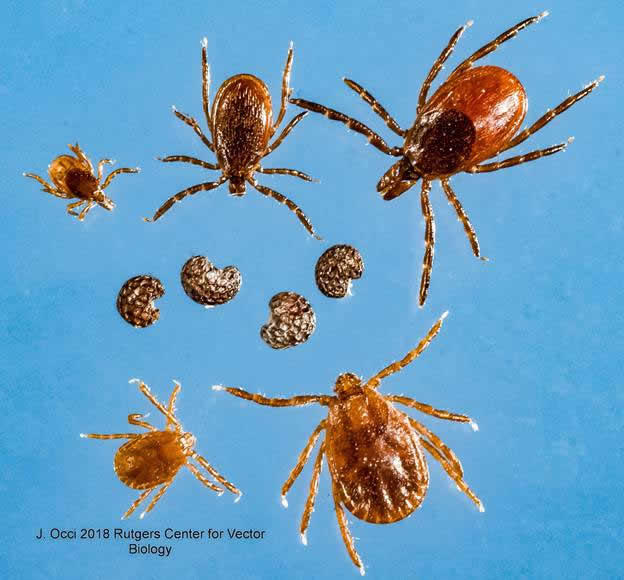 There's a new type of tick in New York, the state Department of Health announced Tuesday: Haemaphysalis longicornis -- the "longhorned tick." DOH says it was found in multiple locations in Westchester County. From the press release:
While the longhorned tick has transmitted disease to humans in other parts of the world, more research is needed to determine whether this can happen in the United States. Regardless, New Yorkers should continue to take steps to protect themselves, their children and their pets against ticks and tickborne diseases that are present in New York State.
This tick is also a concern for the New York State agricultural industry and may pose a threat to livestock. Farmers should continue to work with their veterinarians to check their animals, particularly cattle, sheep and horses, for exposure to ticks and to ensure their parasite control plans are up to date and working. Symptoms of tick-borne disease in cattle include fever, lack of appetite, dehydration, weakness and labored breathing.
That photo on the right compares deer ticks (top) and longhorned ticks (bottom) with poppy seeds (middle) for scale. (Click on the photo for a larger version -- we figured no one needed to see that up close unless they wanted to.)
The Hudson Canyon
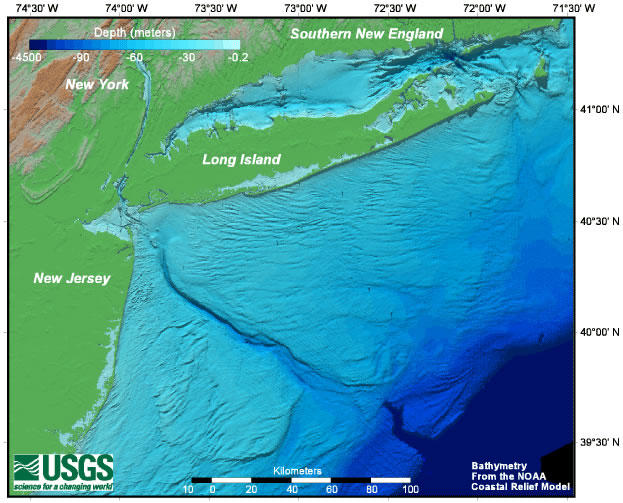
From the US Geological Survey Woods Hole Coastal and Marine Science Center
Not local exactly, but connected to here and kind of wild: A submarine canyon -- the largest on the eastern coast of the United States -- extends from the end of the Hudson River out through the continental shelf in the New York Bight. From the Friends of the Pleistocene blog:
The canyon dates to the Pleistocene and is actually an ancient extension of the Hudson River. During the Pleistocene, sea levels were 400 feet lower (in part because of all the water locked up in glaciers). The reduced sea level meant that the Hudson flowed 100 miles further east of its present location at the terminus of Lower Manhattan. The canyon carved by the Hudson extends a remarkable 450 miles across the continental shelf, then connects with the deep ocean basin where it descends to depths of 3 to 4 kilometers. As the Wisconsin Ice sheet retreated from what is present day New York City, the mighty Hudson of the Pleistocene transported heaps of glacial discharge and carved the surrounding landscape in its path.
As the state Department of Environmental Conservation noted today on Twitter, the canyon is home to many species of cold water corals. (It's also become a collection spot for all sorts of pollution that's been dumped into the ocean and washed down the Hudson River over the years.)
Earlier:
+ Odd and notable creatures of the Hudson River
+ That time whales swam to Albany
+ Ice Ages at the State Museum
A very animated explainer about ticks
This might not be the claymation that we want, but it's the claymation that we need.
The clip embedded above is a short claymation explainer about the life cycle of black-legged ticks and ways to protect yourself against them. It's from the New York State Integrated Pest Management program, which is associated with Cornell and the Cornell Cooperative Extension.*
Ticks and the diseases they carry are a big problem in this part of the country. And just last week the Cuomo admin a announced a new round of increased efforts to address the proliferation of ticks and the diseases they spread, such as Lyme.
But back to the video clip... It was created by Max Helmberger, an entomology grad student. Here's a Cornell news article about his work. And, yep, he has more claymation science videos on Youtube.
* Integrated pest management is a fascinating topic. It's basically about how humans can better deal with things like insects and weeds and plant diseases in ways that hurt the environment as little as possible.
Spotting the spotted lanternfly
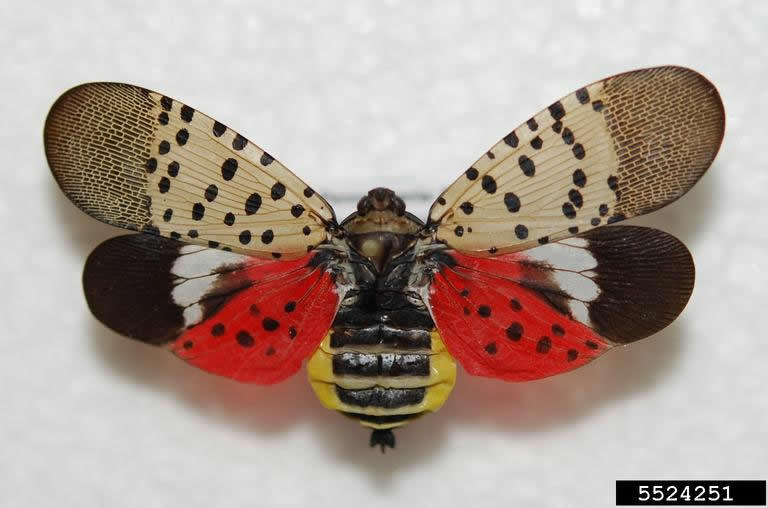
There is an insect called the spotted lanternfly. It's an invasive species here in the United States. And the state Department of Environmental Conservation would like you to report if you see one around here.
DEC reasons blurbage (emphasis added):
SLF pose a significant threat to New York's agricultural and forest health. Adults and nymphs use their sucking mouthparts to feed on the sap of more than 70 plant species. This feeding by sometimes thousands of SLF stresses plants, making them vulnerable to disease and attacks from other insects. SLF also excrete large amounts of sticky "honeydew," which attracts sooty molds that interfere with plant photosynthesis, negatively affecting the growth and fruit yield of plants. New York's annual yield of apples and grapes, with a combined value of $358.4 million, could be impacted if SLF enters New York. The full extent of economic damage this insect could cause is unknown at this time.
Although native insects also secrete honeydew, the size of SLF and the large populations that congregate in an area result in large accumulations of it. The sticky mess and the swarms of insects it attracts can significantly hinder outdoor activities. In Pennsylvania, where SLF populations are the densest, people can't be outside without getting honeydew on their hair, clothes, and other belongings.
Ew. Also: the term "sucking mouthparts."
The recipe for a thunderstorm
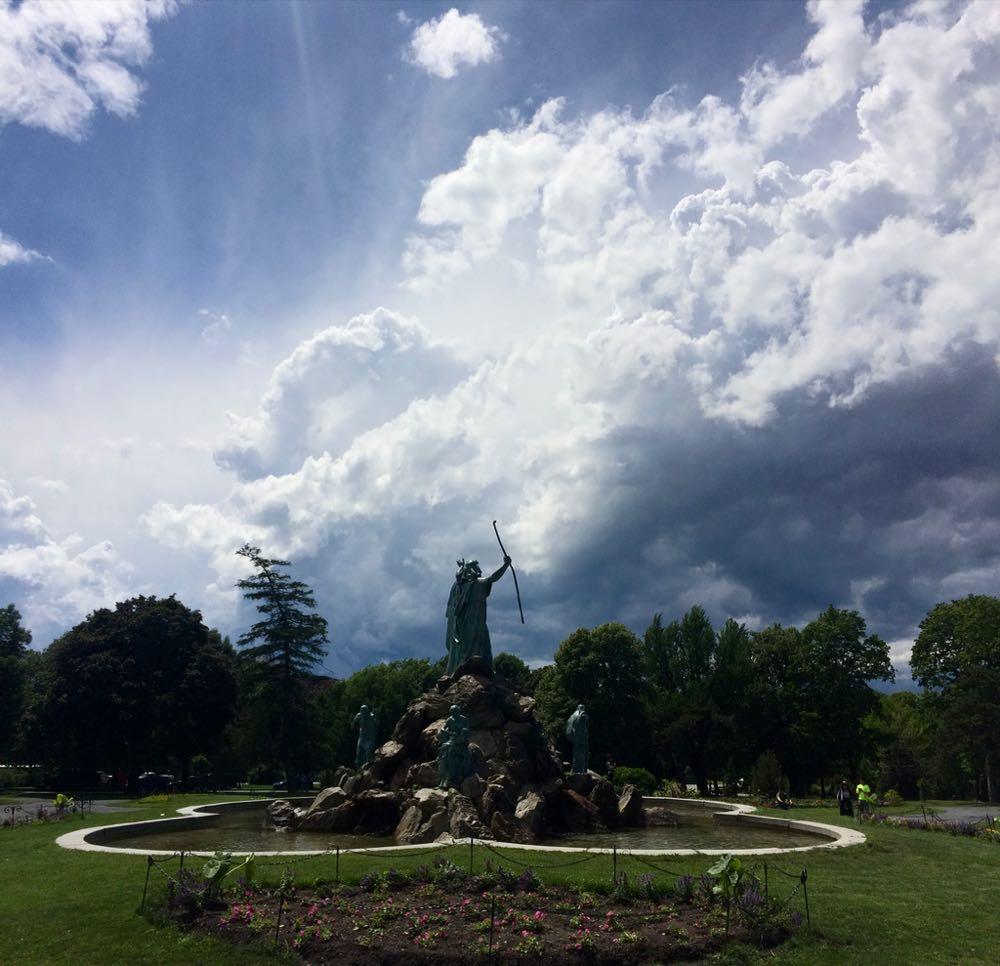
You no doubt know Jason from his many years as a meteorologist on TV here in the Capital Region. He's helping us nerd out on some local weather stuff. Got a question about how local weather works? Send it along!
I was an on-air meteorologist for 17+ years and during that time I visited over 200 schools to give weather talks. The most frequently asked question was: "Why/how did you get in to meteorology?"
The answer is simple: thunderstorms.
Damn things used to freak me out, especially at night. You're like six years old, the whole room lights up and then, BOOM. No, thank you. Didn't want any part of that mess.
But one day my father took me down to the main branch of the Albany Public Library to learn about thunderstorms, and that's exactly what I did. I quickly found out how simply amazing thunderstorms are. And by the way, so is the rest of our weather.
I was hooked, and always will be.
Science in politics, scientists in bars, and another March for Science in Albany
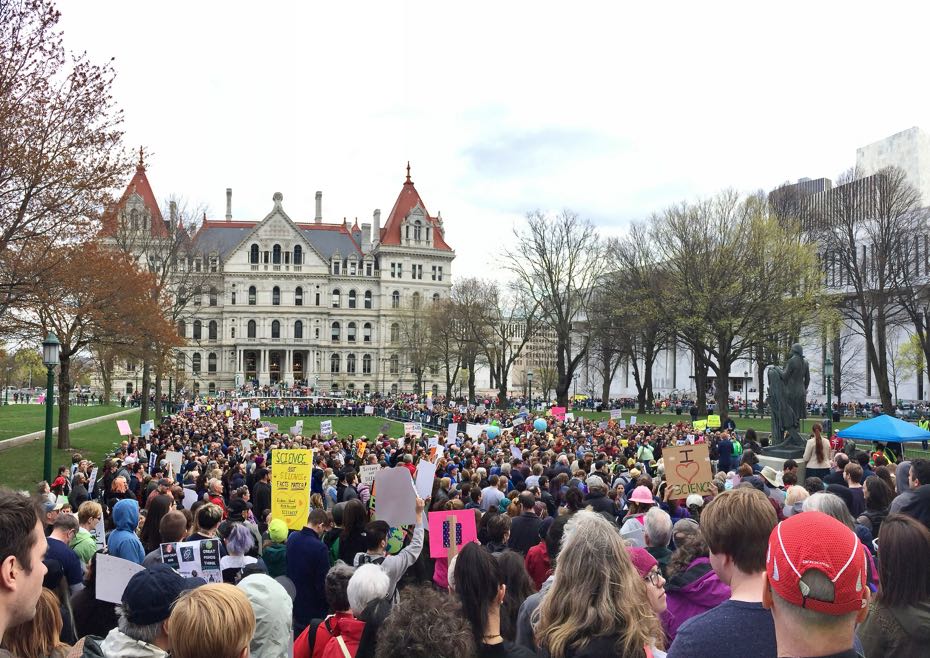
The crowd at last year's Albany March for Science.
The Albany March for Science returns to West Capitol Park this Saturday. It's the second year for the event -- last year's event drew thousands of people rallying to support research funding and evidence-based public policy on issues such as climate change.
This time around the event will again feature speakers, a march, and hands-on science activity tables.
There are a bunch of local academic and research orgs backing event, including a new local non-profit called CapSci that's aiming to promote public understanding of science through all sorts of events.
We talked with one of the organizers of this year's march -- Sarah Berke, an associate professor of biology at Siena -- about the motivation for a second march and... scientists in bars.
Very well acquainted, too, with matters mathematical, they are the very model of a modern forecast meteorological
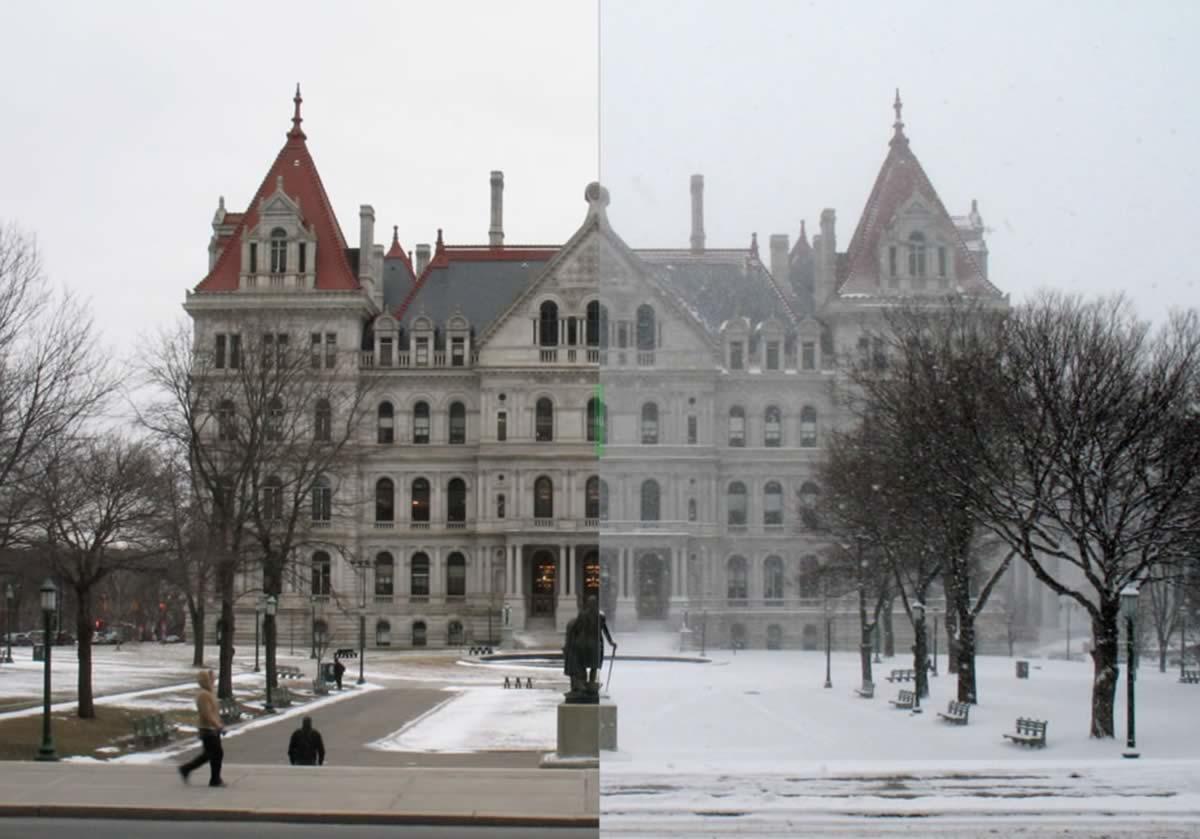
Sometimes the models can't agree on what the picture's going to look like.
We're happy to welcome Jason Gough to AOA as a contributor. You no doubt know Jason from his many years as a meteorologist on TV here in the Capital Region. He's going to help us nerd out on some local weather stuff. Got a question about how local weather works? Send it along!
If you watched me over the years for your weather forecasts on even a semi-regular basis -- and thank you if you did! -- you may have noticed that when winter storms came into the mix, you heard something like: "I'm tracking the storm, but the models don't agree on things just yet. Still a few days to sort it all out."
The models? What's that all about?
The earth beneath our feet
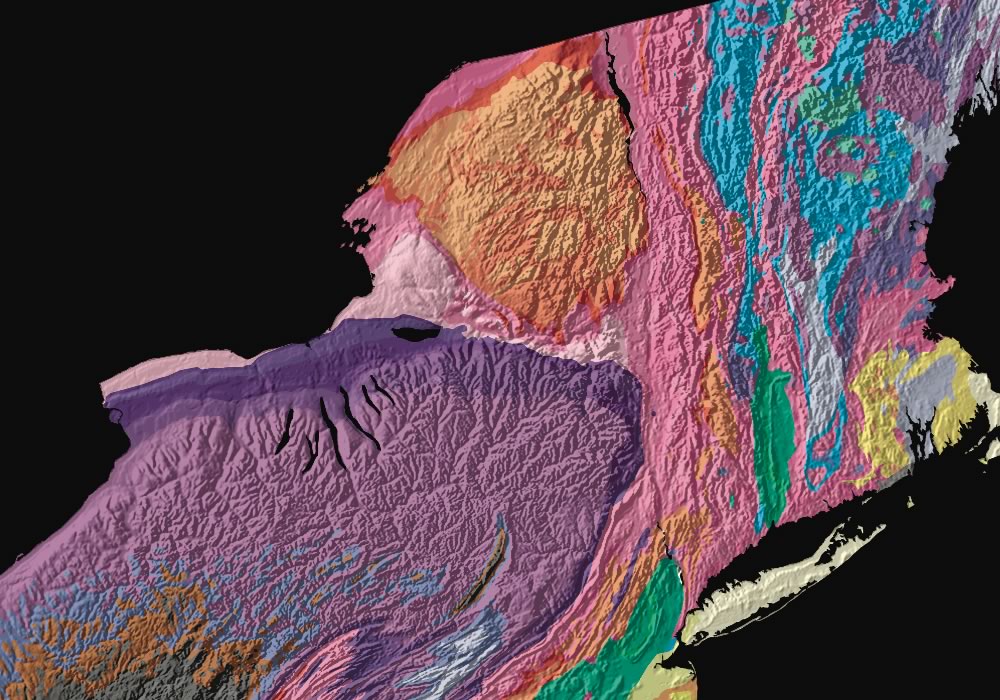
Friday afternoon geology*: Check out this US Geological Survey map showing the topography and geology of New York State and nearby areas. We clipped this section from a national map -- see that link above -- which is really worth a look.
The map colors correspond to the age of the rock. The purple area dates back to about 400some million years ago. The pink dates back to around 500some million.
And then there are the Adirondacks, which (literally) just stick out. So we looked up a little bit about their geology. From an Adirondack Park Agency explainer:
The Adirondack Mountains are very different in shape and content from other mountain systems. Unlike elongated ranges like the Rockies and the Appalachians, the Adirondacks form a circular dome, 160 miles wide and 1 mile high. Although the Dome as we know it today is a relatively recent development, having emerged about 5 million years ago, it is made of ancient rocks more than a 1,000 million years old. Hence, the Adirondacks are "new mountains from old rocks."
____
*What, when is your day and time for thinking about geology?
[via Kottke]
Brain Food for the Curious returns for a new season at the State Museum this week

The State Museum's "Brainfood for the Curious" series of short lunchtime talks starts a new season this Tuesday, October 17.
A museum historian or scientist gives a 20-minute talk in the museum's Huxley Theater and then answers questions. The talks cover all sorts of topics, from history to fashion to geology to archaeology to biology. Each event starts at 12:10 pm. They're free.
Here's the schedule for the new season...
Chronicling the eclipse in Albany... in 1806
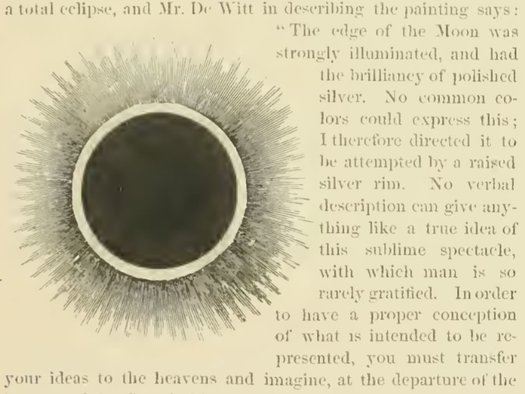
Because eclipse: On June 16, 1806 there was a total eclipse, and the path of totality passed pretty much directly over the Albany area. It was, in the words of Simeon De Witt, a "sublime spectacle" that fixed "the gaze of man in silent amazement" for several minutes.
De Witt was the Surveyor General of New York State at the time and worked from the Capitol in Albany. He summarized the experience of the eclipse in a letter to Benjamin Rush and the American Philosophical Society. Accompanying the letter: a painting the eclipse by the noted local portraitist Ezra Ames (more on that in a second). A clip:
[The painting] gives, I believe, as true a representation of that grand and beautiful phenomenon, as can be artificially expressed. The edge of the moon was strongly illuminated, and had the brilliancy of polished silver. No common colours could express this; I therefore directed it to be attempted as you will see, by a raised silvered rim, which in a proper light, produces tolerably well, the intended effect.
A few spots around the Capital Region for watching the eclipse
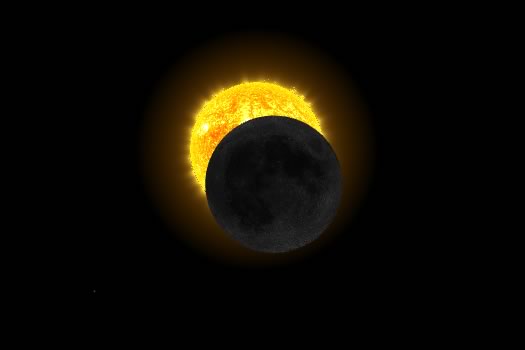
A simulation of what the eclipse will look like at its maximum coverage here. It's from NASA's "Eyes on the Eclipse" online app, which is fun to play with.
Updated
As you've no doubt heard, the moon is going to get between the Earth and the sun Monday, casting its shadow across this part of the world. And though the Capital Region isn't in (movie trailer voice) THE PATH OF TOTALITY, we will see a partial eclipse between 1:22 pm and 3:56 pm (maximum eclipse at 2:42 pm).
If it's not cloudy, you'll be able to see what's happening -- while wearing proper eye protection -- from anywhere with a clear view of the sky. But it might be more fun to see it with other people, some of whom can explain exactly what's happening. (Luna's throwing shade. That's what's happening.)
So here are a few of those places to catch the eclipse in the Capital Region...
Science on Tap: "The Riddle of the Invisible Dark Matter"
 The local drink-and-discuss series Science on Tap is still rolling along after starting up this past February. The next talk is Tuesday, June 27 at MopCo in Schenectady. The topic: "The Riddle of the Invisible Dark Matter":
We are sure that it exists! Searches for this mysterious "dark matter" have gone on for decades, but discovery still eludes us. Please join Dr. Matthew Szydagis, Assistant Professor of Physics at UAlbany, at MOPCO Theatre where he will discuss the status of these searches.
The talk starts at 7 pm and admission is free.
Science on Tap is a monthly series aimed at providing opportunities for conversation between scientist and the general public. Previous talks have focused on solar eclipses, conservation, and "how to smell bullshit."
The old observatory
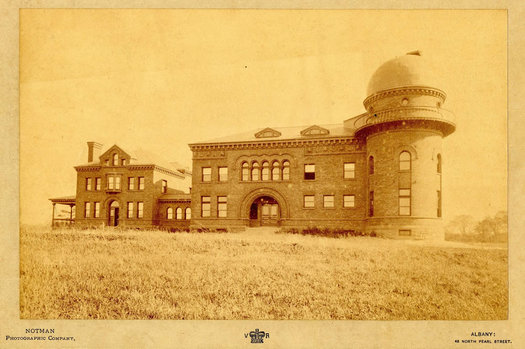
Speaking of observatories... Albany had an observatory. In fact, the observatory still exists... just not in Albany.
The Dudley Observatory was once located at different spots in the city of Albany -- in north Albany, and then on the triangle of land between New Scotland Ave, South Lake, and Myrtle. (The Capital District Psychiatric Center is there now.)
That photo above is from the former observatory building on South Lake. From The Dudley's history blog, Counting Stars:
The second building is Dudley's most famous, and it was one of the most iconic buildings in Albany at the time. It showed up in postcards and maps of the era. It was an imposing Romanesque structure of red brick, two stories tall with an observatory tower at the western end. To the east was the residence of the director and temporary housing for visiting astronomers. In the center were the rooms for the computers, the library and the rooms for the resident astronomers.
And those computers? People -- usually women. (Yep, like in Hidden Figures.)
The observatory sold the building to Albany Med in the 1960s (it later caught on fire), and moved to an office on Fuller Road. It's now located at miSci in Schenectady.
photo via The Dudley Observatory
Siena looks to the heavens
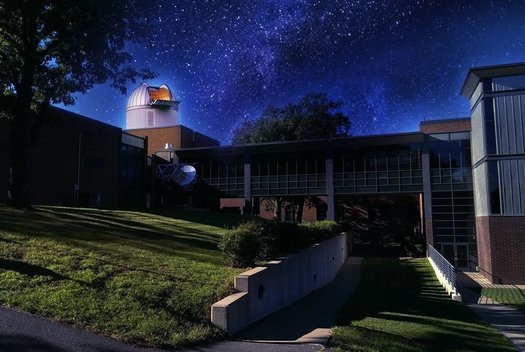
A rendering of the planned observatory.
Something to watch for: Siena is building a new observatory that it says will house the area's largest telescope. Work is scheduled to start this summer on the college's Loudonville campus and it's aiming for the telescope to be up and running this fall.
Press release blurbage:
The permanently-mounted telescope will be housed in a 16-foot structure atop Roger Bacon Hall, topped by a rotating dome with a retractable opening. The telescope will feature a 27-inch diameter mirror that can be remotely controlled via the internet.
The telescope will allow eyepiece observing of such favorites as the moons of Jupiter and Saturn's rings, and will have sophisticated imaging that will be used to track near-Earth asteroids and to follow the fading light of exploding stars, according to [physics professor] Dr. [Rose] Finn. In addition, a spectrograph will allow for analysis of the chemical composition of stars, nebulae and galaxies.
The observatory won't be used by just physics and astrophysics faculty and students - Dr. Finn said that more than 30 percent of Siena students take Introduction to Astronomy as a liberal arts elective, and they will be able to use the telescope as well.
Students and faculty will use the observatory for their coursework and research, and public observing sessions will be held throughout the year.
Siena got a $467,402 grant for the project from a foundation.
Other observatories
Two other observatories in the area:
+ The Dudley Observatory at miSci, which hosts all sorts of events and classes, including star parties with telescopes. (See also its blog)
+ The Hirsch Observatory at RPI often offers public viewing sessions on Saturday nights.
image via Siena
Signs from the Albany March for Science
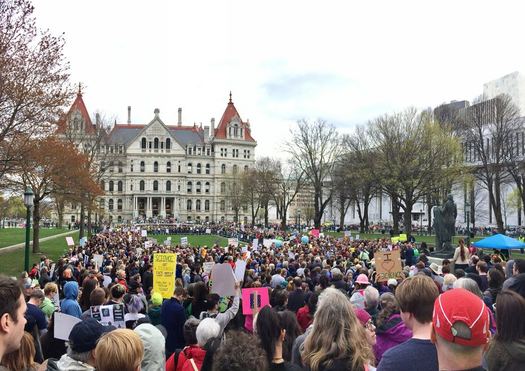
Thousands of people gathered in West Capitol Park Saturday for the Albany Science March event to rally support for research funding and evidence-based public policy on issues such as climate change. (Here's more about the motivation for the event.) It was one of many related marches around the country.
As with most events likes this, many of the people at the Capitol had signs. Unlike most events like this, many of those signs involved mathematical puns or other nerdy references and jokes.
Here are a bunch of those signs, along with a handful of photos from the event...
Talking about the motivation for the March for Science in Albany

From the women's march in Albany in January. "I was very excited after seeing the momentum after the women's march in Albany, so I wanted to get involved," said Jessica Reichard, one of the organizers of the upcoming Albany march for science.
The presidential election has stirred a lot of people to take action or speak up in ways that maybe they haven't in the past, prompting new connections and organizing.
The next example is this Saturday, when there will be a March for Science in DC and cities around the country, including here in Albany. The mission statement for the local event:
• Promote scientific education for both adults and children
• Increase communication between scientists and the community
• See how government and scientists can work together
• Join with the National March to demonstrate the public support worldwide for evidence-based policies
The Facebook page for the event in West Capitol Park and subsequent march has almost 2,000 people marked as planning to go.
"One of the things that I've found most remarkable is the way our group has formed organically," said Jessica Reichard, an engineer and one of the organizers of the Albany event, this week. "None of us knew each other before organizing this -- we just connected on Facebook and it just kind of took on a life of its own with a lot of passionate people."
Here's a quick chat with Reichard about the motivation for the event in Albany and the intersection of science and politics...
Ice Ages at the State Museum
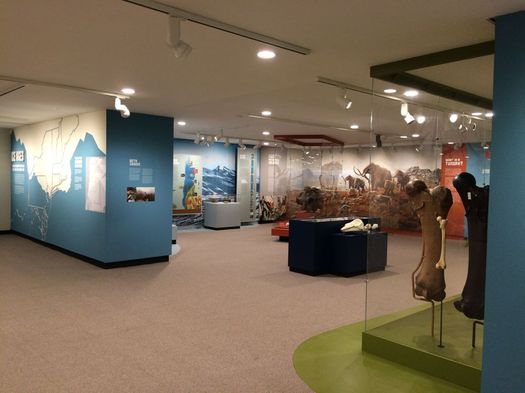
The State Museum opened a new exhibit last week -- Ice Ages -- that is about... well... ice ages in New York. (Surprise!) It's back by the Cohoes Mastodon and worth a stop the next you're at the time museum. It'll be on display until the beginning of 2019.
We got a chance to check out the exhibit recently. And now let us quickly nerd out on a few things from it...
Adapting for a more extreme future
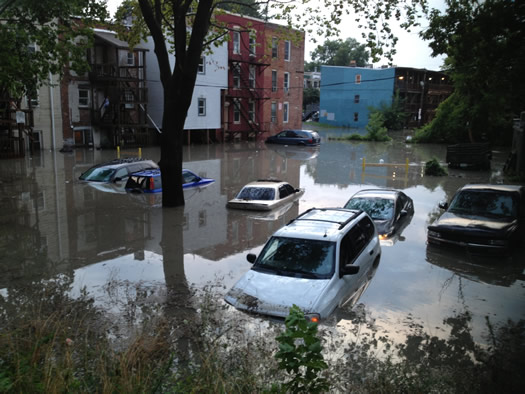
Flash flooding in the city of Albany in 2014 when a storm dropped almost three inches of rain in less than an hour. / photo via Laura (thank you)
The Northeast US is looking at average temperature rises of a few degrees over the next century because of climate change, according to the some of the best estimates. And while an increase of, say, 4 degrees might not sound like much, it's setting up a future in which the extremes are likely to be more extreme and more common: hotter heat waves, bigger rainfall events, more common floods.
Radley Horton, a climate scientist at Columbia University's Center for Climate Systems Research, was at UAlbany this week for a program about extreme events prompted by climate change and their effects on human health.
We got a chance to talk with him for a few minutes about how climate change is already affecting this part of the country, what could be ahead, and how we might adapt.
Clean tech hackathon at Tech Valley Center of Gravity
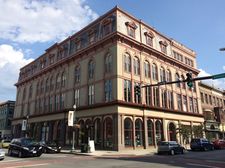 The Tech Valley Center of Gravity in Troy is hosting a clean tech hackathon October 15-16. It's free to attend if you'd like to gawk at what's been made. And if you have a team that would like to take part, registration is still open -- there will be $5,000 in cash prizes.
What is this hackathaon? Blurbage:
A hackathon is an event, usually lasting more than a day, where groups of computer programmers and other tech-oriented people collaborate intensely on projects using software. Hackers typically staying in the space the entire time working constantly. To help inspire the competitors, organizers of the TVCOG Clean Tech Hackathon have solicited problem statements from key players in the industry in the areas of Advanced Buildings, Renewables and Clean Transportation. Some problems hackers may tackle include: making solar photovoltaic and wind energy more predictable; innovations in "smart" building technology that can adjust energy usage based on intelligent predictions of the occupants' behaviors; and designing hardware/software solutions that use on-street installations to improve bike and pedestrian safety and comfort.
Participating teams will have mentors from NYSERDA, BessTech, The Wagoner Firm, New York State Mesonet, and Bette & Cring Construction Group. Also: "An abundance of high quality free food is available to all hackers and participants."
As mentioned above, it's free to attend or participate, but registration is required.
TVCOG advertises on AOA.
But if there were mountain lions here...
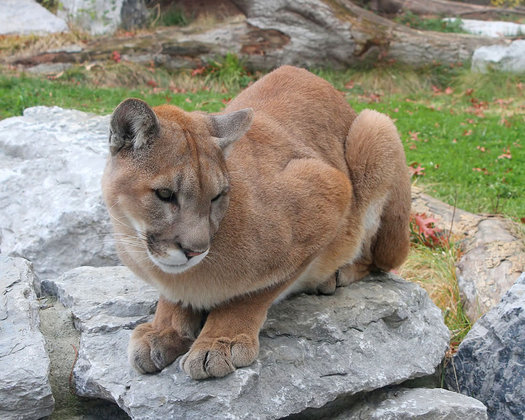
For hire? / photo: Greg Hume (CC BY-SA 3.0) via Wikipedia

An interesting thing about the way the landscape of the Northeast has been changing over the last century is that the amount of forested land has actually increased as many areas that were once cleared for farming have fallen back into being covered by trees.
These new forests aren't exactly like the old forests, though. Among the differences: they lack some of the large predators of the past -- notably cougars/mountain lions and wolves. That might not seem like a big deal for humans -- it might even seem like a good thing, considering those sorts of animals can be a bit fear inducing. But one of the side effects is that deer now lack a natural predator, and their populations have exploded.
There are so many deer. And they cause all sorts of problems -- from car crashes, to disease transmission, to habitat destruction, to grazing on gardens.
So. If we could get some of these predators back in this area -- mountain lions, specifically -- what might that be worth?
Science Cafe at City Beer Hall: evolution
The State Museum has set up another Science Cafe event at the City Beer Hall for May 12.
This time around the topic is evolution and the guest speaker will be Lisa Amati, the state paleontologist and the museum's curator of invertebrate paleontology. Craig Gravina, an exhibit designer for the museum (and, of course, also a beer historian and occasional AOA collaborator), will again serve as host for the informal discussion.
We hear Amati's short talk will center on evolution as an observable phenomenon, and its connection to examples such as antibiotic resistance and mosquitos adapting to the environment of the London Tube. After the talk, there will be Q&A with the crowd. (And we suspect Craig has a few fun questions of his own to ask...)
Here's a NYT profile of Amati and her research from last summer.
The Science Cafe event at the City Beer Hall is Thursday, May 12 at 6 pm. It's free to attend (food and drink not included). The first event was packed, so it's probably worth getting there a little early to grab a good spot.
The Atlas of Inland Fishes of New York
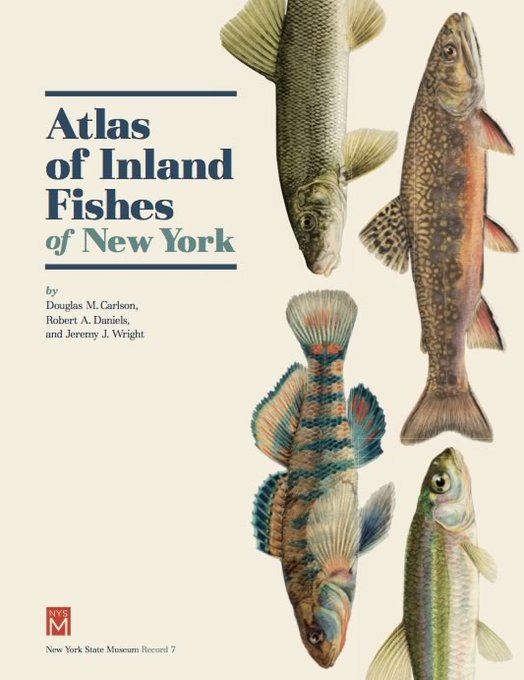
There are 181 native and introduced freshwater fish species in New York State.
That's one of the many, many bits in a huge new catalog of the state's fish released this week as part of joint effort by the New York State Museum and the state Department of Environmental Conservation. It's the first such publication in three decades.
The book is available to download for free as a pdf from the State Museum website.
The Atlas of Inland Fishes of New York is pretty much exactly what it sounds like. It includes photos or illustrations of each of the state's different fish species, along with maps depicting where the fish have been found both in the past and present. As the atlas preface notes of New York: "its freshwater fish species represent one of the richest and most scientifically fascinating ichthyofaunas in the Northeastern United States."*
It's fascinating to flip through the atlas, gawking at some of the wildly-colored or shaped fish, and seeing how they compare or contrast with other similar fish. It's also interesting to see the geographic ranges of each species plotted -- how some species live only in a few river corridors, others are confined to specific watersheds, and others are pretty much everywhere.
And if nothing else, some of the names are great: Gizzard Shad, Central Stoneroller, Northern Redbelly Dace, Tonguetied Minnow, Rosyface Shiner, Bigeye Chub, Northern Hog Sucker, Threespine Stickleback, Pumpkinseed, Tesselated Darter, and so on...
* "Scientifically fascinating ichthyofaunas" really should be some sort of state marketing slogan.
What, your job doesn't involve baby bears?
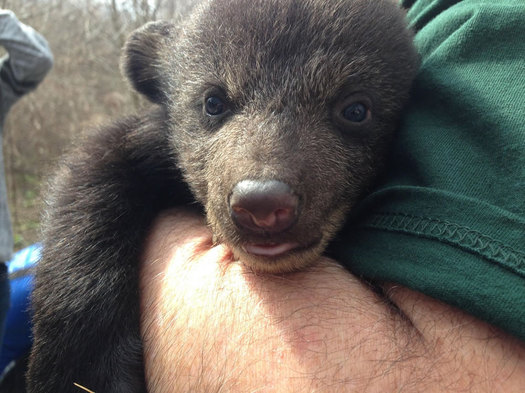
Oh, hello, there...
Filed under "jobs we didn't know existed" and "the cuteness is too much": Biologists with the state Department of Environmental Conservation have been visiting bear dens around the state to gather data about bear populations in New York. And that process involves (temporarily) removing bear cubs from the dens so they can be weighed.
This week the DEC posted photos from one of these recent den visits -- in Allegany State Park -- on its Facebook page. That's one of the pics above. A clip from the post:
The 173-pound sow was ear-tagged and fitted with a GPS tracking system collar. The collar collects GPS points at set intervals, then sends the location via text messages - so even bears are getting in on texting these days! DEC staff carefully monitored the sow's vitals during the process. The bandana is used to protect her eyes while she is immobilized.
During this time, the three cubs were ear-tagged and weighed only. There were 2 males and 1 female bear cub. The cubs were fairly small (3-4 pounds each) and healthy, probably meaning they were born in late January. After the work was done, the sow is placed back in the bear den with her cubs, where they will stay until the cubs are big enough to keep up with their mother in the woods, typically another few weeks.
DEC says it will be sharing more from these bear den visits over the next week.
Black bear populations in New York State have "increase[d] dramatically in number and distribution in recent decades," according to state's Black Bear Management Plan published in 2014 -- and there are now more than 6,000 bears estimated to be in the state, across large portions of upstate.
Earlier on AOA:
+ Don't feed the bears
+ There's a moose... and there's a moose... and there's a moose...
photo: NYS DEC
Science Cafe talks at City Beer Hall
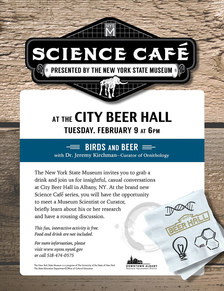 This could be some nerdy fun: The State Museum is starting a series of "Science Cafe" events at the City Beer Hall.
That first Science Cafe event is February 9 and will feature State Museum curator of birds Jeremy Kirchman. Craig Gravina, who's a State Museum exhibit designer (and, of course, also a beer historian), will moderate. We emailed Kirchman for a preview:
I suspect Craig and I will veer off on a few tangents regarding such things as the origin of birds, how I became interested in museum collections and bird evolution, response of birds to climate change, maybe the domestication of chickens if we really end up in the weeds.
The idea with the Science Café is that it will resemble a discussion you might have at a party, more so than a lecture in an auditorium. The series will give the museum scientists a chance to teach the public about on-going research in biology, archaeology, and paleontology, and maybe reach an audience we won't get in our Huxley Theater.
Kirchman says he'll be showing a few pictures, but it won't be a parade of Powerpoint slides.
The Science Cafe event on Tuesday, February 9 is from 6-7 pm. Admission is free, and does not include food or drink.
Earlier on AOA: This part of the State Museum is for the birds
Neil deGrasse Tyson at Proctors

The Neil deGrasse Tyson will be at Proctors April 11. Tickets go on sale to the general public December 15 -- they're $25.75 and up.
Tyson is the director of the Hayden Planetarium at the American Museum of Natural History in New York City. But he's become a prominent pop culture figure as a communicator and advocate for science, hosting TV shows such as the rebooted Cosmos, appearing on The Daily Show, and accreting a huge following on Twitter.
The Proctors event is billed as "An Evening with Neil deGrasse Tyson." Further blurbage: "Join America's favorite science communicator in an 'engaging conversation on science, exploration and the world as we know it.'" It also looks like there will be Q&A with the audience.
photo: Cutty McGill
The long view
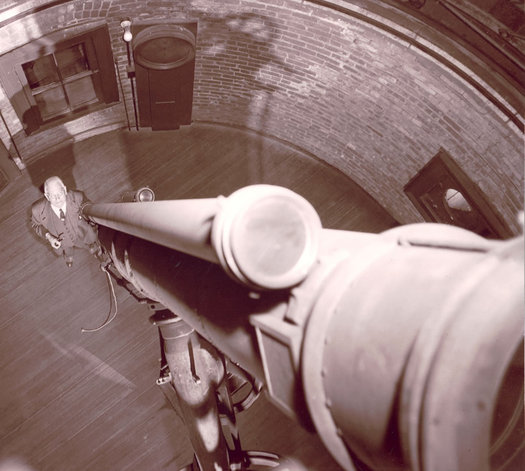
Then-Dudley Observatory director Benjamin Boss with the Pruyn Brashear Equitorial telescope around 1930. / photo courtesy of the Dudley Observatory
The Dudley Observatory recently started a blog -- Counting Stars -- to highlight both its long history and collection, along with what's currently happening there. The photo is above from a recent post about the observatory's Pruyn Brashear Equitorial refracting telescope, which the observatory has owned since 1893 when it was located on South Lake Ave in Albany -- and will again put into service when the Dudley builds its new observatory in Schenectady.
A quick clip:
The Pruyn was named after Robert Hewson Pruyn. The Pruyn (usually pronounced "prine") family is one of the great old dutch families that make up so much of Albany history. Robert H. Pruyn may be the most famous member, serving as the Minister to Japan during the American Civil War. He was also, naturally, a member of the Dudley board.
The telescope was named in his memory by his two sons, Robert C. and Clarence L. Pruyn. These two followed in their father's footsteps as lawyers and politicians, but they're probably most famous as businessmen running the Embossing Company, one of America's most successful manufacturers of puzzle, toys and games during the late 19th and early 20th century. Which means that the Pruyn was purchased with board game money, so to speak.
So many institutions around the Capital Region have long, rich histories -- and probably have photos, documents, pieces, and whatnot from that history. It's good see another one making some of that material more available to the public.
See also: Carl's posts about the history of the Dudley Observatory over at Hoxsie.
Seeing the city for the trees
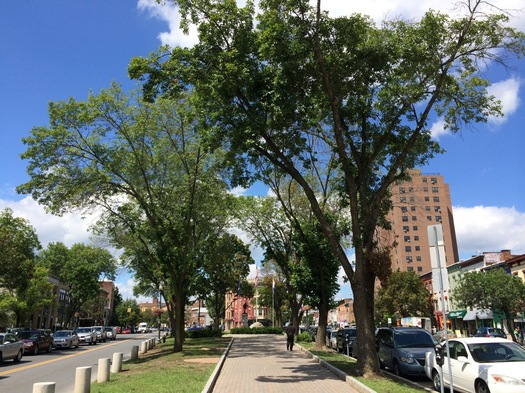
Albany's city forester says the ash trees in Townsend Park will probably have to be taken down.
Trees are often one of those things you don't really have a real sense of until they're gone. It's remarkable how much emptier, starker, hotter a street can feel after a few longstanding trees are taken down.
The city of Albany is facing the possibility of experiencing this sort of impact on a large scale. Last year an invasive beetle was detected in the city for the first time and the city's ash trees -- of which there more than 2,000 along the city's streets and in its parks -- are threatened with being killed off.
We talked with Albany's city forester, Tom Pfeiffer, recently about dealing with this threat, the problems associated with uniformity, trees that stink, and trees as infrastructure.
A future with less heating, more air conditioning
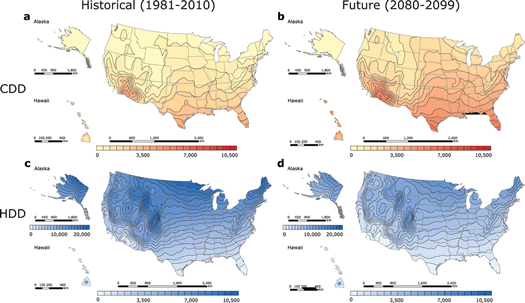
Can you imagine a New York with temperatures that are more like... Oklahoma?
That's one of the comparisons made in a paper published today in Scientific Reports that aims to project how global warming will affect the heating and cooling needs of areas around the United States.
Using a climate scenario that expects global mean surface temperatures to rise by more than 4 degrees Fahrenheit, two Stanford researchers projected how the current "normal" annual number of heating and cooling degree days across the US would compare to levels at the end of this century.
(You can think of heating and cooling degree days as a measure of how much heating or cooling a building needs in a place over a time period.)
Here's a clip from the paper about projections for New York City:
The historical CDD [cooling degree day] value of New York City (1,105 CDD) is projected to increase by the end of the century (2,348 CDD), approaching a CDD value that historically prevailed in the hot desert climate of El Paso, TX (2,331 CDD). The historical HDD [heating degree day] value (4,750 HDD) in New York City is projected to decrease (3,126 HDD) to approximately the number of HDD in present Raleigh, NC (3,246 HDD). New York City's historical degree-day sum (5,855 HDD + CDD) will decrease (5,474 HDD + CDD), resembling the historical degree-day sum in Oklahoma City, OK (5,463 HDD + CDD).
The researchers used numbers for current normals from more than 7,000 weather stations around the country, so they were able to make maps based on the projections. One of them -- showing projected differences in cooling and heating degree days across the country -- is above.
A bigger map, which we think illustrates things a bit better, is after the jump. And it illustrates that the Albany area is, of course, not exactly like New York City. But the general trend is projected to be about the same -- fewer heating degree days, and a lot more cooling degree days.
Odd and notable creatures of the Hudson River
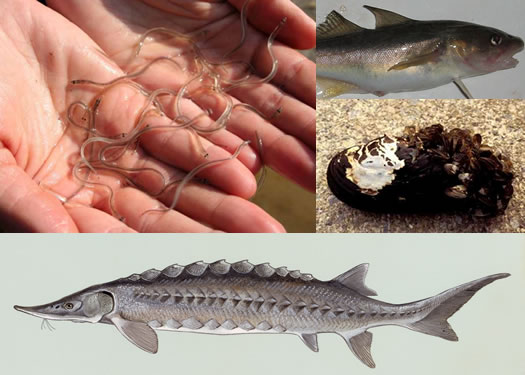
Ahead of the Rail, River, Hudson II tour this coming weekend, we have a series of posts focusing on the Hudson River this week.
The Hudson River is many things:a thread through history, a transportation corridor, a scenic inspiration. But first and foremost it's a habitat for all sort of creatures.
Here are a few odd and notable inhabitants of the Hudson River...
River Week is sponsored by: Albany County Convention and Visitors Bureau, Downtown Albany BID, Dutch Apple Cruises, Harmony Mills, Hudson River Greenway, Nine Pin Cider, Sweet Sue's, and Downtown Troy BID.


Bill Nye the Science Guy at UAlbany

Bill Nye -- you know, "The Science Guy" -- will be at UAlbany's SEFCU Arena March 25 as part of the World Within Reach Speaker Series. It's free and open to public (ticketing details below).
Nye is, of course, famous for his kids science show Bill Nye the Science Guy. (Before that he had been a mechanical engineer at Boeing.) Since the show finished in the late 1990s he's continued to be a pop culture figure and frequent commentator on issues such as climate change and vaccines. Also: He's been trying to crush Ed Begley, Jr.
Tickets to the UAlbany event for the general public will be available March 13, 23, and 24 in the Campus Center West Lounge from 11 am until 4 pm (four ticket max), and then on March 25 from 11 am to 2 pm in the same place. Any remaining tickets on March 25 will be distributed in the Physical Education (PE) building lobby across from the SEFCU Arena starting at 3 pm.
There will also be a limited number of free copies of Nye's book, Undeniable, distributed at the arena.
photo via Bill Nye the Science Guy FB
Measles in New York, before and after the vaccine
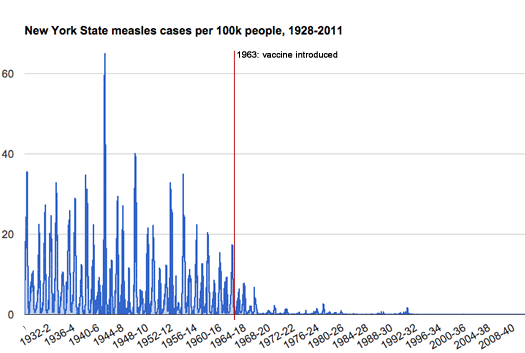
With all the news about the recent upswing in measles cases -- and the all discussions about kids not being vaccinated -- we had been curious about details regarding how a big a difference the measles vaccine made when it was introduced.
A recent Wall Street Journal data visualization illustrates this before/after across the country beautifully. It's based on numbers collected and organized by Project Tycho, a health data project at the University of Pittsburgh.
Project Tycho includes data for many states, including New York. So we pulled out the data for measles cases in New York State between 1928 and 2011. There's a graph above.
There's a bigger version after the jump, along with a few notes.
Genetically modified apples move closer to production
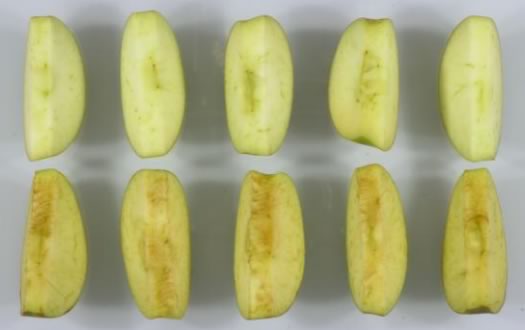
The top row are "Arctic" Granny Smith apples, and the bottom are traditional Granny Smith. / photo: Okanagan Specialty Fruits
Arctic apples -- the apples genetically modified so they don't brown when exposed to air -- have cleared one of their last regulatory hurdles, the US Department of Agriculture announced Friday. [Politico] [USDA]
Okanagan Specialty Fruit -- the company that developed the apples -- is projecting that small test-market quantities of its non-browning Golden Delicious and Granny Smith apples will available by 2016.
The technology used to create the apples is called gene silencing. Basically what Okanagan has done is target genes in the apple that are responsible for producing an enzyme involved in apples browning, and turned those genes off. The company says it's able to silence these genes very specifically. (Here's a skeptical perspective on the precision of the targeting.)
The commercial idea here is that non-browning apples will open up more opportunities for sliced apple snacks, and reduce food waste.
As you know, New York is the second largest producer of apples in the United States. Hearst reported last fall that Arctic apples were being tested at an undisclosed location upstate. Apple growers associations, both national and here in New York, have been skeptical of the genetically modified apples, not so much because of safety concerns but because of worries about how the public will perceive the apples -- essentially, apples already have a rep for being healthy and wholesome, so why do anything that could potentially mess with that. [Hearst/TU] [Modern Farmer]
When did dogs become dogs?
Interesting: Domesticated dogs emerged from wolves about 15,000 years ago, according to recently-published research from a team that includes Skidmore biologist Abby Grace Drake. The estimation is based on very precise 3-D measurements of fossil skulls that can detect very subtle differences between dogs and wolves, and it pushes against other estimates, based on DNA analysis, that had pegged the switchover as far back as 30,000 years. [Skidmore] [Scientific Reports] [Daily Gazette]
So, 15,000 years or 30,000 years... so what? Because the two dates mark a difference in where humans were at in their own development. As Drake explained to CBS News:
"Whether dogs were domesticated in the Paleolithic or the Neolithic creates two different scenarios for how domestication may have taken place," she explained. "In the Paleolithic humans were hunter-gatherers. In the Neolithic is when we started to build permanent settlements that would have required 'dumps.' These piles of food and human waste would have attracted scavengers. Some scientists propose that wolves that scavenged at these dumps would have access to valuable food and those that could tolerate the presence of humans would be more successful."
Drake's research looks at how evolution changes the physical structure and behavior of species. Her Skidmore page includes some cool photos of skulls from different dog breeds, highlighting the huge differences that breeding has introduced over the last few centuries.
That clip embedded above is a Drake video -- it shows a wolf skull morphing into a French bulldog skull.
Won't you guide my sleigh tonight?
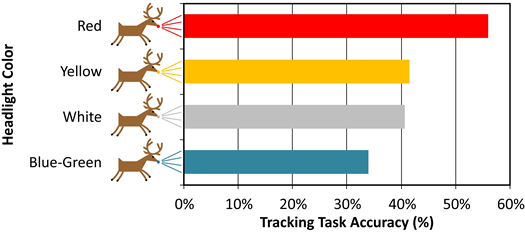
From Lighting Research Center at RPI some science to go along with the Rudolph the Red Nosed Reindeer story:
Interestingly, LRC research on perception under headlamp illumination of different colors under inclement weather like blowing snow confirms that the red color of Rudolph's nose was a very fortunate circumstance. LRC researchers John Bullough and Mark Rea measured peoples' ability to perform a driving task while looking through a simulated nighttime snowstorm. The headlights in that study could be red, yellow, white or blue-green, meaning people had to look through visual noise illuminated by different colors while performing the driving task. Performance was best under the red light and worst for the blue-green light. Bullough's and Rea's results showed that the light reflected by blowing snow when driving at night is least distracting when the color is red and that sensitivity to conditions like their simulated snowstorm may be influenced by rod photoreceptors in drivers' eyes, which are more sensitive to "blue" light and less sensitive to "red" light. In other words, the light from Rudolph's red nose could help make rooftops more visible by making blowing snow less visible!
And to think they used to laugh and call him names.
Looking forward to the "Rudolph" setting for the headlights on some future car.
This part of the State Museum is for the birds
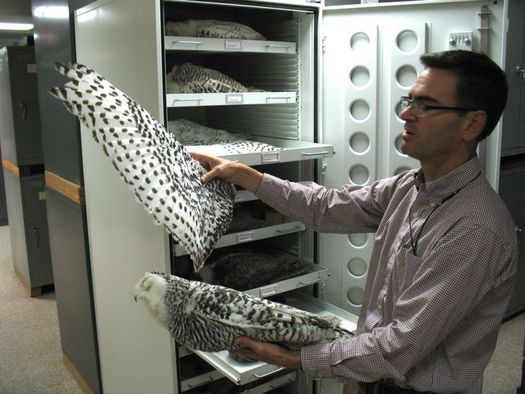
State Museum curator of birds Jeremy Kirchman with a snowy owl specimen.
What's on display at any one time at State Museum is just small slice of all the items in the museum's collection. And because the State Museum is almost two centuries old -- it's the oldest state museum in the country -- there are a lot of things in that collection.
So we were happy to get the chance this week to get a behind-the-scenes look at the museum's large bird collection with its curator of birds, Jeremy Kirchman. He's giving a talk this Sunday about the passenger pigeon -- a current exhibit at the museum commemorates the bird's extinction a hundred years ago.
OK, let's get to the photo tour -- and a quick chat about museums as data sets, global warming, extinction, and some reasons to be hopeful.
FameLab at EMPAC
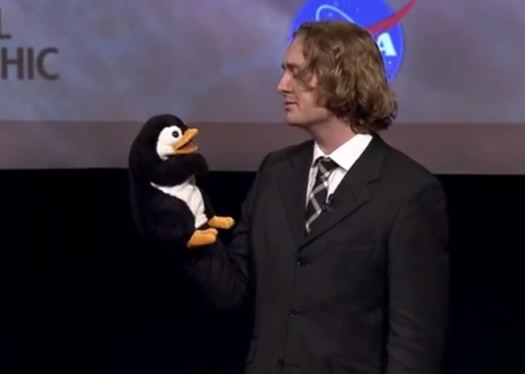
One of the presentations in this year's final included a conversation, in verse, with a penguin puppet.
Could be interesting: FameLab will be at EMPAC Tuesday evening. What's that? Let's go to the blurbage:
Think American Idol...for scientists! FameLab is a panel-judged competition to find the new voices of science across the world. Started in 2005 in the UK, this event is the kickoff to "Season 3" here in the US. Ten young scientists will spin tall-but-true tales of exoplanetary atmospheres, extreme environments here on Earth, the possibility of life on an icy moon in the outer Solar System, and much more - in 3 powerpoint-free minutes each!
And while the judges deliberate, we'll be treated to stories of how science meets science fiction from science advisor to Hollywood, Dr. Kevin Grazier.
The FameLab night at EMPAC is a regional competition for a spot at the final in 2016.
The event is from 7-9 pm Tuesday, July 29. And it's free -- just show up, no pre-registration required.
screengrab: FameLab USA
Important question: Will we be able to put magnets on our future magnetic refrigerators?
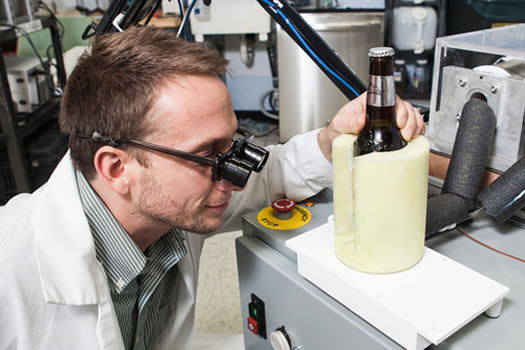
Why develop a new type of refrigerator if not to chill beer?
If ever you wondered what the scientists at the GE Global Research Center in Niskayuna do, here's one answer (of many): develop an entirely new type of refrigerator.
Researchers at the GRC in Niskayuna, along with other research sites around the world, have been working to develop refrigeration technology that uses magnets for cooling. GE recently announced that its researchers believe the tech could be in consumer fridges in about a decade. The company says the technology is about 20 percent more efficient than the sort of technology currently in your fridge at home -- tech that's about a century old. (And it doesn't use some of the substances that make recycling refrigerators difficult.)
A post on GE's Edison's Desk research blog by Frank Johnson, one of the scientists in Niskayuna, explains some of the science behind the technology:
In a conventional refrigerator, a compressor is used to compress and heat refrigerant gas and deliver it to a condenser where it cools off by dumping heat to ambient air. When the refrigerant has given up enough heat it becomes a liquid. It then flows through a tight passage called an expander or capillary tube and drops in pressure and turns into cold liquid at a lower pressure. After exiting the expander it is in an evaporator, really cold, and ready to accept heat from the space it is in, the freezer. When it accepts enough heat it is boiled into gas and is then ready to enter the compressor again. This cycle continues as long as the compressor runs. The magnetocaloric effect is similar except that it occurs entirely in the solid state. The magnetism "evaporates" when heated above a certain temperatures and "condenses" back upon cooling. A magnetic field can be used to drive this reaction and "pump" heat from low to high temperatures, providing the cooling effect.
The magnetocaloric effect has been known for more than a century, but finding a way to apply it in a practical way to a refrigerator has taken years of off-and-on research and the development of new materials. Johnson's blog post covers a lot of that history, and the story illustrates how advances are so often the result decades of work by many people and institutions, often on basic research.
If you're curious, GE scientists talked about the tech this week in a Google hangout.
GE says its researchers are currently working on a magnetic refrigerator that can drop the temperature by 100 degrees. And they see the tech as potential replacement all sorts of cooling devices, including air conditioners.
photo: GE Reports
10,000 square miles of salt
 Geological/road deicing facts of the day: New York State, the nation's third-leading producer of salt, has the deepest salt mine in the Western Hemisphere. From a 2009 article in the DEC's Conservationist:
In New York, salt (a.k.a. the mineral halite) occurs in formations deep underground. These formations are remnants of a vast sea that covered what is today's western and central New York during the Silurian period, some 400 million years ago. Over time, the water dried, leaving behind thick salt deposits. Today, more than 10,000 square miles (about 3.9 trillion metric tons) of salt lie under New York at depths ranging from 500 feet near Syracuse to 4,000 feet near the Pennsylvania/New York border. With salt deposits so deep and expansive, collecting it can be a challenge. ...
Since the early 1900s, conventional hard rock salt mining is the primary process used for mining salt for deicing and snow removal. Employing the "room-and-pillar" method during mining, solid salt pillars are carved in the underground cavern to provide roof support and the walls of salt are excavated through the use of small, controlled blasts. Front-end loaders scoop the pile of fallen salt, which is then processed in a crusher to make the salt uniform. Next, the salt is hoisted to the surface and taken away by trucks and trains.
In New York there are two active conventional salt mines-Cargill's Cayuga Mine in Tompkins County, and American Rock Salt's Hampton Corners Mine in Livingston County. The Cayuga mine is a large operation that encompasses approximately 18,000 acres under portions of Cayuga Lake and adjacent lands. In addition, the mine is 2,300 feet deep, making it the deepest salt mine in the western hemisphere.
That American Rock Salt mine, near Rochester, is said to be the largest salt mine in the United States. As you might imagine, they've been rather busy this winter. [AP/Syracuse.com]
Also: We're not sure this quite lives up to its billing as "The Surprising History of Road Salt," but this recent NatGeo article does include some interesting bits.
Earlier on AOA: And the roads will run with beet juice
Look up in the sky, it's a bird, it's a plane, it's a minotaur and a firefly

Take me where I cannot stand: Launching in Virginia, (probably) visible from upstate New York.
A rocket is scheduled to launch into space from a spaceport in Virginia this evening, sometime between 7:30-9:15 pm. Two local things about the launch of this Minotaur I rocket:
We should be able to see it
The rocket launch "will be HIGHLY visible on the east coast," according to NASA, as long as there isn't too much cloud cover. Here's info on how to spot the rocket -- it boils down to look the south/southeast about 90 seconds after launch. As you face that direction, the rocket will be arcing from right to left, south to east, about 10 degrees over the horizon.
A tiny satellite from Siena College will be aboard
Part of the payload for the Air Force rocket: a "nanosatellite" called Firefly built in part by Siena students. From a press release:
The development of Firefly was a joint venture between Siena College, the National Science Foundation, which is the funding agency, and NASA's Goddard Space Flight Center. The small satellite, which is about the size of a football, was built in part by Siena College students, faculty and engineers. Firefly is designed to help solve the mysteries of lightning. It is the second in a series of National Science Foundation-funded nanosatellites. Small, inexpensive satellites show great promise for focused science as well as enabling new kinds of discovery. ...
Study: New York is at the heart of the nation's "temperamental and uninhibited" region
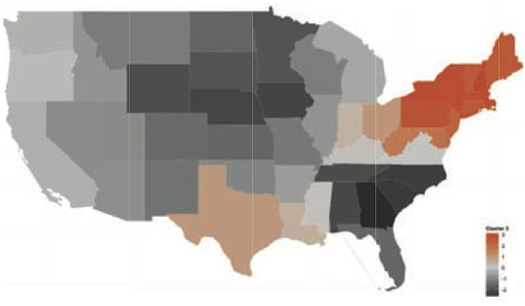
The more orange, the more cranky. (OK, not necessarily cranky, temperamental and uninhibited.)
New York State is at the heart of the "temperamental and uninhibited" region of the United State, according to new research. And that could be having an effect on a wide range of issues -- from politics, to migration, to economic development.
The paper (pdf) appears in the Journal of Personality and Social Psychology. The authors include a group who published similar research a few years back that identified New York State as one of the most neurotic states in the country. In this new research, the authors -- from Cambridge, University of Texas at Austin, and Finland -- aimed to pull together survey data on the "Big Five" personality traits to map the "psychological topography" of the United States, and concluded that there are three regions:
+ Friendly and Conventional - the Midwest and Southeast
+ Relaxed and Creative - West Coast, Rockies, Southwest
+ Temperamental and Uninhibited - the Northeast, near Midwest, and to some extent, Texas
Here's a clip from the discussion for the "temperamental and uninhibited" region:
The Temperamental & Uninhibited region comprises states predominantly in the MidAtlantic and Northeast. This region is made up of the quintessential Blue states. The psychological profile of the region is defined by low Extraversion, very low Agreeableness and Conscientiousness, very high Neuroticism, and moderately high Openness. This particular configuration of traits depicts the type of person who is reserved, aloof, impulsive, irritable, and inquisitive. There are disproportionate numbers of older adults and women in this region, in addition to affluent and college-educated individuals. Residential mobility is low here, and in fact, data from the U.S. Census (Ihrke & Faber, 2012) indicates that significant numbers of residents of this region are leaving the area. Residents of this region also appear to be politically liberal and not mainline Protestants. Overall, it appears that this psychological region is a place where residents are passionate, competitive, and liberal.
There's also some discussion speculation how these traits tended become pronounced here:
The closest darkest place
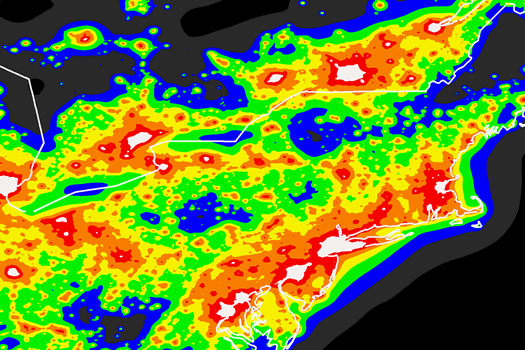
It's that gray spot floating the pool of blue in the Adirondacks.
After reading this interview with Paul Bogard, author of The End of Night: Searching for Natural Darkness in an Age of Artificial Light, we were curious the closest, darkest place. We'll get to that in a second. First, a clip from the interview:
There's a statistic that I quote, which is that eight of every ten kids born in the United States today will never experience a sky dark enough to see the Milky Way. The Milky Way becomes visible at 3 or 4 on the Bortle scale. That's not even down to a 1. One is pretty stringent. I've been in some really dark places that might not have qualified as a 1, just because there was a glow of a city way off in the distance, on the horizon. You can't have any signs of artificial light to qualify as a Bortle Class 1.
A Bortle Class 1 is so dark that it's bright. That's the great thing--the darker it gets, if it's clear, the brighter the night is. That's something we never see either, because it's so artificially bright in all the places we live. We never see the natural light of the night sky.
As Bogard mentions in that clip, there's a scale for night sky brightness, the Bortle scale. Nowhere east of the Mississippi qualifies for the very darkest category.
But we're not too far from a few spots that qualify as pretty darn dark (a scientific term). According to maps created by The World Atlas of the Artificial Night Sky Brightness based on satellite data, there's a patch in the middle of the Adirondacks that qualifies for the second-darkest category on the scale used by the atlas -- here's a zoomable map. Specifically, the patch is just west of Blue Mountain Lake, around Raquette Lake. It's about 135 miles from Albany.
It's not surprising the Adirondacks have a spot like this -- it's one of the least-lit places in the eastern United States.
image: The World Atlas of the Artificial Night Sky Brightness
Today's moment of summer
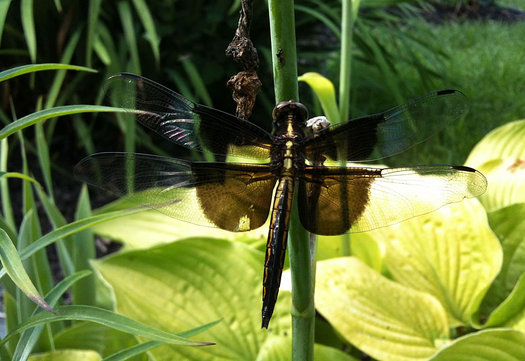
Up close.
New York State has an estimated 193 species of dragonflies and damselflies -- the most of any state after Texas (DEC report). There are about 400 species nationwide. [NYS DEC] [NYS DEC]
Here's a good Flickr pool of New York dragonfly photos.
Bonus link: A recent NYT article on the flight and navigation of dragonflies, perhaps "the most brutally effective hunters in the animal kingdom."
Following Stranger Visions
Here's a short TED documentary about the process RPI grad student Heather Dewey-Hagborg uses to create 3-D "portraits" from found DNA. The video is part science talk/part how it's made/park reflection on the near future. Another thing we liked about it is the way it highlights some of the uncertainty in the work, something Dewey-Hagborn readily acknowledges and folds into her thoughts about the project.
[via Colossal)
Earlier on AOA: Stranger Visions
Bacteria from space (OK, they're originally from Earth, but they went to space)
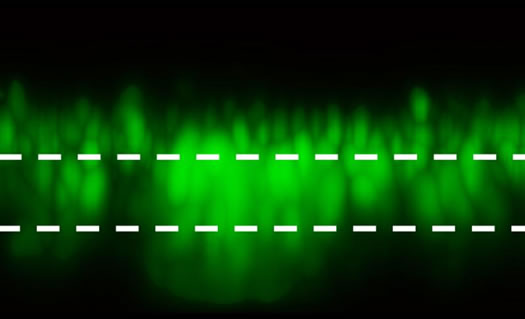
Bacteria were sent into space and they came back glowing green. (OK, not really: these are micrographs of the side view of the unusual structures formed by the bacteria sent into space.)
From the Annals of Didn't This All Go Horribly Wrong in the Movie Version: Researchers from RPI report that bacteria sent into space behave in unusual ways. From an RPI News article:
Recent findings provide important evidence of spaceflight's effect on the behavior of bacterial communities and represent a key step toward understanding and mitigating the risk these bacteria may pose to astronauts during long-term space missions.
The research team, led by Rensselaer faculty member Cynthia Collins, sent the experiment into orbit aboard Atlantis' STS-132 mission in May 2010 and its STS-135 mission in July 2011. Samples of the bacteria Pseudomonas aeruginosa were cultured for three days in artificial urine. The space-grown communities of bacteria, called biofilms, formed a column-and-canopy structure not previously observed on Earth. Additionally, biofilms grown during spaceflight had a greater number of live cells, more biomass, and were thicker than control biofilms grown under normal gravity conditions.
Bad sci-fi jokes aside, this is an interesting topic. Biofilms are common in nature -- That plaque on your teeth? Biofilm. -- and their formation is based on some remarkable bacterial communication (bacteria have been heavily invested in nanotech since, you know, forever). As the RPI article alludes to, biofilms play a role in hospital-acquired infections. In fact, that's probably one of the reasons the researchers picked Pseudomonas aeruginosa -- it's a common hospital infection and is associated with infections from devices such as catheters (yeah, now the urine part is probably making sense, too). A lot of medical devices are already hard to thoroughly clean, and sticky biofilms make the job even harder.
So, sending these microbes into space -- and bringing them back to Troy -- could help scientists better understand how biofilms form. And that, in turn, could help people here on Earth -- or if/when we send people to Mars.
Because spaceships sound kind of germy.
image: Rensselaer Polytechnic Institute
Ecovative in the New Yorker
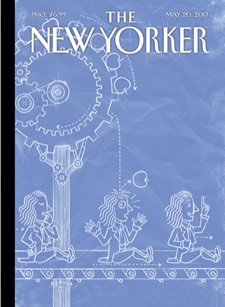 The new issue of the New Yorker include a good article about Ecovative by Ian Frazier. Here's a clip:
Gavin McIntyre, the co-inventor of a process that grows all-natural substitutes for plastic from the tissue of mushrooms, holds a pen or pencil in an unusual way. Gripping it between two fingers of his right hand, he moves his arm across the paper so that his wrist grazes the inscribed line; because of this, he uses pens with ink that doesn't smear. When he draws an explanatory diagram of the chitin molecule--chitin is the principal component of mycelium, the white, rootlike vegetative structure of fungi--he bends over his work, then looks up earnestly to see if his hearer has understood. The gesture makes him appear younger than his age, which is twenty-eight. He wears glasses and has straight black hair, dark eyes, and several piercings, with studs in his lip and ears.
The other co-inventor, Eben Bayer, won't be twenty-eight until June. Bayer is almost six-five, and often assumes the benign expression of a large and friendly older brother. His hair is brown, short, and spiky, his face is long, and his self-effacing manner hides the grand ambitions that people who come from small towns (Bayer grew up in South Royalton, in central Vermont) sometimes have. When he says, of the company that he and McIntyre founded, "We want to be the Dow or DuPont of this century," he is serious. He is their company's C.E.O., McIntyre its Chief Scientist. People with money and influence have bet that they will succeed.
As you know, Ecovative is based in Green Island -- and both McIntyre and Bayer are RPI alumni.
The article highlight both of the founders' backgrounds, along with the key role of RPI professor Burt Swersey in encouraging them, and mycologist Sue Van Hook in helping to grow Ecovative's library of fungus. And it also includes a bunch of interesting bits about the company's beginnings, tech, and plans (fungal resistors for mobile phones?).
More than anything, though, Frazier elegantly lays out Ecovative's ideas alongside the history of Dow Chemical -- the producer of Styrofoam -- and explains why Ecovative could be such an important, industry-altering company.
Earlier on AOA: A whole bunch of items about Ecovative
Watching for cicadas
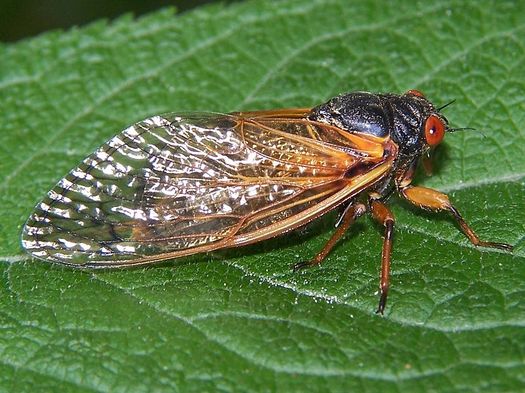
An adult periodical cicada. The red eyes really make the look.
Perhaps arriving soon: the periodical cicada. A "brood" of the fantastically weird insects -- that climb from the ground every 17 years to molt, sing, mate, lay their eggs, and die -- are emerging along the East Coast this month. And we could see some of them in the Capital Region.
This particular cohort of cicadas -- Brood II, or "The East Coast Brood" -- last emerged in 1996. In previous appearances, its range has stretched from North Carolina to northern New York.

Stranger Visions
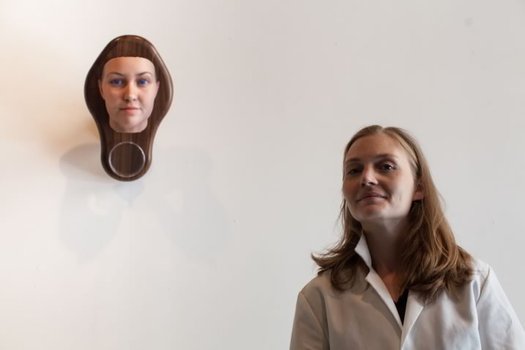
Heather Dewey-Hagborg and her self portrait. (photo: Dan Phiffer)
Filed under... well, we're not sure: Heather Dewey-Hagborg -- a PhD student in RPI's electronic arts program -- has been creating 3-D "portraits" based on found DNA. From the statement for "Stranger Visions":
In Stranger Visions artist Heather Dewey-Hagborg creates portrait sculptures from analyses of genetic material collected in public places. Working with the traces strangers unwittingly leave behind, Dewey-Hagborg calls attention to the impulse toward genetic determinism and the potential for a culture of genetic surveillance.
A press release from this March explains how she creates the portraits. The process, boiled down: Dewey-Hagborg collects discarded hair, cigarette butts, and chewing gum. She then takes it back to a lab, extracts DNA from the sample, amplifies certain parts of it, then looks for certain segments that are associated with various physical characteristics. The info then goes through a 3-D modeling program and the portrait is printed on a color 3-D printer.
Her website has a bunch of the portraits, along with photos the samples and where they were collected.
Grow house
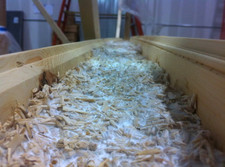 In progress at Ecovative, the Green Island-based startup that creates packaging and insulation from mushrooms: a small house that's growing its own walls. Blurbage:
We spent 5 years focused on protective packaging. Today it's a huge success, being used to package everything from servers to surf boards. Now we're looking ahead to what's next, and it may be time to return to our roots and dive back into building materials.
This project is a bold experiment to build and grow a house with Mushroom Insulation. We could have started by just building a simple wall assembly and subjecting it to lab tests. And we'll surely be doing that soon. But we thought that starting by building a whole tiny house would lead to more learning (possibly through failure) faster than anything else we could do. Also, we all just think tiny houses are really cool.
Basically, they've built a frame and are letting the mycelium (sort of like mushroom roots) fill in the gaps by bonding together agricultural waste. It's pitched as a environmentally friendly alternative to polystyrene insulation.
The company's set up a site with frequent updates tracking the construction and progress.
photo: Ecovative Design
Laurie Anderson on EMPAC
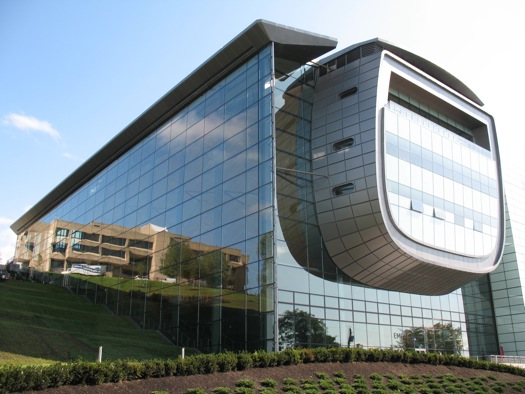
"You can't explain it to someone, because there's nothing else like it in the world."
Laurie Anderson has a long history of mixing science and art. The experimental artist has invented instruments like a tape bow violin, done a residency at NASA and, for the last year, she's held the first distinguished artist in residence post at EMPAC, where she says science and technology have allowed her to do things she never could have done before.
EMPAC may be a bit of a puzzle to folks outside the media arts world, but inside that world, Anderson says, it's gaining quite a reputation.
"You can't explain it to someone," she says," because there's nothing else like it in the world."
Tech Valley Center of Gravity
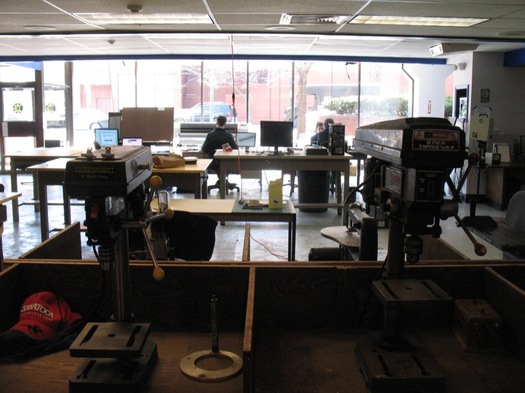
At the corner of 4th and Fulton in downtown Troy, in what was formerly an OTB space on the ground floor of a parking garage, is now a workshop with metal and wood working machinery, racks of tools and parts, 3-D scanners and printers, and biotech equipment.
The new Tech Valley Center of Gravity is a makerspace -- a place for hackers, crafters, artists, geeks to build stuff, take things apart, hack new things to together, and to learn from each other.
But organizers see it as part of something even bigger.
Red light, blue light
 Two things from a recently published study by researchers at RPI's Lighting Research Center:
1. That sleepy feeling after lunch has a name: the "post-lunch dip."
2. Light, especially red light, might be able to help counteract the dip.
The researchers hooked people up to EEGs to measure brain activity and then exposed them to red (longer wave length) and blue light (shorter wave length). From the abstract:
While the use of light at night to promote alertness is well understood, it is important to develop an understanding of how light impacts alertness during the daytime, especially during the post-lunch hours. The aim of the current study was to investigate how 48-minute exposures to short-wavelength (blue) light ... or long-wavelength (red) light ... close to the post-lunch dip hours affect electroencephalogram measures in participants with regular sleep schedules. Power in the alpha, alpha theta, and theta ranges was significantly lower (p < 0.05) after participants were exposed to red light than after they remained in darkness. Exposure to blue light reduced alpha and alpha theta power compared to darkness, but these differences did not reach statistical significance (p > 0.05). The present results extend those performed during the nighttime, and demonstrate that light can be used to increase alertness in the afternoon, close to the post-lunch dip hours.
The researchers say the work could lead to better understanding how light affects alertness and fatigue in safety situations.
In the meantime, we've found (unscientifically) that a cup of tea helps address the post-lunch dip.
photo: RPI Lighting Research Center
The 2013 Albany Prize
 Three physicians/scientists who worked on the development of targeted drugs for cancer treatments are the winners of this year's Albany Medical Center Prize in Medicine and Biomedical Research. At $500k, it's one of the biggest science prizes in the nation.
From the announcement:
This year, the prize will recognize groundbreaking research into the nature of cancer, which has led to the development of a new generation of cancer drugs, most notably Gleevec for chronic myeloid leukemia that, unlike chemotherapy, target specific genetic defects causing cancer.
The recipients are:
+ Peter C. Nowell, M.D., University of Pennsylvania, whose discovery of the "Philadelphia chromosome" in chronic myeloid leukemia established that genetics could be responsible for cancer. + Janet D. Rowley, M.D., University of Chicago, a geneticist who The New York Times called "the matriarch of modern cancer genetics."
+ Brian J. Druker, M.D., Oregon Health & Science University, an oncologist whose research to develop Gleevec saved countless lives and opened the door for more targeted cancer therapies.
You know how people/the media always talk about the promise of genomics for helping to treat diseases? Gleevec is among the most notable examples of that approach.
The art and science of maple sugaring
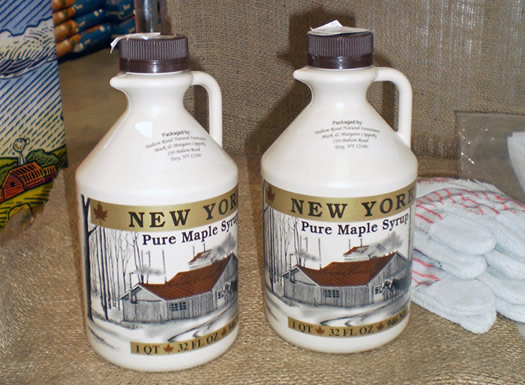
You might have a picture in mind when you think about maple syrup: a bucket hanging from a tree, smoke from the chimney atop a sugar shack, sap boiling in a cauldron.
While there are places where that picture still fits, modern maple sugaring also involves a range of advances in technology: pipelines, vacuums, evaporators, reverse osmosis machines.
Making maple syrup is a combination of science and craft. And in talking with two local sugarmakers, I found that there are a number of surprising factors that influence both the process and product in making maple syrup. From climate change to soil composition to bacteria in the sap, these are the elements that lead to some of the purest sweet stuff out there, much of which is coming from our backyard in upstate New York.
Woman bitten by potentially rabid fox in Cohoes
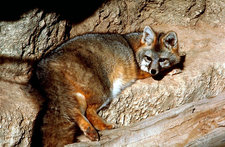 The Albany County Department of Health reported today that a woman in Cohoes was bitten by a potentially rabid grey fox this morning (area map). The fox got away, and officials are urging people to keep an eye out for wild or stray animals that are acting strangely -- and call 911 if one is sighted.
Update: A fox -- maybe the fox -- was shot by Cohoes police later in the day. Update update: The fox that was shot tested positive for rabies, Cohoes police say. [TU] [@CBS6Jennifer]
Rabid foxes turn up now and then in this area. Three foxes tested positive for rabies between January and October of 2012 -- one each in Albany, Rensselaer, and Saratoga counties -- according to the most recent data posted by the state DEC. There were also three positives in 2011 -- two in Saratoga County, and one in Schenectady County. Statewide that year there were 26 positive tests for rabies in foxes, 21 of those in grey foxes.
Back in 2010 a man was bitten by a rabid fox in Greenwich, in a scene that sounds like something from a B movie. From the Daily Gazette:
Richard Leddy, 40, said he was lying on the town beach reading when he heard someone in the water say, "Oh look, there's a fox."
"I thought they meant on the other bank, but then I heard a snarl and looked over to see the fox in mid-leap," Leddy said. "Next think I knew he'd sunk his teeth into my arm."
Yikes.
The animals that most often turn up with positive rabies tests in the state, at least over the last few years, are raccoons and bats. In 2011, there were 162 raccoons that tested positive, and 64 bats. (That's just a raw count of positive tests by the state lab, not a measure of prevalence within the population of those animals compared to other animals.)
In fact, the last two people to die of rabies in New York State -- in 1995 and 1993 -- got it from a bat, according to the state's Wadsworth Center.
Earlier on AOA:
+ "Pet" gray fox on the loose in Troy
+ Fox stalking
photo of a grey fox (*not* the grey fox in Cohoes): US Fish and Wildlife Service via Wikipedia

Gawking at the state's moon rock
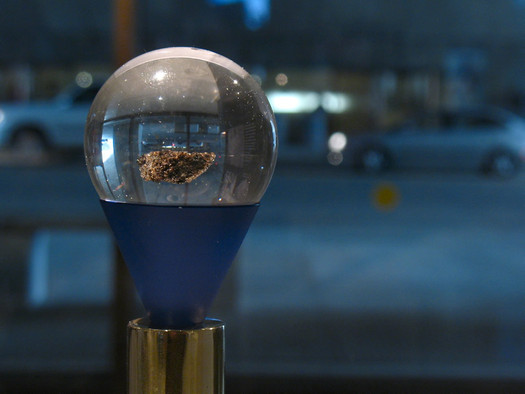
Here are a couple of large-format photos if you're so inclined.
The State Museum placed its moon rock on display today in the main lobby. So we stopped by to have a look.
The rock is really just a shard. And stripped of context, it would just elicit a "Huh?" But there is something cool about seeing a piece of the moon. If anything, it traveled a long way to get here.
The state's moon rock is from the Apollo 17 mission -- the last to visit the surface of the moon. It's part of a larger rock ("sample 70017") that two astronauts on the mission -- Eugene Cernan and Ronald Evans -- dedicated to all the young people of Earth. (Groovy, right? Hey, it was the 70s.) Upon their return, Richard Nixon had the rock broken up and the fragments distributed to 135 countries and the 50 US states. The rocks became known as "Goodwill moon rocks." Many of them have gone missing at various points -- New Jersey apparently just flat out lost its rock.
It was kind of fun watching people stop by the exhibit today to gawk at the rock -- especially when a guy engaged one of the security guards in an impromptu discussion of planetary geology.
The rock will be on display until February 10.
The Karner Blue as another sign from the Year of Odd Weather
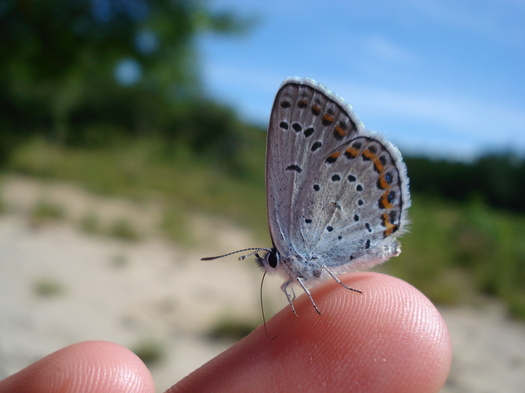
They find the weather strange, too.
Another effect of the non-winter/early spring: Karner Blue butterflies have managed to squeeze out an extra generation this summer. From an Albany Pine Bush Preserve press release:
Karner blue butterflies typically have two broods per year, one in May/early June and the second in July. The discovery of a third brood is both remarkable and a bit alarming to Preserve scientists because the eggs produced by the July brood of adult Karners typically overwinter to produce adult Karners the following May. An early and very warm spring is the suspected cause of earlier broods this year and the additional late-season butterflies currently flying in the Preserve. The impacts of a third flight of adults to the long-term recovery of the species are unknown. ...
Only time and continued monitoring will determine if the late 2012 hatch will have an impact on the 2013 butterfly population and the longer-term recovery of the species. "We had no idea a third flight in a single season was possible before 2010" said [Albany Pine Bush Preserve Conservation director Neil] Gifford. According to Gifford, it was in 2010 that Karner blue butterfly managers from Wisconsin to New Hampshire suspected that the late season adults they were seeing may be a previously unknown third flight. "We don't yet have a good understanding of what the implications of a third brood will mean for the recovery of the species" said Gifford, adding "it will likely depend on whether the changing climate brings such conditions more frequently."
The preserve says this spring's emergence of Karner Blues was the earliest on record -- 10 days earlier than the previous record, and 21 days earlier than the 20-year average.
To say that the weather over the past year is odd would be an understatement. A handful of the signs and side effects:
Meanwhile, on Mars...
 As you probably heard, NASA successfully landed a rover -- called Curiosity -- onto the surface of Mars early this morning. It's so easy to be jaded about amazing stuff these days, but this was truly remarkable -- the plan to land the rover was crazy. We realize the scientists and engineers involved probably don't regard it that way, but they used a robot with a supersonic parachute and a sky crane -- to land on Mars!
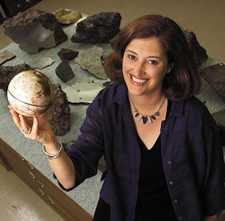
Ahem. Well, as it happens, Laurie Leshin -- RPI's dean of science -- is part of the science team for Curiosity (her field is cosmochemistry) . She was at the Jet Propulsion Lab in Pasadena for the landing. So, yes, her week is shaping up to be more fun and interesting than yours.
RPI's Approach blog has a quick Q&A with Leshin about the mission and the part with which she's been involved. On what she hopes they find:
I also hope we find a lot of water-bearing minerals that we can characterize very well--carbonites, clays, sulfates--and that can teach us about the aqueous environments on Mars. For most of my career we've thought about Mars as a cold dry place with a potential for a warmer weather past, but not a lot of evidence of it. But that's changing and I think this mission has the potential to really start painting a picture of a more habitable Mars from the past and its potential for habitability in the future.
Bonus bit: here's an op/ed Leshin wrote for the Times Union about the mission -- and its potential for inspiring kids.
And she's on Twitter.
photo: RPI
Now emerging: Karner Blues
Beautiful and rare.
The Albany Pine Bush Preserve Commission announced today that it has 600 Karner Blue butterflies emerging from their cocoons right now. From the press release:
Adult female Karners are captured from New York sites and immediately transported to the rearing facility in Concord, NH. Eggs produced by these butterflies are raised to chrysalises and returned to the Albany Pine Bush Preserve. The adults that emerge are released into restored habitat to begin new colonies. ...
"This is a very exciting, and very limited chance to see this Federally endangered butterfly," says Discovery Center Director Jeffrey Folmer. "One question visitors often ask is 'Where can I see the Karner blues?' These beautiful, but tiny butterflies are rare, hard to spot, live only three to five days and are difficult to distinguish from other similar non-endangered butterflies. We now have 600 of them emerging from their chrysalises one by one and they're on view until they all emerge."
The commission says butterflies will available for viewing at the Albany Pine Bush Discovery Center until mid-July. Admission is free.
The Albany Pine Bush -- a sandy inland pine barren -- is one of the Karner Blue's native habitats (there aren't many remaining). In fact, the butterflies are called "Karner Blues" because of the no-longer hamlet of Karner, New York. Vladimir Nabokov -- yep, the author -- stopped to study the butterflies there in 1950 and ended up naming them. Nabokov once described the insects as being "like blue snowflakes."
Earlier on AOA:
+ The Karner Blue
+ Why the Albany Pine Bush is sandy
+ On state animals, vegetables and whatnot
photo: courtesy of the Albany Pine Bush Preserve Commission
Here's your chance to touch a moon rock
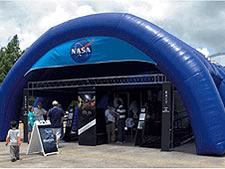 Coming to the Schenectady Museum in July: NASA's Driven to Explore Exhibit. From the blurbage:
Immerse yourself in the story of NASA: learn why we explore; discover the challenges of human space exploration; and see how NASA provides critical technological advances to improve life on Earth. And touch a 4 billion-year-old moon rock brought back aboard Apollo 17, the last manned mission to the moon in 1972. The moon rock is one of only eight lunar samples in the world made available for the public to touch.
The mobile exhibit will be at the Schenectady Museum July 12 (noon-9 pm) and 13 (noon-5 pm). The last tickets will be sold an hour before closing. Tickets are $7.50 adults / $5 children / $6.25 seniors / plus $2 for a show at the Suits-Bueche Planetarium.
And, of course, the museum will also be selling astronaut ice cream.
photo: NASA
Where to hunt for fossils?
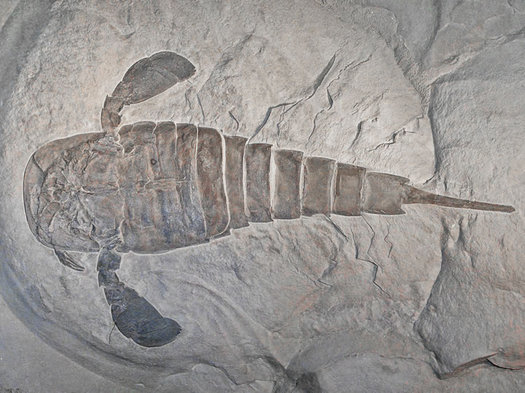
The official New York State fossil: Eurypterus remipes (sea scorpion)
Terence asks via Twitter:
Any reader suggestions for a local destination to look for (not buy) fossils? My son is dying to find a fossil this weekend.
Old quarries, road cuts, and natural cliffs are often good places to find fossils (you'll need to get permission in some cases). [State Museum]
Got a suggestion for Terence and his son? Please share!
photo: H. Zell via Wikipedia (cc)

The spread of Lyme disease
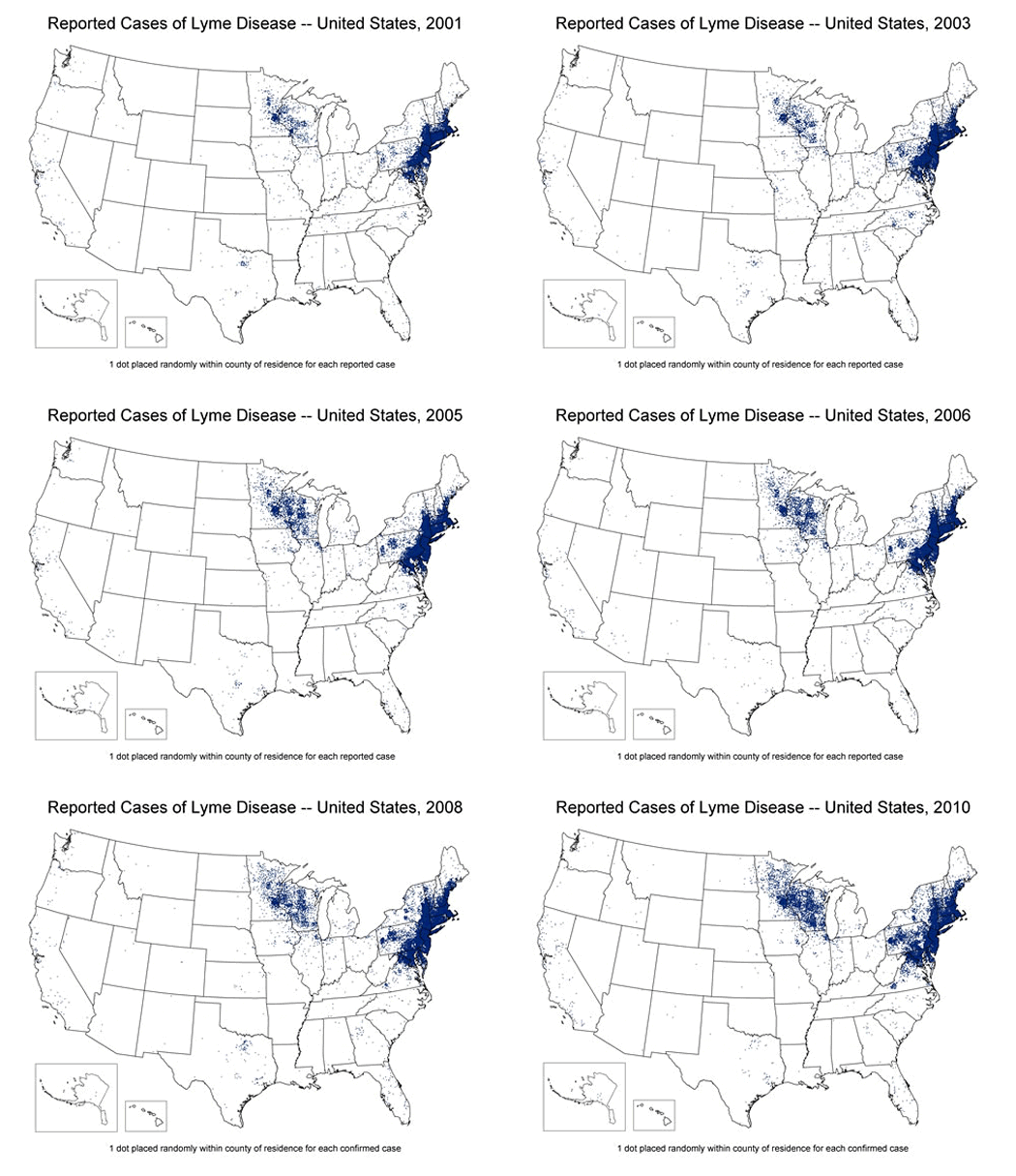
Reported cases, year by year, from 2001-2010.
Mappage: We came across this CDC map of reported Lyme disease cases over the last decade (ending in 2010). The CDC site allows you to switch from year-to-year -- we piled all those years into the animation above.
The thing that struck us about the map is the way it illustrates how Lyme has spread from the coast and the very central part of the Hudson Valley to the entire Northeast (as well as Wisconsin and Minnesota).
As it happens, the number of reported cases in New York was down noticeably in 2010, the last year for which the data's posted by the CDC. The state's incidence rate that year -- confirmed cases per 100,000 people -- was 12.3 that year (12th highest in the country). It was 21.2 in 2009, and 29.5 in 2008.
Delaware led the nation in 2010 with a rate of 73.1. Vermont's rate was 43.3 that year, and Massachusetts' 36.3.
Earlier this spring a research org in the Hudson Valley -- the Cary Institute for Ecosystem Studies -- reported the "northeastern U.S. should prepare for a surge in Lyme disease this spring." And the reason wasn't the mild winter. Rather, researchers based their projections on mice and acorns:
New York's (now lost) native parrot
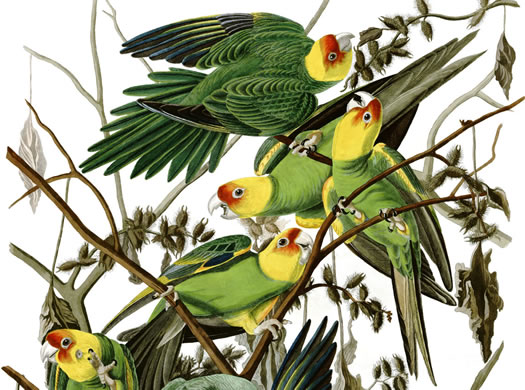
From an 1825 illustration by John James Audubon.
As strange as it might sound, there were once parrots -- parakeets, specifically -- that were native to New York State. The range of the Carolina Parakeet stretched as far north as the Great Lakes, and there are historical reports of them in Albany.
They were brightly colored. They were loud. And by the late 1800s, they were gone from here. After the early 1900s, they were extinct.
With that many legs, we'd like to know its name
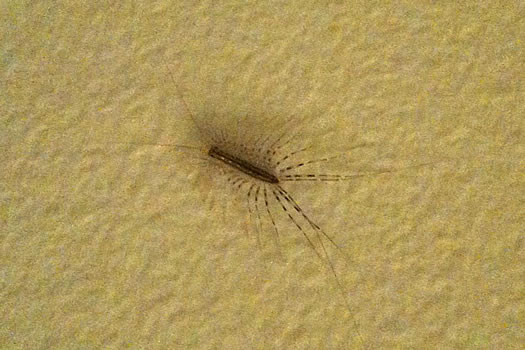
Enlarged to highlight weirdness.
Today's episode of attempted crowdsource entomology: What the heck are these bugs?
Every spring we catch a few of these things scurrying through the house. They seem relatively harmless -- but, you know, they're weird. And some of them are rather large.
We've never encountered them anywhere other than Albany. The topic came up recently with a few friends around here and they, too, had noticed them but had no idea what they are.
So, anyone have the scoop? Please share.
Earlier on AOA: Box elder bugs
The 2012 Albany Prize
Two molecular biologists from Rockefeller University -- James E. Darnell Jr. and Robert G. Roeder -- are the winners of this year's Albany Medical Center Prize in Medicine and Biomedical Research. At $500,000, the Albany Prize is the largest award for medicine and science in the US.
The two scientists won the prize for their research into how instructions in DNA are copied and transmitted to other parts of the cell (we'll stop before we start talking about RNA). Said Albany Med CEO James Barba in the press release:
"Understanding how our cells express their genetic information provides insight into all of human health. By helping to define how cells grow, replicate, and become specialized, these two scientists have allowed countless other scientists and physicians to explore new ways to fight disease including viruses, heart disease, anemia and autoimmune disorders."
The Albany Prize is funded by a $50 million donation made by philanthropist Morris "Marty" Silverman in 2000. This is the 12th year the prize has been awarded. Last year's award went to a trio of scientists for their work on stem cells.
The world's oldest forest -- in Schoharie County
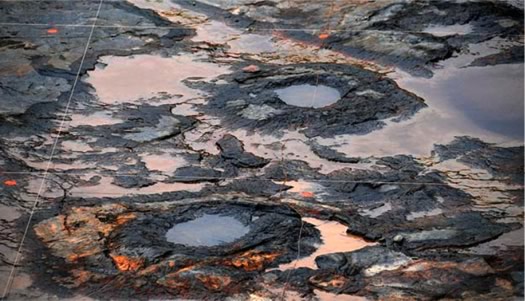
Where trees once stood -- a long, long time ago. These are root mounds. The grid lines in this figure are 1.5Â m on the horizontal.
 A group that includes researchers from the State Museum reported in Nature today that it's found evidence of the world's oldest forest floor in Schoharie County. And in this case old means really old -- almost 400 million years ago. The paper made the cover of Nature. [Nature] [NYS Museum]
The spot in Schoharie County -- Gilboa, specifically -- has been notable to paleobotanists for more than a century because of fossilized tree stumps that were found there. The construction of the New York City reservoir system in the 1920s helped uncover more fossils, including foliage imprints. The specimens became known as the "world's oldest trees." Scientists have continued to find other fossil remains that have helped them piece together what these ancient trees probably looked like. In 2007 this same research team -- which includes researchers from Binghamton University and Cardiff University in Wales, as well as the State Museum -- reported that it had found the crown of one of these trees. [Wikipedia] [Gilboa Museum] [Gilboa Museum] [National Geographic] [Nature]
This new discovery helps the researchers piece together what the whole scene looked like.
White Nose Syndrome continues to kill off bats
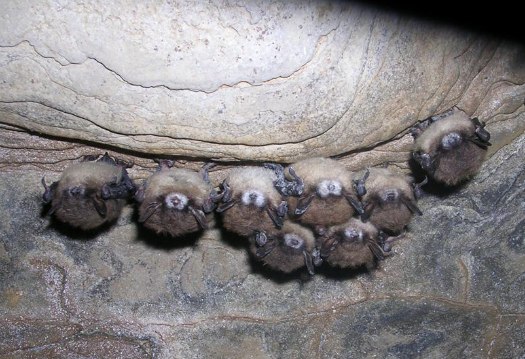
Bats with White Nose Syndrome in Hailes Cave in Albany County.
White Nose Syndrome -- the bat disease first identified in the Capital Region -- has killed as many as 6.7 million bats, according to recent estimates by biologists working with the US Fish and Wildlife Service. Since first being documented in 2006, the disease has now spread to 16 states -- and at many sites it's killed almost 100 percent of the bats. It has some biologists worried that some once-common varieties of bats could be facing extinction. [US FWS] [NYT]
The "white nose" in the syndrome's name refers to a fungus that grows on the face of the bats. Last fall researchers confirmed the fungus was responsible for the syndrome after 100 percent of the bats exposed to it in captivity developed the symptoms in a study. The fungus infects the bats' skin and causes lesions. [Nature News]
In 2010, New York State's Department of Environmental Conservation reported the White Nose Syndrome was likely in all bat caves in the state. The population of some species of bat had declined by 90 percent. [NYS DEC]
The disease was first identified in Howes Cave in Schoharie County -- it spread to other caves in the region and large bat die-offs followed.
Bats don't necessarily have the best reputation with a lot of humans, but they're an important part of the ecosystem because they eat huge numbers of insects -- including mosquitos.
photo: Nancy Heaslip, NYS DEC
A fisher strikes a pose
Today's wildlife moment: a posing fisher.
During our email exchange earlier this week with scientist Roland Kays, he passed along two recent clips his wildlife cameras had captured in the Colonie. The first, embedded above, is of a fisher striking a pose in front of a camera just off Sand Creek Road (we're guessing this is the general area):
This camera was ... in a slim strip of forest that connects 2 larger wooded areas (aka core areas). Our GPS tracking of fishers suggested that they used this strip as a movement corridor to get between the larger fragments, we are now testing that by setting cameras out.
We've linked to it before, but here's Kays' "Scientist at Work" series at NYT about tracking fishers in Latham.
The second clip, of raccoons "jogging" over a footbridge near the Hilton Garden Inn at ALB, is after the jump.
Next stop for Roland Kays: Raleigh
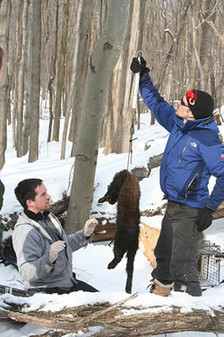 We were disappointed to see recently that State Museum curator of mammals Roland Kays was leaving the institution. As the TU reported, morale at the museum is low and many researchers are leaving as a result, Kays among them (be sure to read chrisck's comment).
Kays is one of our favorite local nerds. He researches how wildlife adapt to urban environments. And the conversation we had with him about fishers in the Pine Bush is still one of our favorite AOA posts (that's him weighing a tranquilized fisher in the photo). Also: he was one of the organizers of the popular Cooking the Tree of Life series at the State Museum. The guy even races unicycles.
So, we emailed him to find out what's next. He emailed back:
[Y]es, sad to be leaving the Albany area, but excited about new opportunities at the new Nature Research Center I'm moving to in Raleigh, NC. I'll also be a Prof at NC State. Dr. Jeremy Kirchman will continue the Cooking the Tree of Life at the NYSM, and I'll also start it up down in Raleigh.
Kays says he's also working on a project that will involve non-scientists running camera traps that report images to a wildlife database. He says that could be up and running this summer and he's hoping it will include some sites here in the Capital Region. We'll see if we can get more details as the project's closer to being ready.
photo via Roland Kays
This just in: the Adirondacks have a lot trees
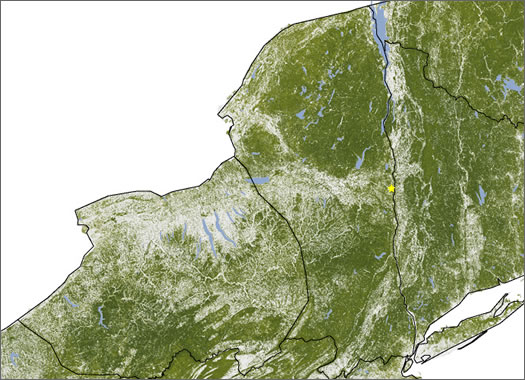
Where the trees are in New York. (We added the star for the approximate location of Albany as a point of reference.)
Forestry fact of the day: the Adirondacks are one of the areas with the most tree mass in the country, according to a map of "above ground woody biomass" created by the NASA Earth Observatory.
A clip from the map, of New York State, is above. The darker the green, the more tree mass there is.
The national map is posted after the jump in large format. You can see the large swath of forest that runs from Maine, through New Hampshire and Vermont, includes eastern New York, and then runs along the Applachians. And as dense as parts of the swath are, the long, narrow (relatively speaking) forests of the West Coast still trump the East for density of tree stuff (the trees are rather large out there).
Researchers built the map as part of an effort to better understand how much carbon is stored in forests -- and which way that amount is trending.
[via Buzzfeed]
Earlier on AOA: The darkness just to the north
More quakes!
The trio of recent earthquake spots in Berne.
The folks at theNew York State Museum and Geological Survey confirmed that there was yet another earthquake in the Hilltowns this morning, this time a 2.8 magnitude. So that makes three recent little quakes and one big one (from far away).
Dr. Chuck Ver Straeten at the State Museum said that this morning's quake, which happened in Berne at 9:13 this morning, was the biggest of the three that have gently rocked the area in the past four days. Earthquakes in the Hilltowns are common. Between February of 2009 and March of 2010, there were 37 of them! But Dr. Chuck says they don't have anything to do with each other -- they are all coincidental and all from deep in the earth. More people are just paying attention to earthquakes this week because of the one in Virginia that was also relatively mild.
Earlier on AOA: From 2009: More shaking in the Hilltowns
Very Important (scientific) People
 GE has posted images from the guest book for the company's original research center in Schenectady (GE Global Research is now in Niskayuna):
While its beginnings were humble, it didn't take long for scientists and inventors from around the world to flock to the Research Lab to see what GE was working on. And each famous mind that visited would stop at Willis Whitney's desk to sign the VIP guest book. The book sat at Whitney's desk from 1914 to 1935, and the signatures are a veritable Who's Who of inventors, physicists, chemists, physiologists, and businessmen -- including 9 Nobel Laureates.
The collection of people who stopped by the place during its first years is remarkable. Among the names signed in the book: Bohr, Marconi, Pavlov.
photo: GE Reports
The Karner Blue
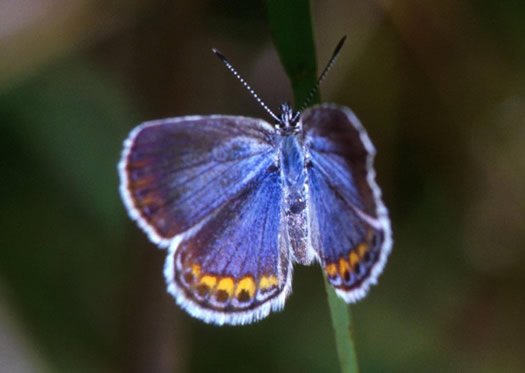
Nabokov once described the a group of Karner Blues appearing like "blue snowflakes".
The first flight of Karner Blue butterflies should be appearing in their habitats around the Capital Region right about now.
The beautiful endangered butterflies hang around sandy pine barren habitats. Two such spots in the Capital Region: the Albany Pine Bush Preserve and the Wilton Wildlife Preserve. Drew was at the Wilton preserve this past week and said the butterflies were easy to spot.
Karner Blues congregate in these habitats because they're also the habitat for blue lupine. The butterflies lay their eggs on the plants.
There's some great history Capital Region history involving the Karner Blue. The common name of the butterflies is linked to a spot here -- and Vladimir Nabokov classified the butterflies. Yep, the author.
Recycled: Pretty. Stinky.
 While out walking Otto today we noticed the pear trees -- with their white blossoms and, uh, distinctive odor -- are back in bloom. As Ryan wrote for AOA last year (almost a year to the day):
Which brings us finally to this: why does this tree smell so horrible? As far as I can tell, there isn't any research on why exactly the trees stink. However, I did come up with this: all of the approximately 30 species of pear contain the aroma compound pentyl butanoate. I will spare you the biochemistry -- this is the compound that makes pears and apricots smell as they do. One the precursors of pentyl butanoate is butyric acid, which is present in butter, parmesan cheese and... vomit.
Ryan's post also gets into the history of the trees and why they're everywhere (despite the stink).
Sheep eat the baaaaad
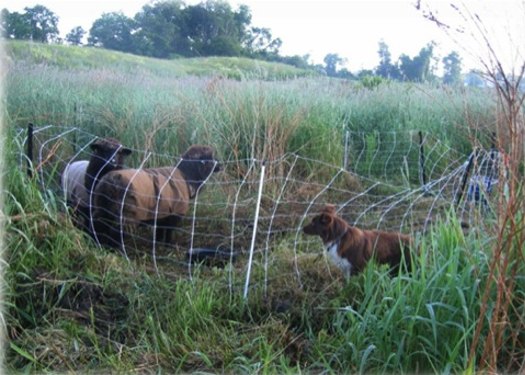
Sheep -- and dogs -- will be working to clear invasive plants from the Normanskill Farm.
There's a new (old) way to combat invasive plant species in upstate New York: small flocks of sheep.
Gary Kleppel, a professor of biological sciences at UAlbany and director of the Biodiversity Conservation and Policy Program there, is in the process of setting up a "targeted grazing" project using sheep at Albany's city-owned Normanskill Farm.
His sheep start arriving in a few weeks and then, with the help of students, dogs, and a fancy fence, the sheep get to work -- eating and gnawing at the plants that cause problems for our ecosystem.
Joseph Henry, Albany nerd for the ages
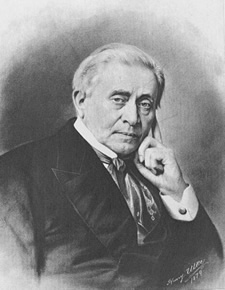 Nick Fahrenkopf has written an interesting post about Joseph Henry, one of Albany's all-time great nerds:
Henry has been immortalized in more than the UAlbany physics building, his early school, a monument near the original Albany Academy, and buildings in Princeton: the unit of induction is the henry and the medal for service to the Smithsonian is the Henry Medal. Even a mountain range bears his name. Back here in Albany, the church where he was baptized even has a stained glass window of Henry lecturing 12 disciples with the words "Master Scientist and Devout Christian". I find it fascinating that now, over a hundred years later this area is home to the next wave of science and technology that will propel our nation forward. Not the Weather Service, Lighthouses, or telegraphs. But nanoelectronics, solar panels, biomedical engineering. It just seems... fitting.
Among many accomplishments, Henry was instrumental in discoveries on electromagnetism, the beginning of the Smithsonian, and the creation of the National Weather Service.
Earlier on AOA:
+ An entire library of Albanians
+ Right back @ you, governor
image by Henry Ulke via NOAA and Wikipedia

UAlbany's garlic guy
 The work of UAlbany chemistry professor Eric Block is the main dish in a NYT piece today by Harold McGee, the creme de la creme of food science writers.
Block is an expert on alliums -- that is, plants such as onions and garlic. From McGee's piece:
"It's still astounding to me what happens when you cut or bite into an onion or a garlic clove," Dr. Block told me in a telephone conversation last month. "These plants originated in a very tough neighborhood, in Central Asia north of Afghanistan, and they evolved some serious chemical weapons to defend themselves."
Their sulfur-based defense systems give the alliums their distinctive flavors. The plants deploy them when their tissues are breached by biting, crushing or cutting. The chemicals are highly irritating, and discourage most creatures from coming back for seconds. They kill microbes and repel insects, and they damage the red blood cells of dogs and cats. Never feed a pet onions or garlic in any form. ...
Dr. Block explains that different alliums stockpile different sulfur chemicals to make their weapons, and this accounts for their varying flavors. The stockpiles themselves are inert, but when the plant's tissues are damaged, enzymes in the tissues quickly convert the sulfur compounds into reactive, stinging molecules.
There a bunch of interesting bits in the article -- whether you cook, or just eat.
Block wrote a recently-published book about alliums, Garlic and Other Alliums: The Lore and the Science. The book blurb says it "outlines the extensive history and the fascinating past and present uses of these plants."
Block co-authored a 2007 paper in the Archives of Internal Medicine that reported the neither raw garlic nor garlic supplements appeared to have clinically significant effects on cholesterol levels in people.
[via @ualbany]
Foxes and fishers and bears, oh my!
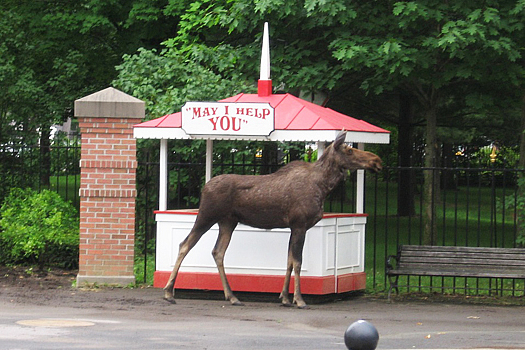
A moose at the Saratoga Race Course in June.
Where are the wild things? Lately, it seems the answer is here. And by here, we mean our backyard. And your backyard.
Over the last month, there have been moose sightings in Saratoga and East Greenbush, a bear spotted in Troy and reports of rabid foxes. Every few weeks someone drops into AOA to post a comment about a fisher sighting. And we seem to be hearing about coyotes a lot more, too.
So, what's going on? We called up Roland Kays, the mammal curator at the New York State Museum, for some answers. He studies urban wildlife.
Roland says some of these sightings are probably just part of the cycle of young animals heading out on their own for the first time. But he says there's a bigger story here, too: wild animals are moving into our neighborhoods. And that's a good thing.
$10,000 eggs
 The board that manages New York State's stem cell research funding has given the OK for researchers to pay women for their eggs (the technical term is "oocytes"). And not just a few bucks, either. The Empire State Stem Cell Board has approved payments up to $10,000.
New York is the first state to allow its research money to be used this way. Guidelines from the federal National Academies of Science "prohibit cash or in-kind payments for donating oocytes for research purposes."
The Mohawk's ups and downs
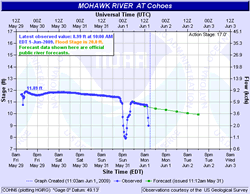 Summer's comment about the Mohawk this morning prompted us to go looking for info about the river's water levels. And, as it turns out, there's a bunch of data posted on online -- something to keep in mind if you're a boater, fisherperson or other river user of some sort.
The US Geological Survey posts some pretty simple river level graphs created from data taken at a station in Cohoes. And the National Weather Service uses that data to create a whole bunch of graphs, charts and forecasts for points in Schenectady and Cohoes.
Bonus river data: the USGS service that tracks the Mohawk also tracks rivers and streams all over the state. As you might expect, this list includes the Hudson (here's the reading near Green Island) -- but also smaller streams such as the Normanskill.
Mohawk graph: National Weather Service
Shaking in the Hill Towns
The site of last night's earthquake -- well, here, but 9 km down.
There was another earthquake last night near Berne -- and it was relatively big (for this area).
The seismographic network that monitors this area reports that quake was a 3 on the magnitude scale ("felt quite noticeably by persons indoors, especially on upper floors of buildings"). There are reports that people did feel this one.
Things have been a little shaky in the Hill Towns recently. Over just the last three months there have been 14 earthquakes. Most of them have been tiny. The one last night was the strongest of the group.
There's an interactive map after the jump.
I think, therefore I Twitter
Check it out: one of the researchers involved with the much-buzzed about brain-to-Twitter interface is from the Wadsworth Institute here in Albany.
Gerwin Schalk, who got his PhD at RPI, is developing software that processes and translates brain signals into action. He and other researchers at Wadsworth helped develop the "keyboard" for the brain-to-Twitter device.
Wadsworth has gained attention over the last few years for its researchers' work on brain-computer interfaces. The institute's Jonathan Wolpaw was on 60 Minutes last year as part of a story about the technology.
(Thanks, Celina!)
Turning thoughts into action
 The Wadsworth Center, a New York State research institute in Albany, got some national attention last night on 60 Minutes.
A piece looked at how a brain-computer interface developed by Wadsworth's Jonathan Wolpaw is helping people with conditions such as ALS communicate with the world. The device allows people to control a computer just by thinking.
screengrab: CBS
The stuff of bat nightmares
Those aren't milk mustaches.
You'd think this would be a good time of year for local bats. Fat and happy from eating insects all summer, they're ready to settle down for their long winter's nap.
But hibernation's gotten a little spooky for bats around the Capital Region.
... said KGB about Drawing: What's something that brought you joy this year?